If you want to support independent women's media, become a Mamamia subscriber . Get an all-access pass to everything we make, including exclusive podcasts, articles, videos and our exercise app, MOVE.
This article is an edited version of one that originally appeared on Nikolina Koevska Kharoufeh's Substack and has been republished with permission. Sign up here.
In the entire 32 years I have been alive, I haven't really ever experienced proper grief. How lucky I was to be able to say that, up until around a month ago, when grief introduced itself abruptly and intensely.
I think back through my childhood, and I can't really remember ever truly being confronted by grief. Now of course there was our first family dog. Ruff was his name. And though we loved him dearly, we didn't experience losing him to death.
He was given over to another family when my parents decided to move us overseas for a year. Missing him was a form of grief, I guess you could say — but not quite there yet.
Watch: How to deal with the loss and grief of loved ones. Post continues after video.
Most of my grandparents had passed before I was born. The one grandfather that I did meet, I met when I was around seven or eight years old, so we really didn't have much of a connection. He passed overseas in Macedonia.
I remember coming home from school to the news and my mum was devastated. That was, I guess, my first look at how powerful grief could be on a human being. But again, it wasn't my own.
During high school, my dear friends lost parents and loved ones. I remember attending funerals and I could see people around me crying. I too cried, triggered by the sadness in my girlfriends' eyes. But I was much more an observer on these occasions as well. So by this point, grief and I hadn't really properly met yet.
There was a close call when I was in my younger teenage years. A family trip to Macedonia to visit our family and friends turned to devastation when my older cousin suddenly passed away. I remember waking to my mum's wailing and crying. Something I had never heard before. She was in pieces. It was all very confusing.
I remember there being a lot of crying around me. I shed a few tears as well… I guess caught up in the sadness of it all. But I have to admit the lack of time spent with that person growing up, again felt like it put a distance between me and a strong and vivid reaction to grief. I was more a passenger in the car where grief was also being taken for a ride. Sitting next to it, but never really connecting.
It was a blessing to have been able to spend so many decades never having to properly mourn the loss of a loved one.

But I guess the time always has to come. It may be that your parents age and you lose them sooner than you can handle (although when can you really handle the loss of your parents).
It may be that a friend or colleague passes following a health battle. It may be the sudden loss of a loved one who you never got the chance to say the things you wanted to say to them.
Or, like in my case, it may be the loss of an unborn baby.
I heard many things about grief before it introduced itself. I heard it could be overwhelming. So painful you can barely handle its weight. It can be cruel at times and unsettling. You can try your hardest, but never escape its presence.
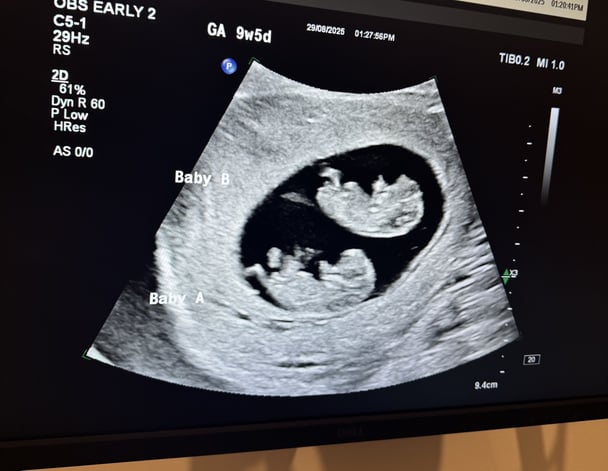
All these things ended up being true and more, when we received the news that one of our twins hadn't made it.
Now, having experienced grief, I can also see how it never really goes away. You can maybe think for a moment, or a minute, that it's gone — but it just as quickly pops back into the picture. Reminding you of its presence.
It can affect you physically. A tug in your chest that makes you think your heart may possibly be breaking into pieces.
And most of all, grief doesn't just stop at the precious person who you lost. It attaches itself to everything that reminds you of that person.
For me, it's the spare baby carrier we borrowed from friends sitting in the corner of the nursery. It's the car with extra seats we ordered and had to cancel passing me at the set of lights. In my case, it's the extra baby plates we bought,t thinking we were planning ahead for when there would be four hungry mouths to feed.
Listen: Explore grief in all its forms, and what healthy versus unhealthy grieving can look like. Post continues below.
Now that grief has pronounced itself so boldly and loudly in my life, there won't ever be a moment I won't be without it. That's hard to comprehend and its hard to accept. But I guess it's part of life. I was just lucky enough that I spent a large chunk of mine, without a proper introduction.
Red Nose supports anyone affected by the loss of a pregnancy, stillbirth, the death of a baby or child. Call their 24/7 Support Line on 1300 308 307 or visit theirwebsite www.rednose.org.au/support .
Feature image: Supplied.
This edited article originally appeared on Nikolina's Substack here .
Feature Image: Supplied.
Nikolina Koevska Kharoufeh
Author
No Comments
Be the first to leave a comment