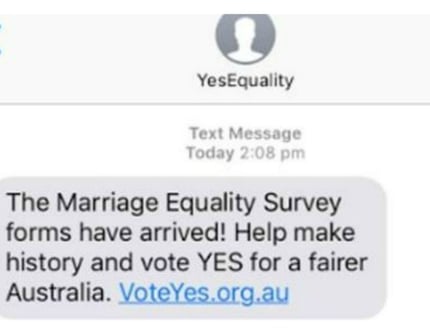
On Saturday, people all over Australia received a text message from YesEquality, encouraging them to vote Yes in the Marriage Equality Survey.
“The Marriage Equality Survey forms have arrived!,” the text read. “Help make history and vote YES for a fairer Australia. VoteYes.org.au.”
But almost immediately, there was confusion, frustration and outright anger over the invasion of privacy the texts represented.
Regardless of the direction of their vote, many wanted to know how the Yes campaign had access to their phone numbers to send unsolicited messages.
Hi @AMEquality I’m for marriage equality & I’ve voted #YesToEquality but I don’t like unsolicited text messages. How did u get my number?
— Jo Kerr (@JoKerr37) September 23, 2017
@AMEquality all for equality & my household voted #yes but I’m not in favour of being text. How did you get my number?
— Barb (@BPS106) September 23, 2017
I respect everybody view in the marriage equality vote , but I don’t appreciate getting spam text telling me what to do . #Auspol pic.twitter.com/Yxs8CvugwL
— @Georgebakhos1 (@GeorgeBakhos1) September 23, 2017
#YesToEquality dont apprec being texted .i have voted but im sure a few pple voted no for your invasion of privacy. how did u get my number!
— sienna (@sienna_smiles) September 23, 2017
#YesToEquality has no right to text my kids. That’s not kind. That’s harassment, invasion of privacy & it’s not acceptable.
— LittleBlueWren (@charmie13) September 23, 2017
So, how did same-sex marriage campaigners access the numbers of these recipients? Are these people right to be worried about their privacy? Did the Yes campaign breach any privacy laws?
Co-chair of Australian Marriage Equality, Alex Greenwich, told ABC the phone numbers were randomly generated by a “technology platform” that’s been used in previous elections.
“The campaign is using every resource available to make sure fairness and equality are achieved for all Australians,” he said. “The campaign has a responsibility to encourage every Australian to post their survey and we have done this through door knocking, media, advertising, social media and SMS messaging.”
While News Corp claim they spoke to mobile marketing experts who “called into question” the explanation that the numbers were randomly generated, the Australian Communications and Media Authority maintains that regardless, the Yes campaign haven’t broken any laws.
The texts don’t violate theDo Not Call Register Act 2006and theSpam Act2003, because they don’t serve a commercial purpose. Communications about political matters fall well within the realm of acceptability.
Listen: A message for Malcolm Turnbull about marriage equality. Post continues after audio…
But, really, it’s not about whether the texts broke any rules. It’s about how they made people feel. People felt like a private space (their text message inbox) had become public, and all of a sudden anyone was allowed to jump in there with an agenda.
How dare they be sent a text about a nation-wide political issue, just after receiving a text from their loved ones? How dare someone invade their children’s phones with something so topical?
The outrage was, and is, palpable.
Which is quite ironic, really.
Because the emotional response many Australians had on Saturday is probably quite similar to how gay and lesbian Australians have been feeling in recent months. When a space they feel is private (their relationship) becomes public, and all of a sudden anyone is allowed to jump in with their agenda.
Yes, seeing an unsolicited text in your inbox might be jarring. Yes, you might be wondering whether privacy is even a thing anymore, and working yourself up about the incomprehensible amount of information companies and campaigns have about you.
If you felt like a text message was an invasion of your privacy, then that is a fair response. No one likes to feel as though their personal space has been invaded.
But imagine it was your most intimate relationship – not your phone number – that was being made public.
That the legitimacy of your relationship was a matter of public interest, voted for by millions of people you’ve never met. That Joe from Queensland and Sue from Victoria get to pick up a pen, and decide whether you’re allowed to marry.
Is there anything more personal?
Perhaps Saturday’s controversial text message was really the perfect metaphor.
Clare Stephens
Contributor
No Comments
Be the first to leave a comment