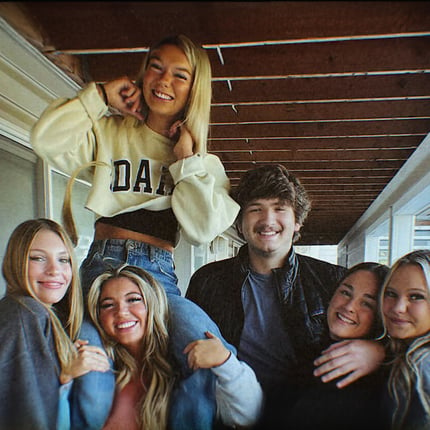
Dylan Mortensen's life is split in two: before and after.
Before the night four of her friends were brutally murdered in their Idaho sharehouse while she slept nearby.
Before her name became tied to a crime she didn't commit, but can never escape.
And the devastation that's followed ever since.
On November 13, 2022, University of Idaho students Madison Mogen, Kaylee Goncalves, Xana Kernodle and Ethan Chapin were killed in their sleep.
Bryan Kohberger pleaded guilty to their murders three years later in July 2025.
Now, a new three-part documentary series, The Idaho Murders: College Nightmare, has landed on Netflix, offering a fresh perspective on the case.
The series features unprecedented access to police footage, as well as archival materials and firsthand accounts from the victims' families.
Watch a snippet of Dylan's emotional victim impact statement. Post continues below.
It also delves deeply into the gruesome realities of the crime and the profound ripple effects it left behind.
Beyond detailing the physical evidence, the series captures the intense emotional trauma experienced by everyone touched by the tragedy, from the victims' grieving families and close friends struggling to comprehend the violence, to the hardened investigators who first stepped onto the scene.
The crime scene was so exceptionally violent that it left a lasting psychological mark on the emergency responders assigned to process it.
"Without going into too much detail, it was absolutely horrific," Moscow Police Department chief Anthony Dahlinger said in the doco.
"That's something that nobody expects to ever see, and something that you can't unsee once you see it. I know not only myself, but every officer that was involved that day has had a hard time with that."
Everything we know about the University of Idaho murders.
Flanked by rolling wheat fields and a mountain range, Moscow is a city of 26,000 people huddled around the University of Idaho campus.
It's the kind of place where people are comfortable venturing out after dark, where bikes can be left unlocked.
Yet, in November 2022, it became the centre of a chilling quadruple murder that shocked the world. Four young University of Idaho students were found dead in their sharehouse. It was Moscow's first murder in seven years.
Around lunchtime on November 13, 2022, Moscow City Police were dispatched to a home on King Road in the city's south-west following a 911 call. There, they found the victims' bodies. Each had been stabbed in their beds on the second and third floors of the home. None of the victims were sexually assaulted, none of their belongings were stolen, and there was no sign of forced entry to the home.
Dylan and Bethany, both of whom slept in bedrooms on the first floor, were unharmed and, according to police, had been unaware of the brutal crime that took place above them.
Over two weeks, authorities collected more than 113 pieces of physical evidence, took more than 4,000 crime scene photographs, received more than 1,000 tips and conducted at least 150 interviews.
They concluded that the killings were an "isolated, targeted" attack.
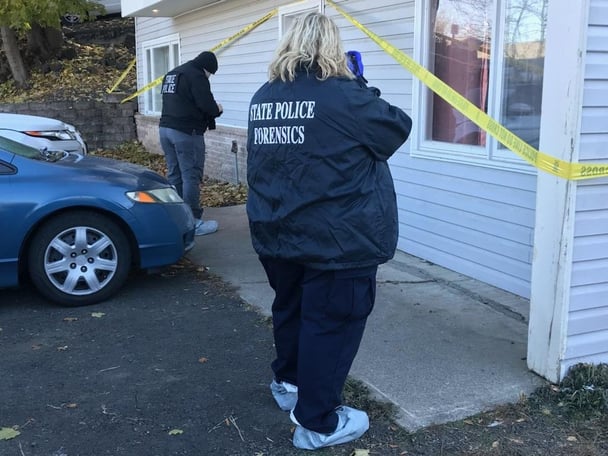
The timeline of events.
In a statement, Moscow City Police shared an updated timeline of the housemates' movements on the evening of November 12.
According to police, in the hours before their deaths, Kaylee and Madison were at a local bar in downtown Moscow. They arrived around 10pm and left at 1:30am, before heading to a local street food vendor.
Security footage from the 'Grub Truck' shows the pair laughing while they wait to collect their food order. They were then given a lift home by a "private party" and arrived at 1:56am. The driver was ruled out as a suspect, as was a man in a white hood captured in the food truck footage.
Meanwhile, Xana and Ethan were seen at the Sigma Chi fraternity house on the University of Idaho Campus.
The couple were believed to have returned to the King Road home at 1:45am. Ethan was not a permanent resident of the house, but stayed with Xana that evening.
The two surviving housemates were also both out in Moscow that evening, and police say they returned separately by 1am.
According to The New York Times, call logs from Kaylee's phone show seven phone calls were made to her ex-boyfriend, who was also a student at the University of Idaho, between 2:26 and 2:52am.
Several calls to the same number were also made from Madison's phone. Each time the calls went unanswered.
Police confirmed they had investigated the calls and that the ex-boyfriend had been ruled out as a suspect.
At some point in the hours that followed, Kaylee, Madison, Ethan and Xana were killed.
Xana's father Jeffrey Kernodle told his local news station, 3TV/CBS 5, his daughter was in constant communication with her family, and nothing about the evening of November 12 had seemed out of the ordinary.
"It doesn't make sense," he said. "They were just hanging out at home. Xana was just hanging out at home with her boyfriend."
A coroner's report stated that all four were likely asleep when they were attacked, but that some of them had sustained defensive wounds, suggesting they struggled with the perpetrator.
"It's such a horrific crime," Latah County coroner Cathy Mabbutt said, according to The New York Times. "It's hard to think that somebody, whether they live here or they were here, commits something like that and is at large."
Police said that the surviving residents on the first floor didn't wake up until later that morning. They then summoned friends to the home out of concern that they couldn't rouse one of their housemates on the second floor, who they thought had "passed out".
Neither of the surviving housemates were considered to be suspects.
Housemate's eerie account.
The documentary details Dylan's harrowing eyewitness encounter during the tragic night.
Before retreating to safety, she spotted a lean, masked man walking down the hallway. At the time, she was unaware of the horror unfolding upstairs.
She wasn't sure if she was dreaming when the shadowy figure in all black walked past her room late at night. She recalled hearing strange noises and then a male voice say, "It's okay. I'm going to help you."
At one point, she says they even made eye contact.
Terrified, Dylan ran to fellow housemate Bethany Funke's room on the ground floor. After a string of unanswered messages to her housemates and a rising sense of dread, she asked her sorority "Big", Emily Alandt, to come over about 11:50am.
Just before midday, Emily's boyfriend Hunter Johnson went upstairs to check on their friends.
What he found was unimaginable.
Xana and Ethan had been brutally stabbed. Minutes later, police arrived and discovered Kaylee and Madison had also been killed, in a bedroom upstairs.
Speaking to People, Hunter recalled the moment the horror set in.
"I was like, 'What is going on?'" Johnson told People.
"'Is this real?' Then you realise the gravity of what you just walked into… That was our last day living as kids."
"Our innocence was gone," Emily added.
The documentary offers a heartbreaking look at the pain carried by the victims' families. Jeff Kernodle, opened up about the haunting regret over a choice made on the night of his daughter's murder.
"It's just such a wrong thing to have to deal with. It's everybody's worst nightmare," Jeff said.
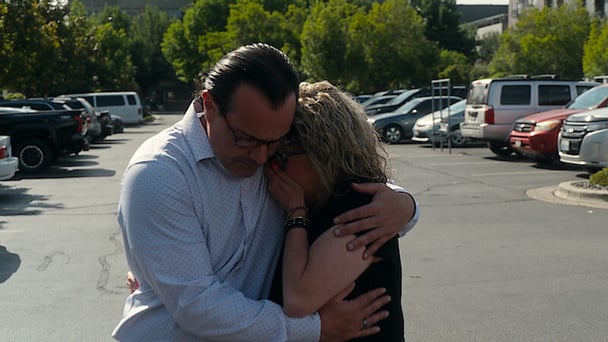
"The night of the 12th and the 13th, I was at a WSU game with Jazzmin. I was thinking, 'You know what? I should give Xana a call. Maybe I'll just go over and stay at her house tonight,'" he explained.
"And I thought about it. I had drunk quite a bit that night, and I go, 'You know what? Xana will probably get mad if I drove over there.' So I didn't go. But I could've gone and things would have been different. Maybe they would've had a chance, you know?"
A chilling 911 call.
In March 2025, the frantic 911 call made on the day the students were stabbed was revealed.
At 11:55am on November 13, 2022, a distressed woman called authorities saying, "Something happened in our house", CBS News reports.
She broke down crying while giving the address. At that point, another woman takes the phone and starts talking.
"One of the roommates who's passed out, and she was drunk last night, and she's not waking up," the second woman tells the dispatcher. "And they saw some man in their house last night."
The dispatcher tells them she needed to know what was going on at the time and if someone was passed out.
One of the women then goes to check on the student and says she's still passed out and not waking up. At this point, the callers sound very distressed, as if they're breathing heavily or have been crying.
A male voice is then heard on the line telling the dispatcher the woman who was passed out was not breathing. The dispatcher tells the group help is on the way and the call ends shortly after when police arrive.
Among the docuseries' most significant revelations is a deeper look into the actions of surviving housemates on the night of the attack — specifically addressing the intense online backlash surrounding why they waited eight hours to contact the police.
For months, internet sleuths and armchair detectives heavily criticised the delay, raising questions about why two people inside the home didn't immediately call 911.
However, law enforcement officials in the series clarify that their reaction was driven by extreme terror and psychological shock.
Moscow Police Chief Anthony Dahlinger explained that being plunged into severe trauma can severely impair standard thought processes and decision-making.
"Shock and trauma… can impair judgment. It can impair thought processes," he explained in the documentary.
Terrified, the surviving roommates locked themselves inside a bedroom, frozen in fear and afraid to make a sound lest the intruder target them next.
According to Dylan's mother, Kristi Goncalves, a coroner later informed them that even if emergency services had been summoned immediately, none of the four victims could have survived their injuries.
"On the phone with the coroner, we asked if somebody would've called 911 at a particular moment that night, could somebody have been saved? And the answer was no," Kristi explained in the documentary.
Understanding the motive.
The tragedy captured international headlines as authorities raced against time and the rumour mill to find the truth about what happened.
Soon after the murders, investigators zeroed in on PhD criminology student Bryan Kohberger.
One month after the stabbings, Kohberger was arrested by police and the FBI in Scranton, Pennsylvania — over 4,000 kilometres from Moscow, Idaho.
He was charged with four counts of murder in the deaths of Ethan, Xana, Madison and Kaylee.
Kohberger is reportedly a college student but did not attend the University of Idaho, according to reports.
He appeared to have been pursuing a doctorate in criminal justice at Washington State University in Pullman, less than 10 miles from Moscow.
Kohberger's DNA was matched to samples recovered at the scene of the crimes, according to CNN.
Authorities narrowed their focus to Kohberger after they traced his ownership of a white Hyundai Elantra seen in the area of the killings.
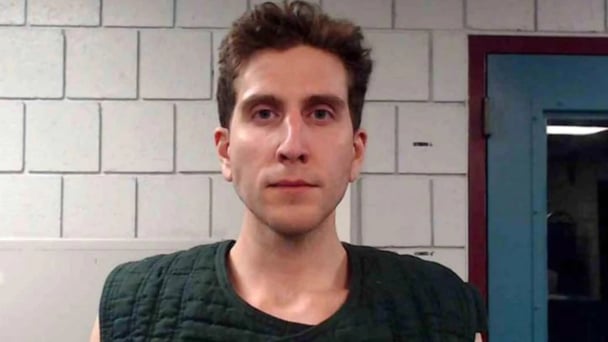
One question remained. Why did he do it?
A previous series called One Night in Idaho: The College Murders presented its own disturbing theory about the former criminology student's motive.
One Night in Idaho featured interviews with Kohberger's former classmates. The then-28-year-old was described as a curious university student, who was always asking questions about killers' motives and how they felt about the crimes they committed.
He reportedly did not socialise much.
"He was someone who travelled to school and then bounced," Kohberger's former classmate Josh Ferraro said. "You didn't really think too much of him, and you would try to get personal, and he wouldn't give you much."
Another former classmate, Brittany Slaven, added: "He never had any friends he really associated with. I don't think too many people paid much mind to him."
According to Kohberger's former classmates, they studied serial killer Elliot Rodger in school. They recalled that Kohberger took an interest in the 22-year-old, who killed six people in 2014 near the University of California, targeting a sorority house.
Administrators of a Facebook group also gave interviews, explaining that someone under the username 'Pappa Rodger' posted various times about the crime; asking questions about how the killer held the knife and talking about a knife sheath before it was public knowledge.
"Did the killer stop at four victims out of exhaustion, convenience, or lack of knowledge?" Pappa Rodger posted. "Did the killer shower at the crime scene afterward?"
They claimed the person in the Facebook avatar even resembled Kohberger. And, when he was arrested, the user never posted again.
The name 'Pappa Rodger' raised other questions about Kohberger, and whether he was an 'incel'. Incel is short for "involuntary celibate" and describes someone, typically male, who is frustrated by their lack of sexual experiences.

In their interviews, the Facebook group admins pointed out that Pappa Rodger is named similarly to the killer Rodger, who had become something of a hero in the incel community.
Prior to the murders, the original Rodger posted a video online about seeking revenge for being rejected by women.
"I'm 22 years old, and I'm still a virgin," he said in the video, per CNN . "I've never even kissed a girl… I don't know why you girls aren't attracted to me, but I will punish you all for it. It's an injustice, a crime, because… I don't know what you don't see in me. I'm the perfect guy and yet you throw yourselves at these obnoxious men instead of me, the supreme gentleman. I will punish all of you for it."
Rodger went on to say he planned to enter "the hottest sorority house" and "slaughter every spoiled, stuck-up, blonde s--t I see inside there."
It has not been confirmed whether Kohberger was inspired by Rodger. There is only speculation.
"After Bryan Kohberger is arrested, I start thinking, okay, Pappa Rodger, Elliot Rodger," Facebook group admin Kristine Cameron said. "If you listen to some of the manifestos of Elliot Rodger, he talks about hating all the girls from Alpha Phi, the same sorority that Kaylee [Goncalves] was in."
Kaylee Goncalves was one of Kohberger's victims, along with Xana Kernodle, Ethan Chapin, and Madison Mogen.
"It does seem like girls were the intended victims of Bryan's rage," Liz Garbus, co-director of One Night in Idaho, told TIME.
A controversial selfie.
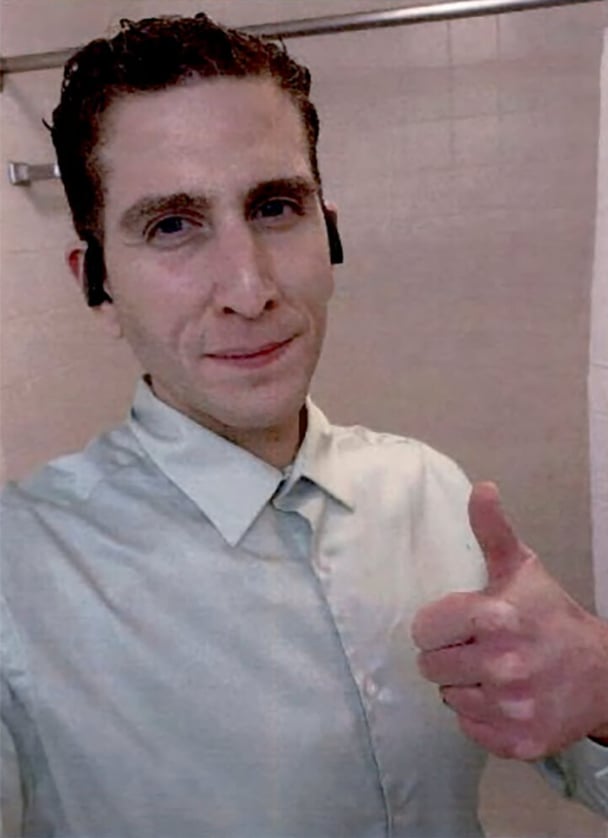
In an earlier court filing, the prosecution made the chilling allegation that Kohberger took a selfie just hours after the brutal killings, per People.
Authorities wanted the photo allowed into evidence, as one of the surviving roommates said in multiple police interviews that the man she saw leaving the home after the killings had "bushy eyebrows".
That photo has since been released. In it, a smiling Kohberger gives a thumbs up while wearing a white button-up shirt.
Prosecutors said Kohberger bought a black balaclava on January 10, 2022 — 11 months before the murders, the New York Post reports. This is reportedly the same type of mask one of the housemates witnessed the intruder wear.
Prosecutors said Kohberger also purchased a combat-style knife, sheath and sharpener from Amazon eight months before the killings.
The Post reported Kohberger's defence claimed he has autism, which will make a "fair and just trial a challenge." They said his inability to show emotion in a courtroom may cause jurors to be biased against him.
Earlier, his defence had pushed for the court to disqualify key pieces of evidence, including security camera recordings that showed a car similar to Kohberger's near the crime scene and DNA samples on a knife sheath left at the scene.
His legal team also requested to block words such as "murder", "murderer", "psychopath", "sociopath" and "bushy eyebrows" — a description of the supposed killer given by a roommate who was in the house — saying it was unfairly prejudicial.
Kohberger pleads guilty, sentenced to life in prison.
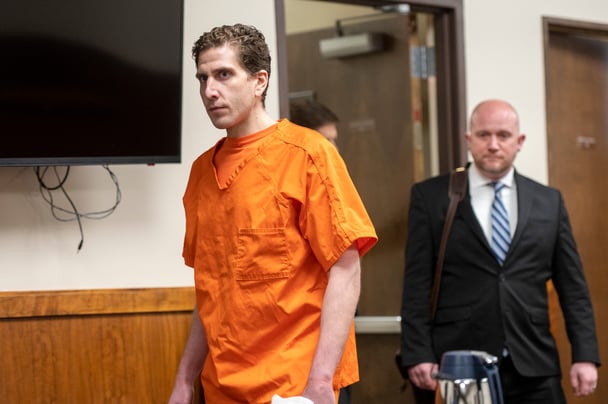
Kohberger had maintained his innocence throughout the investigation. However, he eventually accepted a plea deal.
He plead guilty to four counts of first-degree murder and one count of burglary in connection to the 2022 stabbings.
"Are you pleading guilty because you are guilty?" Judge Hippler asked Kohberger.
"Yes," he replied.
As a result, he was sentenced to four consecutive life sentences on each of the murder counts, and the maximum penalty of 10 years on the burglary count.
He will spend the rest of his life behind bars. He has also waived his right to appeal the case or ask for leniency.
However, the condition of his cooperation was that he would avoid the death penalty.
ABC News reported the victims' family members were sent a letter informing them of the deal.
Some of the families weren't convinced the plea deal was the best result. They wanted a full confession, as well as details about the murder weapon and the surety that the defendant acted alone.
In a post on Facebook, the Goncalves' family said were "are beyond furious at the State of Idaho".
"They have failed us. Please give us some time. This was very unexpected. We appreciate all your love and support," the post read.
The Idaho Statesman, a daily newspaper from Boise in Idaho, said it viewed the plea letter, which was signed by Moscow Prosecuting Attorney Bill Thompson.
The letter said: "This resolution is our sincere attempt to seek justice for your family. This agreement ensures that the defendant will be convicted, will spend the rest of his life in prison, and will not be able to put you and the other families through the uncertainty of decades of post-conviction appeals."
Madison Mogen's mother and stepfather, however, were in support of the guilty plea deal.
A statement shared by their lawyer expressed their thanks for those who supported them.
"We support the plea agreement 100 per cent," the lawyer read.
"We turn from tragedy and mourning... to the light of the future. We have closure," he said.
A powerful victim impact statement.
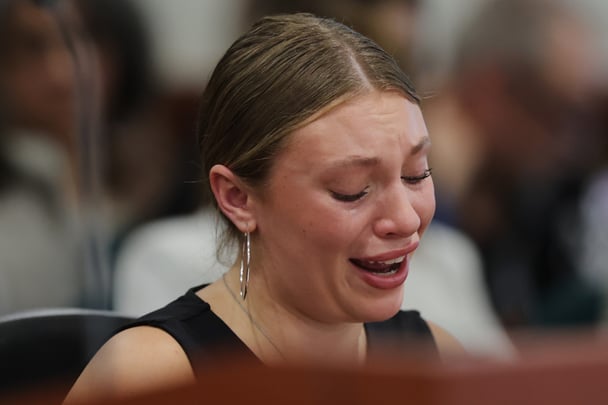
Dylan, one of the surviving roommates, confronted Kohberger at his sentencing hearing and painted a heart-wrenching picture of the ongoing impact of Kohberger's actions.
"What happened that night changed everything," her tearful victim impact statement began.
"Because of him, four beautiful, genuine, compassionate people were taken from this world for no reason. He didn't just take their lives, he took the light that carried it into every room."
Without ever naming him, Dylan said Kohberger took away her ability to trust the world.
"What he did shattered me in places I didn't know could break," she said.
"I was barely 19 when he did this. We had just celebrated my birthday at the end of September. I should've been figuring out who I was… Instead, I was forced to learn how to survive the unimaginable."
"I couldn't be alone," she continued. "I had to sleep in my mum's bed because I was too terrified to close my eyes. Terrified that if I blinked someone might be there."
She described being overcome by severe panic attacks, "the kind that slam into me like a tsunami out of nowhere."
"I can't breathe, I can't think, I can't stop shaking," she said.
"It's far beyond anxiety. It's my body reliving everything over and over again. My nervous system never got the message that it's over, and it won't let me forget what he did to them.
"People call me strong. They say I'm a survivor. But they don't see what my new reality looks like.
"They don't see the hypervigilance, the exhaustion, the way I scan every room I enter, the way I flinch at sudden sounds.
"They don't know how heavy it is to carry so much pain and still be expected to keep going and that's because of him."
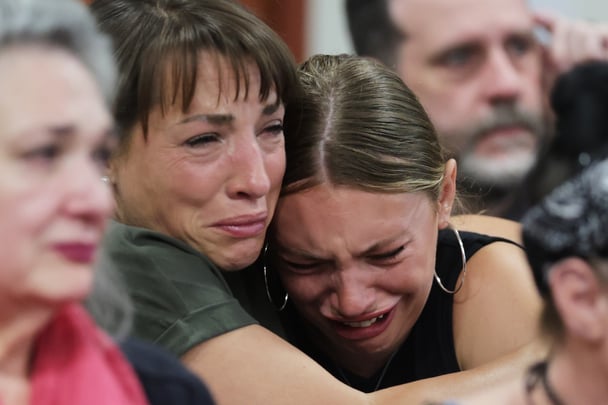
Dylan continued: "He stole parts of me I may never get back. He took the version of me who didn't constantly ask, 'What if it happens again? What if next time I don't survive?'"
She described Kohberger as "a hollow vessel, something less than human, a body without empathy, without remorse."
"He chose destruction. He chose evil. He feels nothing. He tried to take everything from me. My friends, my safety, my identity, my future," she said.
But there's one thing he can't take from her: her voice.
"Living is how I honour them," she said. "Speaking today is to help me find some sort of justice for them, and I will never let him take that from me. He may have taken so much from me, but he will never get to take my voice.
"He will never take the memories I had with them. He will never erase the love we shared, the laughs we had or the way they made me feel seen and whole. Those things are mine. They are sacred, and he will never touch them.
"I get to live, and while I will still live with this pain, at least I get to live my life. He will stay here, empty, forgotten and powerless."
A statement from the other surviving roommate, Bethany Funke, was read by a friend.
In her statement, Funke said when she woke up that day, she didn't know what had happened.
"I still carry so much regret and guilt for not knowing what happened and not calling (911) right away even though I understand it wouldn't have changed anything, not even if the paramedics had been right outside the door," she said, CBS News reports.
"I still think about this every day: Why me? Why did I get to live and not them? For the longest time, I could not even look at their families without feeling sick with guilt.
"Everything I do, I do it with them in mind. I know that they would want me to keep living my life to the fullest."
Judge Steven Hippler sentenced Kohberger to four life terms in prison without the possibility of parole.
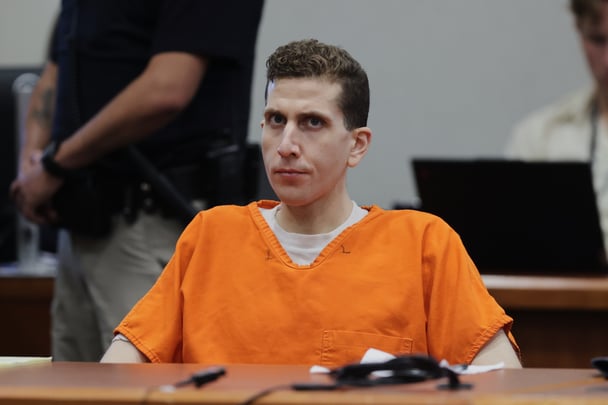
The new series, The Idaho Murders: College Nightmare is now streaming on Netflix.
This article was published on November 30, 2022 and has since been updated with new information.
Feature Image: Instagram/@kayleegoncalves
Belinda Jepsen
Author
No Comments
Be the first to leave a comment