The news moves fast and so do we.
The Quicky is Mamamia's daily news podcast, getting you up to speed on all the latest news in a quick, digestible format.
Here are your headlines for today.
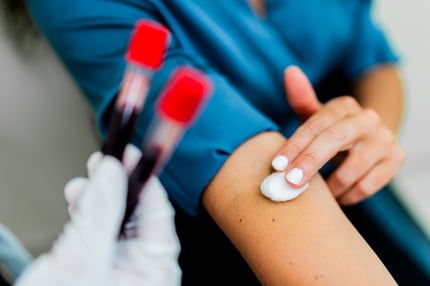
Early Alzheimer's detection via a blood test?
A simple blood test could detect Alzheimer's disease decades before symptoms appear.
Researchers say the new study showed Alzheimer's may be present in midlife and already linked to cognitive differences.
The team from the US analysed three biomarkers (two amyloid ones and the known p-tau217), associated with Alzheimer's disease in 1350 people.
They circled back again five years later and found those who had elevated biomarkers also saw increased cognitive decline after the period had passed.
The authors found it demonstrated "the potential for early detection of Alzheimer's disease in middle-aged adults through blood tests."
While still in early stages, experts say using blood tests to pinpoint changes in the brain earlier could be incredibly valuable.
However, there was some question over whether these tests would return ' false positives' in a younger cohort.
Alzheimer's happens when specific proteins abnormally build up in the brain – it's the most common form of dementia – making up between 60 per cent and 80 per cent of cases.
Reacting to the studies, Dr Jacqui Hanley, head of research funding at Alzheimer's Research UK, said: "These two studies add to a growing body of evidence showing progress in detecting the biological changes linked to Alzheimer's disease much earlier in life.
However, there is existing testing which many Australians may not know about.
According to the Florey Institute, it starts with a GP assessment, which may lead to various referrals to geriatricians, neurologists, memory clinics or even neuropsychologists.
Testing can include brain imaging like CT, MRI or PET scans to detect amyloid plaques.
Another method is a lumbar puncture to test cerebrospinal fluid (CSF). The Florey Institute official site is currently the only accredited pathology lab providing Alzheimer's CSF biomarker testing.
This will review biomarkers such as amyloid beta, phosphorylated tau and total tau, which offer around 90 per cent sensitivity and specificity for early Alzheimer's diagnosis according to the lab.
The test currently costs $400 privately and isn't covered by Medicare.
And finally, there is an existing blood test: the plasma pTau181 blood test.
It measures phosphorylated tau protein linked with Alzheimer's pathology and is intended for adults aged 55 to 80.
It's available to people with memory complaints and is designed to identify people who are unlikely to have amyloid pathology. It was approved late last year, in September 2025.
It's not a standalone diagnostic test and results still need clinical interpretation alongside symptoms and other investigations.
It's not on medicare but costs just $250 privately (from January 2026).
Finally, there is neurofilament Light (NfL) testing, which can test nerve cell injury in plasma and CSF. However, it can only indicate brain injury or neurodegeneration, not exactly which disease is causing it.
The key takeaway is that if you're concerned about your memory, it's best to inquire early with your GP for specialist review.
Because more now can be done than ever before in this space.
Pauline Hanson says she's up for being Prime Minister.
One Nation leader Pauline Hanson says she believes she has what it takes to be Australia's Prime Minister and is considering a tilt at the lower house at the next federal election.
She told Sky News she "won't knock the job" and that it is about getting "the right person" to lead the country, but said she hasn't yet decided whether she will give up her Senate spot to run.
Watch: The Olympian taking over the manosphere, on The Quicky. Post continues below.

"It is in the mix, but I'm not making a decision now, and I'm not going to tell anyone what I'm doing at this moment because I haven't clearly made up my mind," she said.
"It will be a discussion that I will have with the team around me, with my other members of Parliament, and it will be based on political strategy as well on what I'm going to do to move forward with it.
"But there is a clear indication that people really want change in this country."
Her comments come as a new Redbridge/Accent Research poll, published on Monday by The Australian Financial Review, showed party support for One Nation has risen four points to 31 per cent.
Anthony Albanese remained the preferred Prime Minister in the poll, with 31 per cent favouring the Labor leader, while Senator Hanson was on 25 per cent and opposition leader Angus Taylor on 14 per cent.
Hanson said the party's recent by-election win in Farrer and the polling surge show voters are "fed up" with Labor, the Coalition and the Greens and are demanding change.
"The Albanese Labor government is the worst government I have ever seen," she said.
"Even their backbenches are rising up against these tax cuts. They don't know how to sell it to the people.
"That tells you there is clearly a dictatorship that goes on within the Labor Party in the caucus, so their backbenches don't have a say."
Nationalised gun reform stalls.
The potential for nationally consistent gun reform has quickly spiralled into state-by-state uncertainty.
But hope remains that key legislative gaps, exposed by the shooting massacre of 15 people on Bondi Beach in December 2025, can be bridged.
A federal push to cap the number of firearms an individual can own and establish an Australia-wide gun buyback scheme has suffered a significant blow, with Victoria rejecting the reforms.
Most states have shunned the idea of restricting firearm ownership or placing harsher limits on faster reloading, straight-pull rifles like those used in the Bondi attack.
An offer by Canberra to fund half the cost of a national scheme is contingent on states implementing caps.
But Queensland, South Australia, Tasmania, the Northern Territory and now Victoria have all signalled they don't plan to.
After the national cabinet agreed to wide-ranging changes in the days after Bondi, NSW led the push with a range of reforms, including capping ownership of four firearms for recreational hunters.
The wealth gap is widening between Australia's generations.
The Actuaries Institute says all age groups are better off than they were in 2000, but older Australians have pulled much further ahead than younger people.
Over the past two years alone, households headed by 65–74-year-olds gained on average $375,000 in wealth and those aged 45–54 gained $336,000, more than three times the $98,000 increase recorded by 25–34-year-olds.
The report also showed government spending shifted further towards older cohorts and public debt is much higher for today's young adults than it was for previous generations at the same age, meaning they'll shoulder more of the repayment burden through taxes.
Theft, obesity and mental health issues all hit younger Aussies hardest, even as unemployment and the gender pay gap fall to historic lows.
The Institute said without policy changes in areas like housing, tax and retirement, intergenerational inequality could soon return to record levels.
Dentists to identify DV using new guides.
Dentists who notice their patients may be experiencing domestic violence will have better guidance on how best to respond, as advocates say the profession is uniquely positioned to identify abuse.
A first-of-its-kind legal guide has been released as part of domestic violence prevention month.
North Queensland Women's Legal Service's Ashley Lawrence said dentists are often among the first health professionals to see possible signs because they treat areas commonly impacted by abuse.
The guide intends to provide a clear legal lens and help dentists balance patient autonomy and safety with their professional obligations.
If this story has raised anything for you, help is available 1800 RESPECT 1800 737 732 or Lifeline 13 11 14.
Paul McCartney wants Prince's estate to release his Beatles cover.
The music icon said he wants Prince's secret Beatles cover released.
The 83-year-old said he was stunned to discover Prince had recorded a version of the group's 1970 classic "The Long and Winding Road" after it was played to him following Prince's death in 2016.
For more on news, listen to today's episode of The Quicky. Post continues below.
Speaking to Vernon Kay on BBC Radio 2, he said he'd ask Prince's estate to release the track.
"I could make it into something really good," he said.
"It's kind of rocky. He plays some really good guitar on it.
"It's so sad these people, you know, they're like, suddenly, it's not here and always makes me wish that I'd known him better and that I could sort of say, Hey, now come on, what's going on.
"But it's such a shame because they're such talents."
Feature image: Getty.
-With AAP.
Cassandra Green
Acting Deputy Editor
No Comments
Be the first to leave a comment