
If you’re big on beauty or love wandering the aisles of your local pharmacy, you might’ve heard Sukin has released a new sunscreen.
Enter, the Sukin Sheer Touch Face Sunscreen SPF 30, $24.95.
This is very exciting because we all know we’re meant to wear sunscreen on our faces every day, and this one is the solution to two of the biggest excuses used for not slathering on the good stuff:‘sunscreen is too expensive’and‘sunscreen is not natural’.
Although there’s no such thing as a 100 per cent ‘natural sunscreen’, this new Sukin sunscreen uses minerals to block the sun.
What does that actually mean and does this product live up to the hype? We asked fiveMamamiastaffers to road test this sunscreen to find out. Oh, and let’s decode some common SPF marketing terms along the way.
Sukin answers all of your SPF questions below, post continues after video.
What does a ‘mineral’ sunscreen actually mean?
SPF 101: Sunscreens are commonly referred to as either being ‘chemical’ or ‘physical/mineral’. So what’s the difference?
In short, ‘chemical’ sunscreens contain active sun filters that penetrate the skin, absorb UV rays and convert them to heat to prevent them from causing damage.
‘Physical/mineral’ sunscreens use naturally-derived minerals zinc oxide and titanium oxide (naturally derived means the minerals once appeared in nature, but are treated to access their properties). These minerals still absorb and convert UV rays, but they also form a barrier over the skin to block and scatter UV rays too.
Both ‘chemical’ and ‘physical/mineral’ sunscreens are safe to use, but which one you choose is a personal choice. Some people find ‘chemical sunscreens’ irritate their skin where ‘physical/mineral’ sunscreens don’t. If you have facial pigmentation, you might also opt for a ‘physical/mineral’ sunscreen as pigmentation is worsened by heat, and ‘chemical’ sunscreens produce more heat within the skin.
And what about ‘reef safe’ sunscreens?
You might’ve heard some chat about ‘reef safe’ sunscreens or certain SPFs being ‘bad’ for the environment, but what does that actually mean?
In 2018, Hawaii became the first US state to ban the sale of sunscreen containing oxybenzone and octinoxate. The new law goes into effect January 1, 2021. This is because studies on isolated coral samples have shown some sunscreen ingredients, including oxybenzone, have been found to cause coral bleaching.
We know climate change is the biggest threat to our Great Barrier Reef, but what’s coral bleaching?
Coral contains an algae called zooxanthellae which essentially gives the corals energy to grow and reproduce. When corals get stressed from things such as heat or pollution, they react by expelling this algae, leaving a ghostly, transparent skeleton behind. This is known as ‘coral bleaching’.
‘Reef safe’ sunscreens are formulated without oxybenzone and any other chemicals that may be harmful to coral and sea life.
A bit about the Sukin Sheer Touch Face Sunscreen SPF 30.
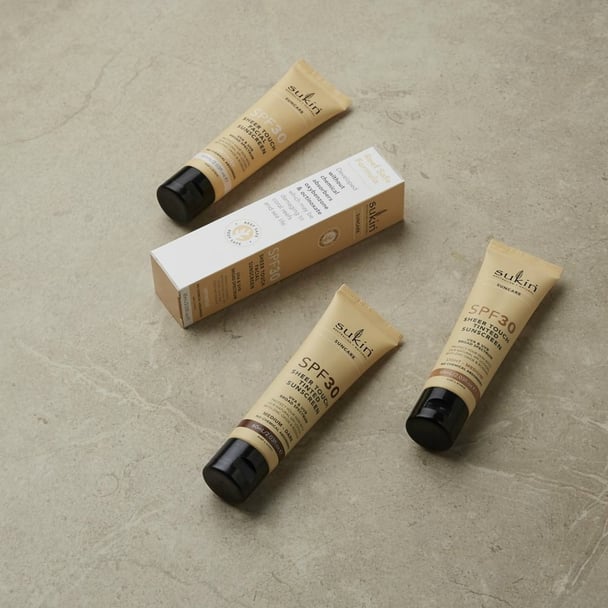
Meet Sukin's new mineral sunscreens. Image: Supplied/Sukin.
Now we know what a mineral sunscreen is and what makes it 'reef-safe', let's talk about Sukin's Sheer Touch Face Sunscreen SPF 30, $24.95.
So, that's all great but what's it like in real life on real faces? We asked five women (including this writer) to swap their regular SPF for this one:
Rikki, 36.

Image: Supplied/Rikki Waller.
Since becoming pregnant, I have been looking for a product to replace my usual BB cream that has more natural ingredients and an SPF factor. This SPF is lightweight, goes on nicely, isn't greasy and offers the type of coverage I like. It also boasts reef and ocean safety which is important to my family and I as we have grown up on the beach and care about its existence for generations to come. I really like this product and will be adding it to my daily routine.
Emily, 23.

Image: Supplied/Emily Vernem.
I literally wear this every single day. It’s so hard to find tinted products that match my skin tone but the Sukin tinted sunscreen in tan/dark suits me perfectly. It applies like a normal moisture and leaves a natural, glow effect. I hate wearing foundation so this product is perfect for me.
Millie, 36.

Image: Supplied/Millie Carter.
This sunscreen formula is light and thin, making it easy to apply and massage into your skin. It absorbs fast and doesn't appear to leave any white residue. It doesn't feel greasy or oily and sits well under light makeup without adding any extra shine. It also smells really nice and has that pleasant summer scent!
Kee, 31.

Image: Supplied/Kee Reece.
I much prefer physical sunscreens, so was super excited to try this. The tint is a really nice colour and great for everyday. It is a little on the dewier side, so I powered my T zone, chin and forehead. Otherwise, loved it!
Amy, 27.

Image: Supplied/Amy Clark.
I tried the light/medium tinted version. This is great for days when you don't want a heavy base but still need SPF and some help evening out your skin tone. The formula dries down pretty quickly - I have dry skin and found it to be non-greasy. This helps because you need at least a teaspoon of product to get the SPF30 protection.
Have you tried Sukin's new facial sunscreen? Tell us your thoughts in the comments!
Amy Clark
Lifestyle Editor
No Comments
Be the first to leave a comment