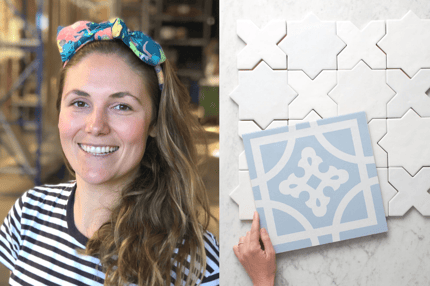
When it comes to tiles, I know my stuff.
I’m Floss, I’m 30 and I live in Sydney with my husband and our labradoodle. I’m the Co-founder and Head of Creative at TileCloud, an online store for tiles.
Basically, it's tile shopping simplified, hassle-free sampling and we deliver everything to our customers’ door. Most of them we find are renovators who can now design their dream bathroom from their office desk, while they binge Netflix or when they are waiting for their morning coffee. We try and make it as easy as we can for them to bring it all to life, in a nutshell.
My co-founders and I started the business in 2017. My partners both have a background in construction while I studied design at University and then worked for the Australian design company Mud Australia.
When we started I was the only full-time employee and my desk was in a communal kitchen (I have to laugh about this now).
Now I'm so proud to say we have a team of 16, and we’re on to our third warehouse. In October last year, we also opened our flagship showroom in Sydney.
But these bites of success for us didn't arrive overnight by any means. If I could go back in time to 2017 when this was our side hustle and we were just starting the process, these would be the 6 tips I'd want somebody to be giving me (and what I always tell other side hustlers and Lady Startups like I once was).
1. Start an Instagram account. Right now.
I did this one by accident, because I was so excited to give TileCloud a presence and start interacting with potential customers.
It’s the advice I give any friend starting a business so I'd always recommend this to anyone who will listen with a new business in their hands: before your website is live or your product/service is even finished, start an Instagram account and just see If people are interested in what you are doing.
It's the best getting direct feedback from the community, and getting to gauge in real-time how your content is being received.
The best thing about this is it is free, you just need to put in the time to creating content that people want to know about you and your industry, and actually engaging in a back-and-forth with your audience.
And, if you can’t create original content, that’s okay too; when we started we didn’t have any physical tiles to make content out of, so we made our Instagram account in the beginning using a curation of images that reflected our inspiration and aesthetic, and what we would go on to sell.
2. You can learn as much from a customer that doesn’t buy from you as one that actually does.
We built our website to be incredibly beautiful and stylish.
But after a few months our conversion rate wasn’t great and we wanted to find ways to improve it, so we ran some focus groups (which was basically me getting on the phone with customers who had ultimately decided not to buy through us).
The feedback was overwhelmingly that they loved our product but assumed we were more expensive than competitors because of our fancy website – even though we’re actually one of the cheapest in the market.
Such valuable insight to us.
We immediately changed our brand positioning, website and socials to feel much more affordable in order to stop confusing our customers, and adopt a more accessible approach.
I wish I could go back and tell myself to stop obsessing over creating the perfect, premium website and start talking to potential customers sooner. We've learned so much from doing this over the years, and something that every Lady Startup can start doing.
3. Networking isn’t just for corporates.
When we first started I had zero interest in attending networking events – and my first was equal parts cringe and riddled with imposter syndrome. "It's definitely not my thing", and "I shouldn't be here", I kept thinking each time I would attend one.
But it turns out that small business and startup community events are a great way to meet other people going through the same challenges. What's even better: they’ve been through them, have come out the other side, and have advice to help you.
So much to learn, so little time. It's honestly been one of the best things in disguise.
At a networking event run by our shipping company, we actually met a digital marketing agency that day, and after hearing all about how they work and more about them as people, we’ve thankfully worked with them ever since.
4. Write a business plan (but actually, do it).
It’s not an original, I know, and yes it might sound a tad boring.
Maybe it even feels like overkill, as you know what you're all about and what you want to achieve in your head. But I promise it’s not.
We always waved it off as being “too early” to make one, we were “too small”.
Then suddenly we weren’t.
It wasn’t until we were knee-deep in the business that my two business partners and I realised that we didn’t have exactly the same vision of where we were going and how we’d get there.
It worked out fine in the end (thankfully, after lots of communication and planning), but if we’d have put it down on paper super early on, the process could have been a lot smoother and aligned across us as co-founders.
If you don’t know how to get started, I really recommend this free guide from CommBank. Behind every organised business is a solid business plan, and I know this now. This guide makes sure you cover what you need for starting a business successfully.
5. Decide how much you personally are going to invest in the business (and stick to it).
This was actually advice I was given from a mentor of mine, and I’m so glad I listened.
I’ve seen other business founders throw do
Floss Kelly
Author
No Comments
Be the first to leave a comment