Thanks to our partner, La Roche-Posay
As a self-confessed skincare nerd, I really thought I had my skincare routine sorted.
I've spent a number of years in the beauty media space, writing about trends, 10-step routines and the 'must-have' actives. Building a skincare regimen has become something of a scientific formula, with each step having a purpose and getting me closer and closer to my skin goals.
Whilst my skin does lean towards being more naturally sensitive, I've put in the work to make sure that I'm including my retinol, my vitamin C, my exfoliating acid and then more of everything else to balance it out. After all, more really is more, right?
Perhaps not.
I'm putting in all this effort, and it seems like my skin actually doesn't care. Ouch.
Fortunately, I had the chance to ask dermatologist Dr Cara McDonald all my burning questions to help understand why simplifying my routine could be the key to happier skin.
Signs your skin is overwhelmed, and how to recognise them.
An impaired skin moisture barrier or overwhelmed skin can sometimes be a bit tricky to figure out, especially if you're using a number of different products within your routine.
Dr Cara suggested that "inflammation, irritation and redness" are all signs that your skin is doing it tough and that it's a good sign to take a step back and evaluate what you're using.
Product intolerance is a little bit different and can feel more like a reactive response to putting something on your face. Dr Cara described "stinging, burning, peeling or excessive tightness are not normal sensations" and instead means you should cease using something immediately.
In general, your skincare should either be helping to prevent or reduce inflammation — so if that's not happening, then it's time to take things back to basics and refocus on supporting your skin moisture barrier.
Repair and recovery over adding another serum.
Speaking about active ingredients (and feeling compelled to add more to your routine), Dr Cara made the point that social media often creates the feeling of missing out on something.
"People can end up confused, and they're feeling like they need to do everything early, or they might get left behind," she said, adding that: "If you don't have the problem there already, then there's really only four things that I think are really good to think about for your skincare".
Those four things? Hydration, inflammation, the skin microbiome and barrier protection. It's important to look at your routine and your skin, and ask yourself if each of those areas is being supported.
But there is one that stands out as a main priority.
"Inflammation is one of the biggest triggers of ageing signs in the skin, so we want to do everything we can to not cause inflammation or to help reduce it," said Dr Cara.
Switching your focus to skin repair can look like adding in a product like the La Roche-Posay Cicaplast Baume B5+ Balm Cream ($44 for 400ml). It's a rich and nourishing formula that features their unique tribioma prebiotic complex — hello microbiome — alongside madecassoside and 5 per cent panthenol (also known as B5).
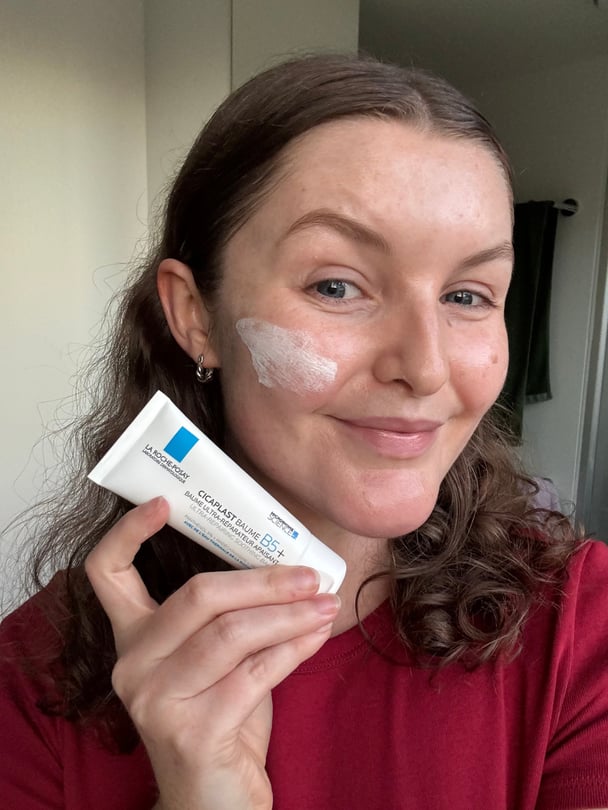
All of this to say: it's an intensely hydrating option to reach for, that can help in skin recovery but also fortify that skin moisture barrier.
If you're wondering what that sound is, it's my jaw hitting the floor. I've never had someone explain so concisely how you can be preventative in your skincare, and why every choice plays a role.
"When skin is healthy, it functions its best," said Dr Cara.
Dr Cara also summarised it nicely. "You're better off avoiding inflammation and protecting the skin at a younger age than you are trying to use active ingredients that you don't necessarily need yet."
How to streamline your skincare routine.
Obviously, everyone's skin concerns are a little different, but Dr Cara recommended your three non-negotiables being a cleanser, moisturiser and sun protection.
"'Simple' looks like a cleanser that's suitable to your skin. For most people, I'd recommend a cream cleanser so that you have something gentle and hydrating, not drying," said Dr Cara.
She added that you also need sun protection. "Yes, every single day! Because the sun is the number one cause of premature ageing and exacerbates a lot of inflammatory problems in the skin." No disagreements from me on that front, we stan SPF in this household.
As for a moisturiser, you want to pick something that also suits your skin type, which is where the Cicaplast B5+ Baume re-enters the chat, as it's such a versatile product to help support across a number of skin concerns. Ingredients like the 5 per cent panthenol help to fortify the skin's moisture barrier and support overall skin health.
A tip on using skincare actives.
We covered what it means to go back to basics in your routine, but it's only once you're addressing those main areas — hydration, inflammation, microbiome and barrier health — that you'd look to add onto it.
Think of anything beyond that as a 'bonus' that's targeted to your skin goals and can add to that really solid foundation you've built.
"You want to choose ingredients that are going to give you the biggest bang for your buck, rather than just hitting your skin with everything," explained Dr Cara. The main takeaway: above all, you should be prioritising "doing everything you can not to cause inflammation."
Armed with my new *do less* and targeted approach, I feel energised and ready to tackle the world; or at least my bathroom shelf. Keeping things simple doesn't mean it's boring and a bit of restraint now is helping Future Me out big time.
Shop La Roche-Posay's Cicaplast Baume B5+ Balm Cream online or at your local pharmacy.
Featured image: Instagram/@morgansskinjournal.

Win a $1000 voucher!
Do you love trying new skincare products? Complete our survey for a chance to win a voucher in our quarterly draw!
Take survey →Morgan Rohan
Author
No Comments
Be the first to leave a comment