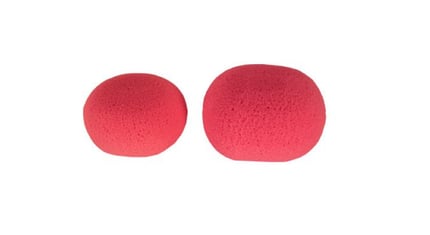
Image via Jade and Pearl.
Like most women, I have a vivid memory of my first attempt at wrangling a tampon. After twenty minutes of poking my vaginal walls with what felt like a weapon made of only sharp edges, I quit. I didn’t quiz friends or – god forbid – my mum for tips. Instead, I failed privately and that was the end of tampons and me for a long while.
Twenty years on, applicators have become much smoother for the 70 per cent of Western women who use them as their primary period product, and occasionally I’ll still use one. But regular tampons are not my go-to product anymore.
Mercifully, we ladies with periods are no longer burdened with a monthly Sophie’s Choice of pad vs. tampon. In fact, our modern period wonderland has reintroduced incredible alternatives, including the exotic sea sponge tampon, which, as far as I can tell, is the only one made from a dead sea animal.
Tales of cost savings, comfort and lack of waste drew me to these at a time when my go-to menstrual cup wasn’t fitting very well and I sought a new reusable solution.

Sea sponges seem to have first reappeared on the market in the 1980s as a “safer” alternative to tampons during the Toxic Shock Syndrome scare (TSS happens when Staph and Strep bacteria enter the bloodstream and shut down vital organs). In a Vice piece on model (and TSS amputee) Lauren Wasser, NYU professor of microbiology Dr. Philip M. Tierno says “synthetic ingredients of a tampon are a problem”.
TSS is rare even with widely available tampons made from hybrid natural-synthetic materials that are hyper-absorbent, which can foster bacterial growth and create micro-tears on vaginal walls… all women know the fingernails-on-chalkboard feeling of a dry tampon dragging down the inside of their vaginas.
Sea sponges, while not drying, are absorbent too and pose a rare risk of TSS – as is now the case with menstrual cups too apparently. However, my years of TSS-free regular tampon use left me feeling pretty good about my sea sponge odds.
Plus, expert opinion is that sponges are safe (particularly if sanitised, an activity forgone in the 1980 University of Iowa study indicating they harbour contaminants). In a recent Mashable article gynecologist Dr. Raquel Dardik at the Joan H. Tisch Women’s Health Center at NYU Langone Medical Center says “yes, they're absolutely safe… A tampon is just a piece of cotton that's shaped so that it absorbs blood so that it doesn't come out, and in that sense, menstrual sponges are doing exactly the same thing because that's what sponges do."
Fears of sponge bits stuck in your vagina should be put to rest too. The same happens with regular tampon use – tiny rayon, viscose and cotton fibers cling to the dehydrated walls of your vagina. Potato, Poh-tah-to. Luckily your vagina is like a self-cleaning oven.
It’s also hard to ignore the online anecdotes that make sea sponges sound like wonder plugs – instantly ease cramps! Lighten heavy flows! They’re imperceptible once inserted (damp sponges are soft and pliable). Most importantly (if we’re being honest), the $21 to $24 you pay up front will seem like a downright bargain six months later (the expected life of a sea sponge tampon), when you’ve halved the out-of-pocket cost foisted on you for needing physical period products.
Unlike non-organic tampons which “might eventually” break down (or pads, which are forever, like diamonds, but way less sparkly (although just as bloody), these things are compostable. There’s also the not-so-secret fringe benefit of using sea sponges to have mess-free sex on your period, much the way original lady boss Cleopatra did.
So do sea sponges really work? Yes and no, which is the answer for every period product I’ve tried. The first time I coughed while wearing one, I spent the next 10 minutes blotting up the mess in my underwear. User error. I swapped out the offending sponge – the smaller of the two Porifera I’d bought – for the bigger one and avoided further exertion-related mishaps.
There was none of the trauma with inserting the sea sponges that I had with my first foray into tampons. True, I’m more experienced now (and it should be easy for anyone who’s used a menstrual cup or masturbated before), but that aside, they still seem easier even sans applicator. (Post continues after gallery.)
Popular forms of birth control
Contraceptive pill
The Pillis the most popular form of birth control. There are two types: the combined pill, containing two hormones, and theprogestogen-only, or mini, pill, which only contains one female hormone. The combined pill works by preventing the ovary from releasing an egg each month. The mini pill changes the mucus at the entrance of the uterus, which stops sperm from entering. Both are 99.7% effective; however, they don't offer protection from STDs.
Intrauterine device
IUDs are small, T-shaped devices that are inserted into the uterus by a doctor in order to prevent pregnancy. There are two types of IUD: copper, which affects the movement and survival of sperm in the womb while changing the lining of the womb;and hormonal, which releases progestogen (a synthetic version of the naturally-occurring hormone progesterone) into the uterus. Although IUDs have a success rate of more than 99%, only around 2% of Australian women currently use one.
Condoms
The male condom is a barrier contraception that prevents both pregnancy and the transmission of STDs. They work by collecting semen so it doesn't enter theman's partner's body. Condoms are 95 to 99% effective at preventing pregnancy.
The female condom
The female condom is a pre-lubricated sheath, which loosely fits inside of the vagina. The condom has a removable ring, which helps to insert the sheath and keep the condom in place. A larger ring remains on the outside to cover the opening of the vagina. They are designed to fit all women and can only to be used once. Due to misuse of the product it is only 79 per cent effective.
Diaphragm
Like the male condom, the diaphragm is a barrier method of contraception. It's a shallow silicone dome that's inserted into the vagina andcovers the cervix, which is the entrance to the uterus. It's held in place by the pelvic muscles, and works by preventing sperm from entering the uterus. After sex, diaphragms need to remain in placefor another six hours, in which time the sperm inside the vagina die. This method is 88 to 94% effective at preventing pregnancy, although this rate increases with experience.
Birth control implant
This is a 4cm-longimplant that is inserted into a woman's upper arm, just under the skin, by a doctor. It releases a hormone called etonogestrel, which prevents ovulation and thickens the mucus in the cervix, which can stop sperm from entering. Contraceptive implants - usually sold as Implanon - are removed under anaesthetic every three years, and are close to 100% effective.
Vaginal ring
Vaginal rings are soft plastic rings that contain the same two hormones as the combined pill - oestrogen and progestogen. The ring is inserted into the vagina, where the hormones are absorbed into the body and then prevent the ovaries from releasing eggs. Once inside the ring can't be felt, and it needs replacing every three weeks (with one week's break in between). When used correctly, this method is more than 99% effective.
Depo Provera
Depo is a long lasting hormonal injection. The synthetic form of progesterone is administered every 12 to 14 weeks to woman, preventing pregnancy within this ongoing time period. The injection, which is given in the buttock or muscle of the upper arm, prevents ovulation and thickens the mucus in the cervix, helping to block sperm. The injections are 99 per cent effective but do not protect against STDs. Male contraceptive injections are currently being trialled
The morning after pill
Emergency contraception (popularly referred to as the morning after pill) is used to prevent a pregnancy following unprotected sex. Other reasons include missing a contraceptive pill or a condom breaking. It is common in Australia to use the progestogen-only method. This entails a dosage of EC pills containing progestogen or the synthetic version. A doctor can prescribe the pill or they can be bought over the counter at a pharmacy without a prescription. Emergency contraceptionis 85 per cent effective in reducing the risk of pregnancy.
Sterilisation
Sterilisation is a permanent form of contraception. For women there are two types of sterilisation: tubal ligation, in which clips are placed on the fallopian tubes, or tubal occlusion in which a device is inserted into the tubes. These methods work by preventing the sperm from reaching the egg. Tubal litigation is 99.5 per cent effective. The Vasectomy (for men) works by cutting and blocking the tubes called the vas deferens, preventing sperm from leaving the testicles. The chances of impregnation with a vase
Author
No Comments
Be the first to leave a comment