Like pretty much every other women's health issue, hair thinning is just another one of those taboo topics we don't talk about.
And it's funny, really. Notfunny, funny — but considering how many of us deal with it (you can step into a room and at least one person in that room will struggle with thinning hair), it's a conversation that needs to be louder.
In case you're not yet across it, female pattern hair loss is a term used to describe hair loss or hair thinning in women— and it will affect 49 per cent of women at some point in their lifetime.
Hair loss is a fickle beast. And the causes behind it are way more complicated than it seems — because no two experiences are the same. It can be triggered by everything from genetics and illness, to periods of extreme stress and hormonal conditions.
Watch: Sally Obermeder talks on No Filter about the moment she had to shave her head. Post continues below.
Take Australian author Sally Hepworth, for example.
TheNew York Timesbestseller is someone who is vocal about her experience with hair thinning, opening up the conversation around hair loss on Instagram. Hundreds upon hundreds of followers have praised her for normalising hair loss.
Speaking withMamamia, Hepworth said, "I have a condition known as trichotillomania, which is really just a fancy way of saying I pull out my hair from the root when I’m anxious."
Heard of it before?
Commonly called 'trich', the hair-pulling disorder usually begins in late childhood and is something that typically lasts for life, taking an emotional and social toll on individuals.
"The Wikipedia definition describes it as 'a mental disorder that involves recurrent, irresistible urges to pull out hair from your scalp, eyebrows or other areas of your body, despite trying to stop.' For me, I pull the hair around the crown of my head," the author shared.
Given trichotillomania is a silent disorder, many people keep it a secret — so it's surprising to learn just how common this condition is.
US-based studies estimate it affects around two to five per cent of people - however, its prevalence in Australia remains unknown due to the lack of research funding. The result? It's pretty poorly understood.
For Hepworth, compulsive hair-pulling is something she's lived with for most of her life. She was a tween when she started doing it, which soon resulted in a bald patch on the crown of her scalp.
"The first time I recall pulling out my hair was around age 12, during a long drive from Melbourne to Queensland. Thirty years later, I’ve never quite shaken the habit, despite hypnotherapy, psychology, and a rapidly growing bald spot."
Dealing with this distressing disorder, combined with ageing and the common effects of perimenopause, Hepworth said she has been experiencing thinning hair.
"I have periods when I don’t pull out my hair, but the habit always returns in times of stress - suffice to say after the last few years my hair is fairly thin on the ground, so to speak. Combine tricho with a bit of perimenopausal hair thinning, and I have found myself rather follically challenged of late." https://www.instagram.com/tv/Ce5KNJqjKCk/?utm_source=ig_embed&utm_campaign=loading
As Hepworth told us, learning to deal with her hair loss has been a journey. She said trying to tackle thinning hair can feel exhausting — but there are options out there.
How to get thicker hair.
So, what are the best options when it comes to thinning hair?
While there are prescription treatment options if you want to go down the medical route (again, the effects of this are different for everyone), alternative hair is a solution that is growing in popularity.
There's everything from clip-in hair wefts (hair extensions) to crown extensions (also known as a 'topper' or 'toppette'), synthetic wigs, and custom human hair wigs that can be cut and styled to suit your individual preference.
"I started with clip-in hair wefts to add volume to my hair," Hepworth toldMamamia.
"I’d seen people use them on TV, and I thought they were a clever idea and seemed easy enough to use. I used these for a week or two with some success, but they didn’t cover the crown of my head where I most desperately needed coverage."
"It wasn’t long before I disappeared into the rabbit hole of alternative hair, and that’s where I found 'toppers' - a hair-piece which covers the crown of the head. I bought one of these, and while I was online, found myself looking at wigs as well. They looked so damn good, I decided I needed to try one."
"Now I’m the owner of several wigs and toppers and I have to say, I’m obsessed. Not going to lie, having a good hair day at my fingertips is a game changer. And the upside is that I can’t pull out my hair while the wig is on. If wigs are good enough for the Kardashians… why not me?"
Hear, hear.
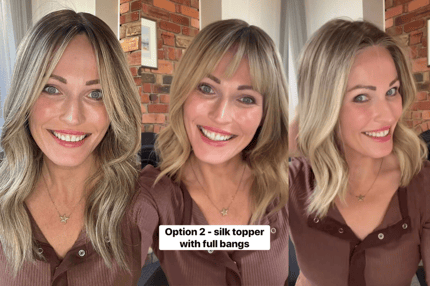
In a recent Instagram post, Hepworth shared some of the latest wigs she's tried, asking followers to help her choose which one to buy.
"If you're looking for someone who's having the best day ever, you've found her because I just got a delivery from Highline Wigs, who have sent me a bunch of wigs and toppers to try on," said Hepworth.
The first was a "silk topper with curtain bangs,", option two was a "silk topper with full bangs" and option three was a "full lace top wig."
"The hair feels so soft... it's human hair, so you can straighten it, curl it — you can do anything to it. The hair quality just feels so good. It would be so easy to wear."
Check it out below:

Sign up to You Beauty
Sent weekly
Erin Docherty
Beauty & Lifestyle Editor
No Comments
Be the first to leave a comment