Image: Imgur
The internet can be a fairly hateful place, so would you ever actively put yourself up to be insulted by strangers online?
That’s exactly what users of the popular ‘ Roast Me’ Reddit thread do, inviting users to “roast” them with their meanest comments and insults. The subreddit has more than 100,000 subscribers and many more posters, with almost a hundred people preparing for a roast every day.
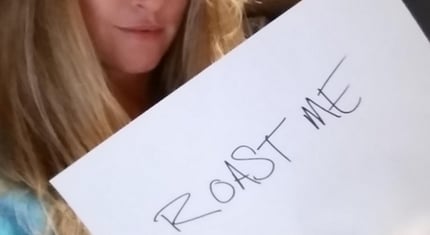
Users are required to take a picture of themselves holding a sign saying “roast me” to indicate they are willingly volunteering, post it online, and prepare for the barrage of insults and abuse. Some claim to have been dared by friends; others are doing it ‘just for fun’.
Accompanying each photo is a tagline with some personal information or a plea from the poster. “Make me feel terrible please”, “Just got dumped; do your absolute worst” and “Make me more insecure than I already am” are just some of the taglines present.

Once invited, 'Roasters' certainly don't hold back. Their comments include, "You could put a second face on that forehead", "You'll never have sex in a position where someone can see your face" and "My gut says you're a female but I honestly can't tell" — and those are some of the more tasteful responses.
Hateful comments online are usually labelled as bullying, but the "Roast Me" guidelines claim "it's a comedy subreddit, not a hate subreddit." Joke or not, why on Earth would people willingly do it?
According to Blue Horizons psychologist Dr Yuliya Richard, people could be using it as a coping mechanism.
"We experience strong emotions such as anger and shame when we are insulted. Most people would avoid or at least not ask to be insulted, however, in some cases people use humour to help them to deal with an unfortunate situation — a major disappointment or relationship breakdown," she says.
"In some cases people find it easier to feel angry than sad in times of stress, so they might also seek out anger-provoking situations, like the Roast Me thread." (Post continues after gallery.)
Celebrities dealing with hate
After recieving lots of online hate about her dress at the 2014 Golden Globe Awards, Gabourey Sidibe tweeted "To people making mean comments about my GG pics, i mos def cried about it on that private jet on my way to my dream job last night. #JK" (Image via Instagram @daremagcanada)
Speaking to The Huffington Post, Gweneth Paltrow likened online hate to war: You come across [online comments] about yourself and about your friends, and its a very dehumanizing thing. Its almost like how, in war, you go through this bloody, dehumanizing thing, and then something is defined out of it. My hope is, as we get out of it, well reach the next level of conscience." (Image via Instagram @gwenethpaltrow)
No stranger to being body shamed online, Ricki Lee posted this on National Action Against Bullying Day: "I've been called every name under the sun & have always managed to maintain an unbreakable self confidence. It's that self confidence that I've always tried to encourage women to have." (Image via Instagram @therickilee)
After comments were made about her weight in 2011, Miley Cyrus posted this response on Twitter: "By calling girls like me fat, this is what you're doing to other people. I love MYSELF & if you could say the same I don't wanna be shaped like a girl I LOVE being shaped like a WOMAN & trust me ladies your man won't mind either." (Image via Instagram @mileycyrus)
James Blunt often replies to hate on Twitter in the most eloquent and polite way. After recieving a tweet saying "@JamesBlunt looks like my left testicle" he replied saying "Then you need to see a doctor @Lewisscoot" (Image via Instagram @jamesblunt.)
After fans called out Pink for her "worrying" weight, she posted this on Twitter: "So my good and concerned peoples, please don't worry about me. I'm not worried about me. I am perfectly fine, perfectly happy and my healthy, strong, voluptuous and crazy stroung body is having some much deserved time off. Thanks for your concern" (Image via Instagram @official.pink.fanpage)
In a celebrity blog post for E! Online Khloe Kardashian wrote "People looooove to comment about my weight and tell me I'm not as tiny as my sisters. I didn't lose weight because people were calling me "fat." I did it when I was good and ready, because I wanted to. And whenever I read a comment from someone calling me a "whale," or saying something derogatory about the way I look, all I have to do is remind myself that they're hiding behind their computers spending hours a day reading up on my life and probably weigh 700 pounds themselves" (Image via Instagram @khloekardashian)
Obviously, there are better coping mechanisms out there people can employ.
"On the day you might suppress your pain and find it funny, but tomorrow you might feel a bit more vulnerable and the comments are still there in cyberspace. It might leave emotional scars," she explains.
In an article for The Telegraph earlier this year, writer Amy Molloy put herself up for roasting and was hit with insults on her looks, weight and career.
"Someone remarked that I looked like an 'anorexic Ellie Goulding' - having spent a decade battling an eating disorder, I didn’t cry, but I certainly didn’t laugh either," she wrote.
"Yet, even though every comment was scathing, I finally understood why so many roastees were doing this when I felt a strange sense of pride at noting my picture had been viewed 2,326 times. That brief moment of pride having passed, I was left with a slightly bitter taste in my mouth."
So is it all about attention?
Whatever the incentive — and even if it's meant in jest — it wouldn't be hard to push someone at risk over the edge, nor is it really a good idea to add more negativity to the internet.
"Before you ask to be roasted based on your appearance, ask yourself: 'What do I want to achieve? Will it be an uplifting experience? Do I really think I will laugh at the comments?'," suggests Dr Richard.
"Humiliation and insults can impact negatively on self-esteem and confidence. It is shame-evoking and can affect interpersonal relationships negatively. While some people have very strong boundaries and can differentiate the comments of internet trolls, many of us will just find it hurtful and upsetting."
Would you or have you ever put yourself up to be roasted? Why?
Author
No Comments
Be the first to leave a comment