This article originally appeared on Jo Castro's Substack, Lifestyle Fifty with Jo Castro. Sign up here .
Come with me to India — not the backpacking India of my youth, but the India encountered with older bones, softer edges, and sharper awareness. I wasn't sure how I'd cope. What unfolded surprised me.
Travel feels different at 67 than it did at 25. I no longer chase intensity for its own sake — but I still crave meaning. This piece is about what happened when I returned to a country that once overwhelmed me, and discovered that age changes the traveller more than the destination.
When India was first suggested as a holiday, I hesitated.
Watch Mamamia's lifestyle editor on the must-pack travel essentials. Post continues below.

We wanted adventure — not a lie-by-the-pool, cocktail-in-hand escape — but at 67, I no longer travel with the reckless resilience of my 25-year-old backpacking self. My immune system is less cavalier, my energy no longer boundless, my patience no longer elastic. I crave discovery and meaning over gung-ho escapades and Kingfisher beer-fuelled nights.
Having backpacked through India in 1983, I felt certain my 2026 expectations would be met. I remembered the onslaught to the senses. I expected noise, colour, humanity and chaos to press in from all sides. I was prepared to feel hesitant, anxious, and slightly undone. This was not going to be a holiday of serenity and ease.
And yet, arriving in Delhi felt like slipping on an old glove that had been sitting quietly in my pocket for years.
Comfortable. Familiar. Known.
We arrived just before dawn on a hazy winter's morning. The air was cool, smudged with smog. Instead of bracing myself, I found myself exhaling.
Our first day unfolded gently in the gardens of Maidens Hotel in Civil Lines — one of Delhi's oldest surviving colonial-era hotels. Indian palm squirrels darted across the lawns, babblers chattered in the trees, parakeets flashed green overhead. It felt tranquil, almost improbably so.
Then we stepped outside the gates.
Tuk-tuks rattled past. Car horns shrilled without restraint. Traffic thrummed and surged. The air vibrated with movement.
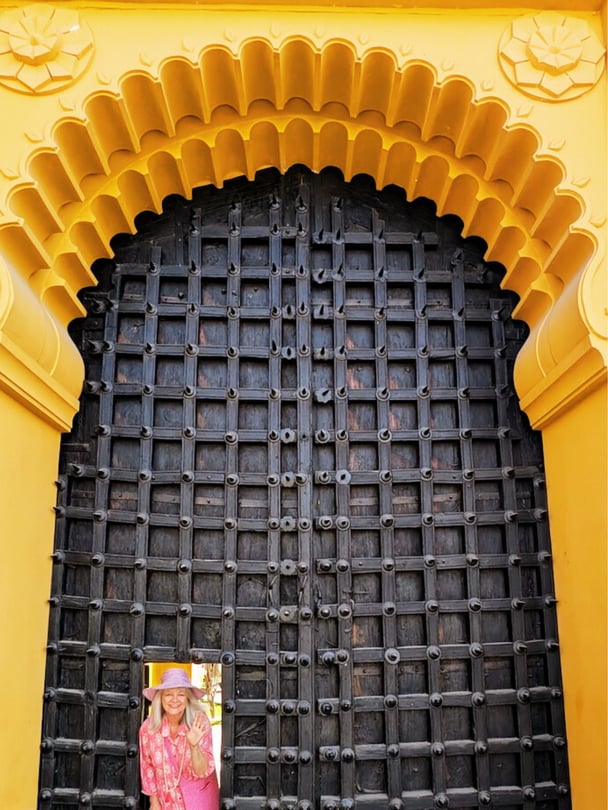
A short walk led us to Qudsia Bagh — once a Persian-style garden of water channels and pavilions, now a crumbling echo of its former elegance. A derelict mosque and the worn stone arch of Hathi Gate leaned into the present, speaking of empires, revolts and time's quiet erasure. History in India does not sit neatly behind glass; it frays at the edges in plain sight.
Along the road we passed a Mother Teresa orphanage. In a recessed window, a small cradle — a Palna — waited silently: a place where unwanted newborns can be surrendered anonymously. We walked on, quieter than before, suddenly alert to the stark contrasts India presents without apology.
Delhi revealed itself as a living paradox — ancient and urgent all at once. At Raj Ghat, the simple black marble memorial marking Mahatma Gandhi's cremation site, flowers lay fresh against the stone and soft devotional music drifted through the air; it was unexpectedly moving, a pocket of stillness in the capital's restless heart.
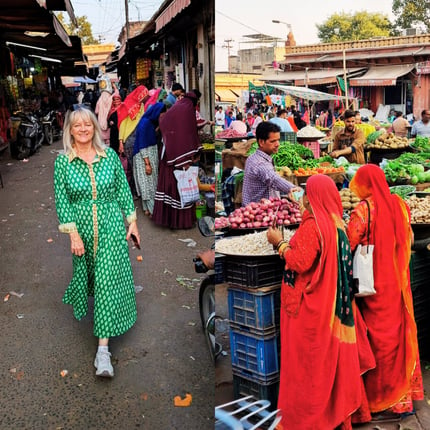
Hours later, we were swallowed whole by Chandni Chowk — a riot of colour and commerce where rickshaws tangled with cattle carts, monkeys balanced along railings, merchants hawked everything imaginable, and the senses simply surrendered.

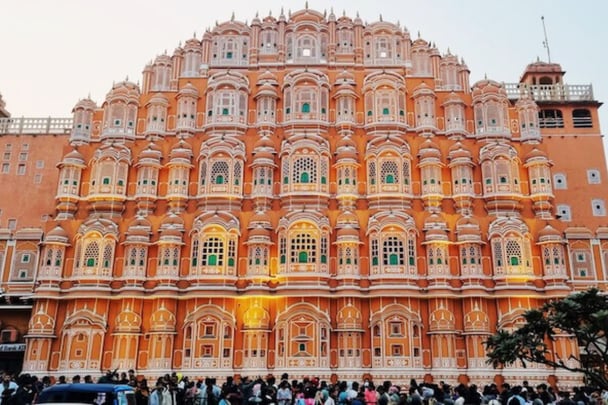
We climbed the vast steps of Jama Masjid, Shah Jahan's grand 17th-century mosque, wandered through the formidable Red Fort — once the palace of a Mughal emperor — and ended the day at Akshardham, a modern temple complex shimmering with devotion and spectacle. It was a whirlwind of faith, empire, noise and reverence — a day that left us exhilarated, reflective, and acutely aware of both India's antiquity and our own privileges.
Later that evening, we found ourselves at the restaurant said to have made Butter Chicken famous. I hadn't realised this most comforting of curry dishes dates back to 1947. In India, even the familiar carries history.
Our journey through Rajasthan over the following weeks connected me with everything that sustains me — continuous learning, the uncovering of ancient culture, history appearing in the most unexpected places, culinary discoveries at every turn. Yes, there was sensory overload. At times, it felt like being thrown into a kaleidoscope and shaken — dazzling, disorienting, impossible to categorise.
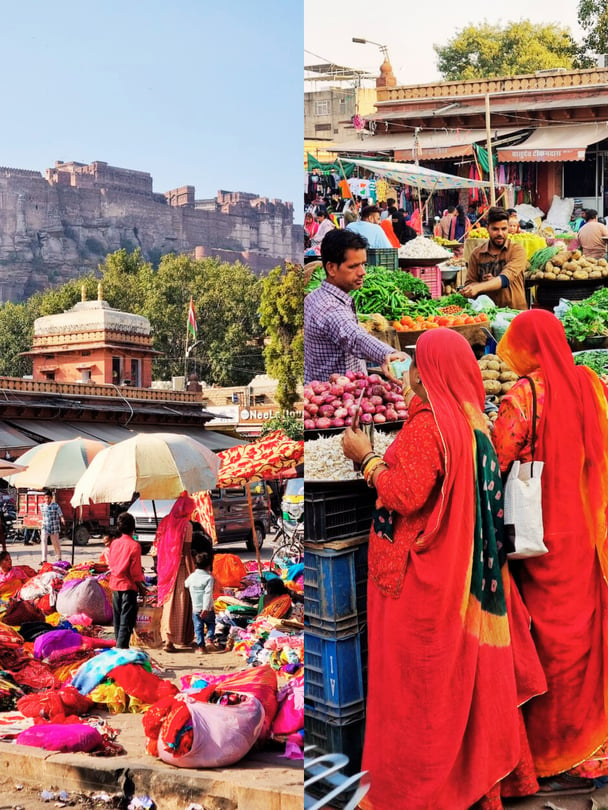
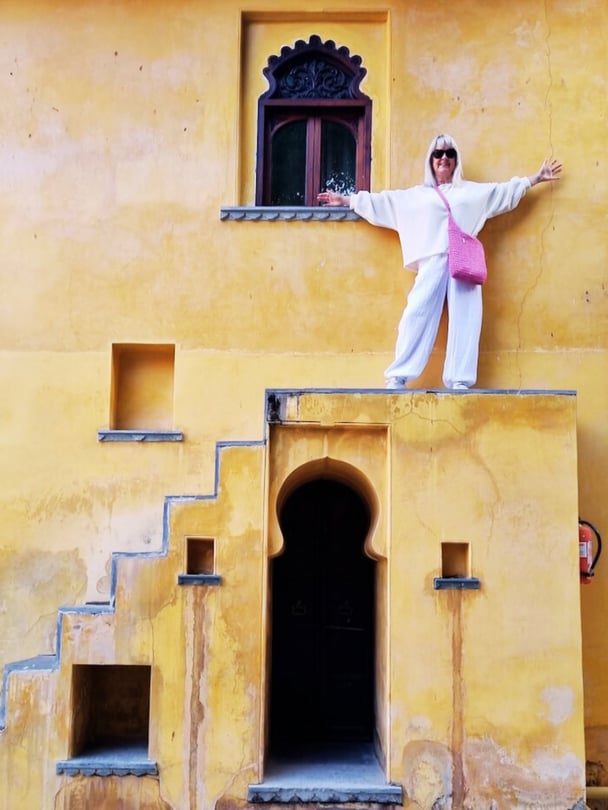
Gustave Flaubert once described his Egyptian travels as being "hurled while still asleep into the midst of a Beethoven symphony".
Alain de Botton, in The Art of Travel, suggests that travel reveals our character by exposing us to places we might, unexpectedly, prefer to home.
When I returned to Australia, I felt acutely aware of my privileges — our orderliness, our space, our dependable infrastructure. I was grateful for clean tap water, plentiful loo paper, the absence of relentless noise. Coming home to long, straight, empty roads and vast open land was a profound relief.
And yet.
Almost immediately, I longed for India again.
For the jewel-bright saris against the dust.
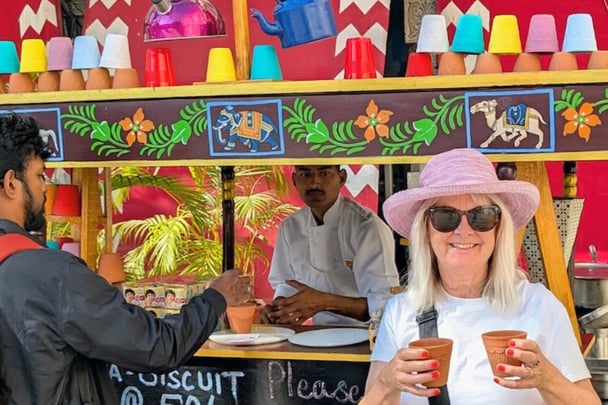
For the call of "Chai! Chai!" rising above the traffic.
For antiquity leaning into the present on every street corner.
For the heave and pulse of humanity lived so visibly, so unapologetically.
I returned relieved.
I remain enchanted.
For more daily entertainment and stories, listen to Mamamia's The Spill. Post continues below.
This article originally appeared on Jo Castro's Substack, Lifestyle Fifty with Jo Castro . Sign up here .
Feature Image: Supplied.
Want to win a $1000 gift card in just 8 minutes?
Obsessed with all things beauty and skincare? We’d love to hear from you!
Take survey →
Sign up to Mamamia Daily
Sent daily
Jo Castro
Author
No Comments
Be the first to leave a comment