Animal rights organisation PETA are known for using controversial tactics to get the masses talking about animal welfare.
But on Wednesday, what was probably one of their more conservative strategies started a heated conversation online, with some saying the “absurdity” of the organisation had “gone to a whole new level”.
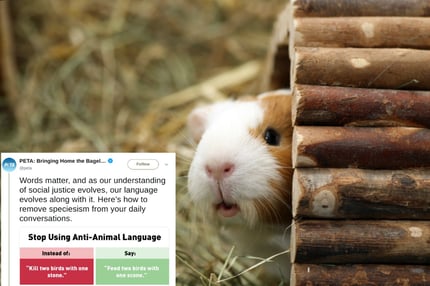
You see, according to PETA, our words matter, and using language that trivialises cruelty to animals can do significant harm. So, they suggested, we should all try to tweak our language, so as to “remove speciesism from your daily conversations”.
According to BBC Ethics , ‘speciesism’ is a form of discrimination based on species membership, whereby humans assume they innately have greater moral rights than other animals. People who fight speciesism believe that the concept of human superiority is arbitrary, and is akin to other forms of prejudice like sexism or racism. Of course, there are many who find this comparison offensive and disrespectful.
Nonetheless, PETA tweeted a list of five common animal-related phrases we all tend to use in our day-to-day lives, providing alternatives to remove their ‘anti-animal’ sentiment.
These phrases included sayings like, ‘kill two birds with one stone,’ ‘bring home the bacon,’ and ‘beat a dead horse,’ with alternative suggestions including, ‘feed two birds with one scone,’ ‘bring home the bagels,’ and ‘feed a fed horse’.
Words matter, and as our understanding of social justice evolves, our language evolves along with it. Here’s how to remove speciesism from your daily conversations. pic.twitter.com/o67EbBA7H4
— PETA: Bringing Home the Bagels Since 1980 (@peta) December 4, 2018
Just putting aside all the ethical questions surrounding this issue,no one has ever fed a scone to a bird. Ever.
In less than a day, the tweet attracted over 10,000 retweets and over 30,000 likes, with over 40,000 people commenting their opinion on the new ‘rules’.
What happens if someone’s gluten free. Bringing home the bagels could be offencive to them.
— Patrick Murphy (@PMurphs21) December 5, 2018
— nael ibra (@naelibra) December 6, 2018
Well, I’m gonna take the bull by the horns here and *not* do that.
— sicc (@XamThaumiel) December 5, 2018
You wouldn’t feed a fed horse. That’ll just cause him to get sick to it’s stomach which would be against the cause.
Be the test tube? What about animal cruelty in labs? Why endorse that phrase? You need to reconsider these phrases as they also promote animal cruelty. Smh.
— DarkTempTrez❤️ (@darktemptrez) December 5, 2018
So many things to unpack here. Most important is why would you ever grab a flower by the thorns?!?!
— Dan the Man (@DMiddlebrooks47) December 6, 2018
Taking my dog to the pound right now. I had no idea animals could understand what we say and I have been talking shit to this little asshole for years and now I can’t even look her in the eye.
You did this PETA. pic.twitter.com/unZlELAhAN
— J (@viaJBT) December 6, 2018
This has to just be a publicity stunt. There is no way any human being is this sensitive.
— Steve Fornataro (@steve_fornataro) December 6, 2018
PETA followed up their list of rules with another tweet.
Just as it became unacceptable to use racist, homophobic, or ableist language, phrases that trivialize cruelty to animals will vanish as more people begin to appreciate animals for who they are and start ‘bringing home the bagels’ instead of the bacon.
— PETA: Bringing Home the Bagels Since 1980 (@peta) December 4, 2018
A common thread in the responses to both tweets was the argument that idioms about animals are not the same as other forms of discriminatory language.
Hi, @peta. As someone who has had homophobic slurs shouted at him and seen individuals physically threatened and beaten while anti-LGBTQ epithets were hurled, your stupidity is not even laughable— it is offensive to equate common animal idioms to racism, ableism, or homophobia.
— Anthony Michael Kreis (@AnthonyMKreis) December 5, 2018
I’m sorry did PETA just compare the phrase “bring home the bacon” to racism or am I reading this wrong https://t.co/PtguMwrNUy
— Noemi Rodriguez (@NoemiRodriguez_) December 5, 2018
PETA introduced me to the term “speciesism” today which 1) is not a thing and 2) diminishes the legitimacy of racism, sexism and classism that many still don’t quite recognize. By all means, advocate for animals… but don’t co-opt those movements. https://t.co/FnwMIDxm6A
— joey (@joeygall) December 5, 2018
While racist, sexist and homophobic phrases have the capacity to reinforce stereotypes and offend vulnerable people,pigs can’t hear us when we talk about bringing home the bacon.It’s also a big step to assume that, in a society where at least two thirds of people regularly consume meat, those people will feel compelled to stop using language that reinforces ‘speciesism’.
Look, I love animals. Significantly more than I love humans. But I’m just not sure that a reference to ‘being the guinea pig’ actually has a real-world impact.
But maybe it does.
If only our favourite creatures had the words to tell us how they feel. Becauseno onewould intentionally do anything to hurt or upset this little guy.

Darling.
What do you think? Do you think we should take the language we use about animals seriously? Let us know in the comments.
Clare Stephens
Contributor
No Comments
Be the first to leave a comment