
On paper, I looked like one of those women in a Miele ad. Capable. Efficient. Unnaturally perfect.
At one point in my late thirties, I was working full-time in corporate, running my own business five nights a week, and three weekends out of four on top of that. Two full-time jobs, basically.
I'd get up early to make everyone breakfast — hubby's delivered to him in bed — then pack three different lunches, each one tailored, because apparently I also ran a short-order kitchen.
Three nights a week, I'd sit in the café at an ice rink while two daughters did figure skating and ice hockey, respectively. The café smelled rough, like a chip fryer that had never been cleaned. I worked from there for a few hours, then we'd get home just before midnight.
I lived in a permanent half-jog.
Watch: The right way to say no to people you love. Post continues below.

At any point, I could have said: This is too much. I need help. But I didn't. Because somewhere along the way, needing help had started to feel like a personal failing.
It's hard to pick one specific time I said "yes" when I meant "no", because it stopped feeling like a decision a long time ago. It's not "Should I say yes?" It's a reflex. Of course, I'll do it. Because the alternative — disappointing someone, asking for more, "making a fuss" — feels genuinely unthinkable. Not dramatic. Unthinkable.
I can see the roots of it in my twenties.
I was living in a shared house with a tight little gang of friends-of-friends from the UK. They'd known each other for years. They'd travelled the world together, been to festivals, worked side by side. They moved like a single organism. I'd never had that. I didn't have a big social circle growing up, and I was always hyper-aware of saying the wrong thing or not being interesting enough or cool.
I remember sitting in the lounge room one night, watching them casually decide where we were going, and feeling this mix of longing and panic. I wanted to belong, desperately. I also didn't trust my own opinions. I always assumed other people's ideas were better thought through, more "right" than mine.
I didn't feel like I had any authority or conviction. I mostly felt like a waste of space taking up a spot on the couch. So, I made a quiet deal with myself: don't rock the boat, and you might get to stay on it. If they wanted to go somewhere I didn't, I went. If someone made a joke at my expense, I laughed. If I felt disrespected or hurt, I told myself it didn't really matter. My job, as I saw it, was to smooth the edges, be easy, not cause friction or inconvenience.
At the time, I would never have called that "people-pleasing". I thought I was just being "laid-back". Fast-forward a decade and the stakes were much higher than which pub we went to.
I was running my own business and money got tight in that way that sits on your chest at 3am. I told myself it was my responsibility to fix it. That asking for help would be unfair. That I was supposed to be able to handle it. So instead of a five-minute adult conversation, I pushed the fear down and ignored it. Neat trick. Highly recommend.
On the outside, I was the capable one who "had it covered." On the inside, I was silently screaming: Why can't I just admit I can't keep doing this? I never said it. So, of course, nothing changed. In the end, I shut down the business I loved and went back into full-time corporate work. Not because it failed. Because asking for what I needed felt like making a fuss — and I'd spent years convincing myself that making a fuss was the worst thing I could do.
By my late thirties, I'd upgraded from "laid-back" to "one-woman small country".
Full-time job. Business on the side five nights a week and three working weekends out of four. The running list of school forms, appointments, sports, birthdays, Christmas, house admin. It's not that help wasn't available. I just couldn't ask for it. Asking felt like admitting I couldn't cope — and that felt worse than just quietly not coping.
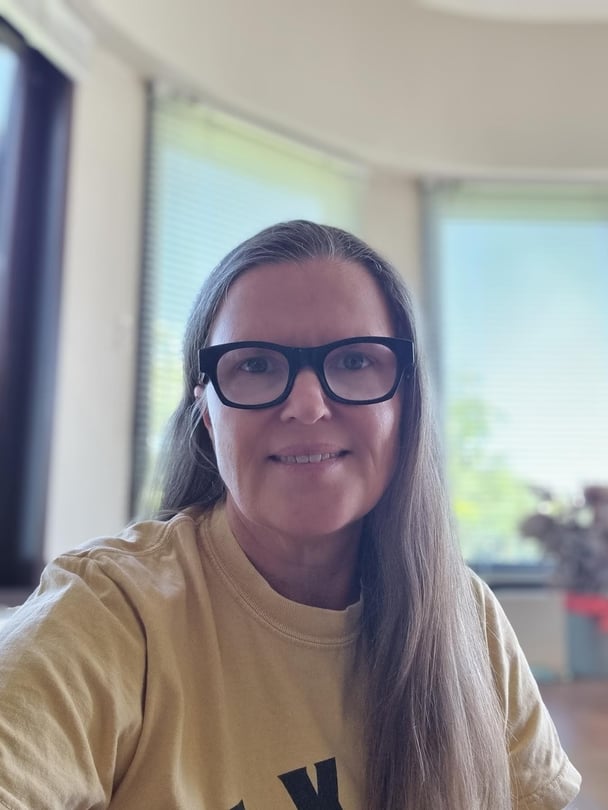
My internal monologue, on rotation:
Stop complaining and just get on with it.
Closely followed by: Say something, and you'll have to stand up for yourself. And you know how much you doubt yourself — you'll spend days in your head going over it. Is that what you want? Do you? Thought so. Now zip it and keep going.
So, I didn't say anything. I just ran faster.
This is the part they don't put on the cute little "boundaries" posts. I wasn't cheerfully declining book clubs. I was burning myself to the ground to avoid any conversation where I'd have to say what I actually needed.
At the time, I thought I was being kind and easy to live with. Now I can see I was being dishonest with everyone, including myself.
What the research says.
People-pleasing sounds like a personality trait — something warm, even virtuous. She's so thoughtful. She never complains. She just gets on with it.
But therapists who specialise in anxiety and people-pleasing tend to frame it differently.
At its core, people-pleasing is an anxiety management strategy. You're not saying yes because you genuinely want to. You're saying yes to avoid the discomfort of what you think will happen if you say no — the disapproval, the conflict, the guilt, the fear of being seen as difficult or selfish or "too much."
Kara Loewentheil, whose work I mainlined when things got bad in the early days, teaches that you don't actually control other people's feelings; you control your thoughts about their feelings.
When you believe "I cause their feelings," you spend your life managing and pre-empting other people's reactions so you don't have to feel anxious or guilty yourself. That's people-pleasing in a nutshell: you abandon yourself to try and escape your own discomfort.
Psychotherapist Dr Robert Glover, in No More Mr Nice Guy, talks about what he calls covert contracts (I know, this book is written for men — but this applies to women too).
These are the unspoken deals we make with the people around us: if I'm good, generous and low maintenance, then people will like me, meet my needs, and I'll get the life I want. If I meet other people's needs without them having to ask, then they'll meet mine without me having to ask. The other person usually has no idea this contract exists. So, when they don't magically notice or reciprocate, resentment builds. You give more, hope harder, and feel increasingly like a victim when the universe doesn't pay you back.
That's exactly how my people-pleasing operated. I wasn't just trying to keep other people comfortable. Putting myself last didn't feel like a sacrifice — it felt correct. It confirmed the story I'd been telling myself since I was the awkward girl in the shared house who didn't trust her own opinions.
The experiment.
I'm not going to attempt some dramatic boundary-setting conversation. Partly because that's not how rewiring works. Mostly because the thought of it makes me want to punch myself repeatedly in the face until I don't have to think about it anymore.
Instead, I'm starting smaller.
Step 1: Notice, don't fix.
For one week, every time I say yes when my body says no, I'm writing it down. Not to beat myself up about it — just to see it clearly. What was asked? What did I say? What was I afraid would happen if I said no?
Step 2: One low-stakes experiment.
At some point this week, in one small, non-marriage-restructuring situation, I'm going to state what I actually need. Not with a long explanation or apology. Just: "That doesn't work for me" or "I can't do that this week."
Step 3: Watch what actually happens.
Does the world end? Does anyone even blink? Does the anxiety pass faster than I expect?
I'll report back.
Because here's the thing I'm slowly learning: the discomfort of saying no is usually over in about thirty seconds. The discomfort of saying yes when you mean no? That one sits in your body for years.
Listen: In this episode of But Are You Happy, clinical psychologist Dr. Anastasia Hronis unpacks the psychology of people pleasing. Post continues below.
Feature Image: Supplied.
Sarah Sullivan
Author
No Comments
Be the first to leave a comment