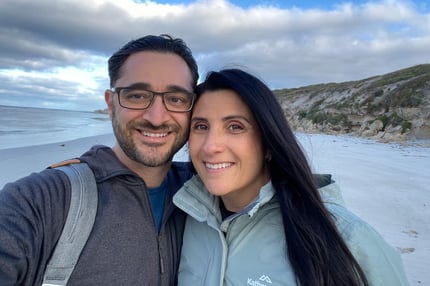
On the same day Pegah Kamal-Bugeja learnt she had miscarried, a good friend and colleague pulled her aside to gently tell her that his partner was pregnant.
He wanted to give her a heads-up before the team-wide announcement. He didn't know Pegah had miscarried, but he knew she had been trying for years.
She smiled. She congratulated him and was genuinely happy for him. But on the inside, Pegah was screaming — because once again, it was someone else, not her, who got to make a pregnancy announcement.
Pegah, now 46, always knew she wanted to be a mum.
Despite being an only child, she grew up with a big family of aunties, uncles and cousins. Dining rooms filled to the brim with family, food and laughter have always been the norm for Pegah and adding her own children to that mix is something she always assumed was inevitable.
"I've always had family around me and I think I've always wanted that," Pegah told Mamamia.
She met her partner Stephen Bugeja, relocated from America to Australia to be with him, and they got married. For them, the logical next step was to start a family.
She never expected doing so would be quite as challenging as it has been.
"When you are inherently given those parts, and you have a partner and you want to embark on that journey, you naturally think, 'we should be able to have this very easily,'" Pegah said.
But it hasn't been easy. After 13 IVF cycles and tens of thousands of dollars spent on medical bills, Pegah and Stephen are still trying to welcome their first child into the world.
The cost, they've learnt, is astounding. Not just financially but physically and emotionally.
Well hosts discuss when to seek help for fertility concerns. Post continues below.

Pegah and Stephen started their IVF journey while COVID-19 restrictions were still in place. It meant Pegah went to a lot of her early appointments alone, while Stephen waited in the car.
Of the 13 cycles they've been through, only one resulted in a pregnancy.
At five weeks, Pegah suffered a miscarriage.
Each cycle since has involved more hormonal injections, more surgeries, more hope and, ultimately, more grief.
"Typically you're going through about two to three weeks of injections and then your prep, so you're getting all the hormones that come with it, the emotions that come with it," Pegah told Mamamia.
"You're up and down, you're crying one minute, laughing another, you're upset — all the emojis you can think of that come up as part of that experience — and you're trying to cope. You're trying to manage through that."
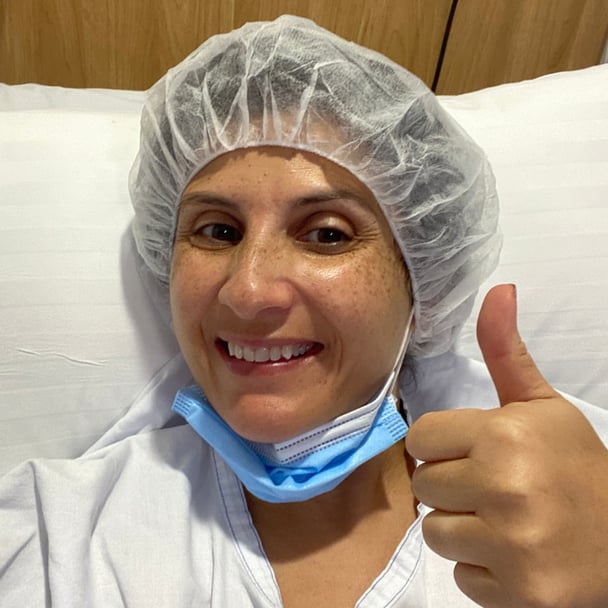
Each unsuccessful cycle has introduced a new layer of grief.
"You're dealing with a constant sense of loss," Pegah said. "You may not have known the human being, for lack of a better word…. It's an embryo regardless. It's still a part of you."
While she and her husband went to appointment after appointment, it felt as though everyone around her was having no trouble in the baby-making department. Pregnancy announcements flooded social media. Colleagues shared their happy news.
Her excitement for that colleague who pulled her aside was real — but so was the disappointment that her own moment hadn't yet arrived.
"You feel like there must be something in the water, and you're drinking the wrong water," she said.
The emotional toll is only part of the battle. There are also the logistics — which Pegah is grateful to Stephen for helping to manage — and the finances.
Listen: Claire Murphy and Dr Mariam take us on a lifetime hormonal tour. Post continues below.
Pegah is grateful to receive financial IVF support in Australia. She knows she wouldn't have made it this far had she still been living in the United States.
"Medicare does a great job. If we were in the US, no way in hell would we have made it through 14 cycles. No way. I mean it's almost triple the cost there," she said.
"We're so blessed to be here in Australia and the benefits in the Medicare system here."
But despite that assistance, the cost has still piled up. Pegah and Stephen have spent tens of thousands of dollars throughout the past five years and are looking towards more as they prepare for a 14th round.
What has made an unexpected difference is the support she's received at work. Pegah's experience has helped inform broader change at her workplace ServiceNow, where she is the APAC Social Media and Thought Leadership lead.
The company has introduced family planning benefits that include around $45,000 in assistance for those seeking IVF treatment, along with a comprehensive family-building program giving all employees access to emotional support, pre-conception coaching, reproductive health resources and financial assistance — the kind of wrap-around support she knows not everyone is lucky to receive.
The support from her colleagues has made the grief a little lighter to carry. Pegah says her manager and her team have become an "extended part of [her] family".
From her very first day, her manager made it clear that her health and wellbeing was the priority. Small changes made a big difference — from installing sharps disposal bins in the office for her injections, to renaming the "mother's room" to a "wellness room", ensuring the space felt welcoming to those not yet mothers.
But not everyone has been as supportive. Pegah says she has faced judgement and unsolicited opinions from people around her as she and her husband continue to try for their child.
Pegah stresses that it is important to do "what is right for you, not what others think is right for you because everybody has an opinion".
"They'll say, 'Oh you should do this and it's like hold on you don't know my situation'," Pegah said.
"It's a very personal journey," she added.
Pegah is now preparing for her 14th IVF cycle. She is hopeful. But she also knows she may need to start considering other paths to bring her much-wanted child into the world.
Whatever that looks like, she knows she has the strength to get through it. Going through 13 — soon 14 — IVF cycles has taught her "how resilient of a human being" she is.
And while it may not pan out the way she expected when she was younger, Pegah is certain she will have the family she always dreamed of, one way or another.
"I'm excited right now because there's hope," she told Mamamia.
"I always tell myself one way or another we will have a family, whatever that looks like."
Feature image: Supplied.
Win a $1000 voucher!
We want to ask you a few questions about multivitamins. Complete our 3 minute survey for a chance to win a gift voucher in our quarterly draw!
Take survey →Gabrielle Oehlmann
Author
No Comments
Be the first to leave a comment