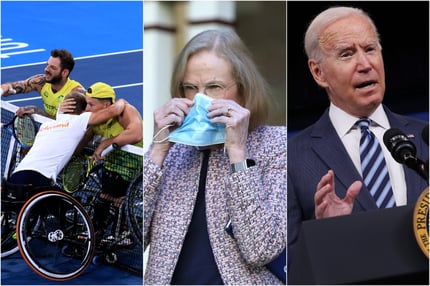
Govt steps up to reward Para medallists.
Top Australian Paralympian Dylan Alcott has hailed the federal government's major funding boost as a win for people power.
Australia's 2021 Paralympic medallists will receive the same financial reward as their Olympic counterparts, thanks to the federal government's support.
Prime Minister Scott Morrison announced in parliament on Thursday that the government would guarantee $20,000 for every Australian gold medal at the Tokyo Games, plus $15,000 per silver and $10,000 for each bronze.
The Australian Olympic Committee provided the same incentives for Tokyo Olympics medallists.
But Paralympics Australia said it lacked the financial resources to match the Olympic reward program.
"How cool is this news. It's because of all of you backing the Paralympic Games and making some noise to make this change happen," Alcott tweeted.
"We appreciate the support of the Australian public so much, and hope the last week has put some smiles on some faces back home!"
How cool is this news. It’s because of all of you backing the Paralympic Games and making some noise to make this change happen. We appreciate the support of the Australian public so much, and hope the last week has put some smiles on some faces back home! https://t.co/1jhMR3Us61
— Dylan Alcott (@DylanAlcott)
The government added it will work with Paralympics Australia and other sporting bodies to increase corporate backing for para-sports.
Paralympics Australia hailed the funding announcement as a landmark move towards equity in sport.
"We have fought so hard for equity in funding for our para-athletes and the Government, along with Sport Australia and the Australian Institute of Sport, have been great supporters of this along the way," said Paralympics Australia chief executive Lynne Anderson.
The Paralympics end on Sunday and Australia is eighth on the medal table with 17 gold, 23 silver and 26 bronze.
Family causes scare in QLD as premier scolded for "scaremongering."
A family at the centre of a coronavirus scare on the Gold Coast has tested negative to the virus, a school principal has told parents in a letter.
The family was ordered into hotel quarantine, with some of them unwell after reportedly returning from Melbourne without quarantining.
The only reason they were discovered was because the children told their classmates of their travels. They entered the state undetected via an inland route.
QLD Health Minister says a family of five illegally travelled from Queensland to Victoria "through back roads" and have refused to get tested. Their children attend the Australian International Islamic College on the Gold Coast, which has been shut down. #Covid19Qld @SBSNews
— Naveen Razik (@naveenjrazik)
Separately the Queensland government reported a new locally acquired case of COVID-19, a truck driver who is now in NSW.
Premier Annastacia Palaszczuk said the driver, who lives at Windaroo, returned a positive result amongst 10,433 virus tests in the 24 hours to 6.30am on Thursday.
The 46-year-old man was infectious in the community in Logan and the northern Gold Coast between August 28 and September 1.
He is the second truck driver to test positive in as many days.
Palaszczuk, meanwhile, has been called out for "scaremongering" over her claims that reopening her state would make "every child under 12 vulnerable."
Queensland's @AnnastaciaMP is still convinced there’s a big risk to millions of unvaccinated Aussie kid, withdrawing support from the national reopening plan. #TheProjectTV pic.twitter.com/eMv9P4pLWE
— The Project (@theprojecttv)
A stream of senior federal cabinet ministers tore into the Queensland leader with LNP Senator Amanda Stoker telling theABC Radio,"No where in the world is there a vaccine that's approved for under 12s, nowhere. She's set a goalpost that can be met by no one.
"If the premier had a good look at the Doherty modelling she would have seen that the potential for risks to children was considered and found to be extremely low."
Delta cases rise in Victoria as state abandons COVID-zero.
Victoria has turned its back on COVID zero in favour of vaccinations, with tough restrictions to stay until at least 70 per cent of eligible Victorians are fully inoculated.
There is some reprieve from Friday, including the reopening of playgrounds for children aged 12 and under, with certain rules such as QR code check-ins and masks for their one permitted supervisor.
Of the 176 new cases on Thursday, 67 were located in the northern suburbs of Melbourne, 61 in the west, 22 in the east and south, and 13 in the regional town of Shepparton.
The number of mystery cases of COVID-19 in Victoria is on the rise. Most are in Melbourne’s inner north and west, writes @CraigDButt. #lockdown #coronavirus https://t.co/9Jwn3uPYOM
— The Age (@theage)
"This virus is here, right now, and it is spreading fast," Acting Chief Health Officer Ben Cowie told reporters.
"The increasing case numbers are a herald of what our health system is going to be faced with in the coming weeks and months."
More than 3000 people were swabbed as part of day 13 testing in Shepparton on Thursday, which could further lift case numbers on Friday.
Health Minister Martin Foley said Burnet Institute research had suggested the state's lockdown had avoided a further 6000 cases in the past month, but now was the time to pivot.
"You've got to follow the advice of the science. Delta has changed the script," he said.
To aid Victoria's quest to ramp up vaccinations, the interval between doses of the AstraZeneca COVID-19 vaccine has been halved to six weeks.
In an attempt to get more Victorians double-dosed with a vaccine, the state government is halving the interval for AstraZeneca jabs from 12 to 6 weeks. @maddieslattery #9News pic.twitter.com/mQLwPFLLsZ
— 9News Australia (@9NewsAUS)
The move, effective immediately, makes the wait time between AstraZeneca doses the same as for Pfizer and will help the state reach its 80 per cent double dose target faster.
While clinical trials have shown AstraZeneca is most effective with a 12-week second dose interval, Prof Cowie said the state needed to strike a balance between long-term efficacy and increasing protection against the Delta variant.
Western Sydney COVID restrictions eased.
Residents of Sydney's coronavirus hotspots are now allowed to exercise as much as they like outside of a curfew, after a one-hour limit was lifted.
People living in the NSW local government areas of concern must still be at home by 9pm and cannot start going for jogs or walks before 5am.
Restrictions limiting exercise to one hour in Sydney’s 12 hotspot local government areas have now been scrapped. #9Today pic.twitter.com/pNg6zDzqfM
— The Today Show (@TheTodayShow)
Premier Gladys Berejiklian announced the easing of the exercise restriction on Thursday, the same day the state reached 70 per cent single-dose vaccination coverage of people aged 16 and over.
More than seven million jabs have been administered in NSW.
The milestone all but guarantees NSW will soon reach double-dose vaccination for 70 per cent of the population, triggering a wider easing of restrictions.
Some 38.68 per cent of NSW residents are already fully vaccinated.
Tasmania is continuing to speed up the first dose vax pace, while NSW has plateaued pic.twitter.com/QiQ7gNpWx6
— casey briggs (@CaseyBriggs)
The state reported 1288 new locally acquired COVID-19 cases in the 24 hours to 8pm on Wednesday - a new daily record.
Seven more people died, including two who acquired their infections while in hospital.
Ms Berejiklian said on Thursday opening up would mean more people could die, but Australia had to "sensibly transiti
Gemma Bath
True Crime Conversations host
No Comments
Be the first to leave a comment