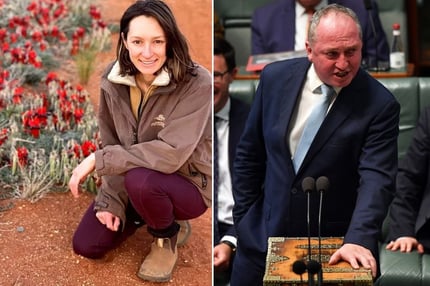
In times of drought, Anika Molesworth can walk along the tree-line of her sheep station in far west New South Wales to an eerie silence.
There's usually birds. But when the water dries up, so does life.
There are plenty of skeletons though; an awful reminder of what global warming can and is doing to our planet.
Anika, a farmer and scientist based in Broken Hill, knows intimately what doing nothing about climate change means. She's seen it. She's studied it. She is fighting to change it.
So is everyone she surrounds herself with in the rural farming and agriculture industries. They're desperate for action on climate. In fact, they're not waiting for politicians, they're pushing forward with change themselves.
If you're a city dweller, this might be news to you. Because if you glanced across the headlines this week you would've seen a lot of shouting from the federal National Party about how they're being held "hostage" on climate, and how they're "fighting for jobs and industry in regional areas."
Watch: Labor is not confident the Morrison government and the Nationals will strike a deal that means anything. Post continues after video.
The Federal Government is trying to commit Australia to 2050 net zero targets ahead of climate talks in Glasgow next week. At the moment, it's the Nats that are holding them back.
At the heart of the Nationals' concerns is the impact of deeper emissions cuts on rural and regional jobs and industry, especially mining and farming. They are adamant the coal industry must be allowed to continue well into the 2050s. It's this statement in particular that Anika finds incredulous.
"It's not going to happen," she toldMamamia."The way the world is going you've got to have your head fairly deep in the sand to think that's actually going to be happening - that there are going to be people buying our coal still. And I think it's incredibly dangerous to be putting that forward as a statement when the most vulnerable and exposed people to the impacts of climate change, are those living in rural communities.
"To actually put them into a position saying, 'Oh, yeah, you know, your industry will be fine, long into the future, you'll have that stable job...' When it's actually not going to be that way. It's putting them in a pathway of danger and putting them in a pathway of failure."
The rural communities Anika frequent know this. She says when you look across Australian society, it's actually the farmers and the agricultural sector that are some of the most progressive in this space asking for strong emissions reduction, and actually putting it upon themselves to step up and do something about it.
The National Farmers Federation have already backed the net zero target. So has the Minerals Council.
Farmers For Climate Action want emission reductions to be hit by 2030, and the meat and livestock industry has already enforced their own targets of net zero for that earlier date.
"There is a very obvious gap between our climate ambition in the farming sector and rural communities and what we want to see in terms of climate action... and where the federal Nats are standing, and what they're doing to delay serious climate action," Anika toldMamamia.
"Farmers look out the front door, and they can see climate change in action. Drought, floods, bushfires, extreme temperature; they're not an abstract concept [for us]. These have a very real impact, which are hurting farmers today."
According to a 2021 Australian Bureau of Agricultural and Resource Economics and Sciences report, the average Australian farm is losing $30,000 a year thanks to climate change. They simply can't afford to wait for the government to stop dragging their feet.
Research is underway to look at reducing emissions from livestock through selective breeding and feed supplements, farmers are planting trees to increase biodiversity and they're looking at drawing carbon down and putting it back into the soil. In their world - it's all systems go.
But as Anika explains, "the rate and the magnitude of climate change is actually beyond farm scale. And that's why we actually need national and global leadership on this. The greatest driver of climate change is the burning of fossil fuels, so we absolutely need to be dealing with how we're producing energy as a major way out of this mess."
As the 33-year-old points out, Australia is one of the sunniest and windiest continents on earth, and we could not just be powering our own country with renewable energy, we could be a superpower in this space - exporting renewable energies around the world.
"And that, obviously, injects growth into rural communities. Because that's where these rene

Sign up to Mamamia Daily
Sent daily
Gemma Bath
True Crime Conversations host
No Comments
Be the first to leave a comment