If you want to support independent women's media, become a Mamamia subscriber . Get an all-access pass to everything we make, including exclusive podcasts, articles, videos and our exercise app, MOVE.
No one warns you about the mean girls of menopause.
You hear about the hot flushes, the insomnia, the creeping sense that your body has quietly rewritten its instruction manual overnight.
You're told about the brain fog, the weight that settles around your middle like an unwanted house guest and the unexpected tears that make you wonder if you're going through puberty all over again.
But almost no one talks about what can happen to female friendships in midlife.
Watch: A GP breaks down how Western culture has medicalised menopause, but other cultures see it as a powerful transition phase. Post continues below.

By the time most women reach their late forties and fifties, we imagine we've left the social hierarchies of adolescence far behind.
We believe we've evolved beyond playground politics and whispered alliances. After all, we're adults now — mothers, professionals, partners, carers, community members.
Surely, we've outgrown the dynamics of the schoolyard.
And yet, sometimes, the mean girls return. Only this time they're wearing linen blazers and diamonds, discussing weight loss, adult children and health complaints.
Menopause is a strange crossroads. It's not just a biological shift, it's a life-stage upheaval. Careers plateau or pivot. Children grow up and leave home. Marriages change shape. Parents age and require care. Bodies alter in ways we didn't consent to.
And alongside all of that, friendships — the very relationships we once relied on for solidarity — can suddenly become complicated.
I've been watching it happen. And if I'm honest, I've experienced it too. I'd like to say I've never done it myself — but that wouldn't be entirely true.
There's something about this stage of life that seems to change or even sharpen certain personalities. Perhaps it's hormonal volatility. Perhaps it's accumulated resentment from decades of juggling work, family and emotional labour.
Perhaps it's the uncomfortable realisation that youth, that very currency as women we have been told to trade on, is slipping quietly away.
Whatever the cause, some women respond with extraordinary generosity and wisdom. They become mentors, cheerleaders, truth-tellers.
They laugh more easily and care less about impressing anyone.
Others… well, they seem to become competitive.
The comments are subtle, but unmistakable.
"Oh, you're wearing that again? You're brave."
"Gosh, I wish I had time to write a book."
"Must be nice not having to worry about money."
"I didn't ask you because you're always working.''
"She brings me down. I can't be bothered with her issues.''
These are certainly not the overt cruelties of teenage bullying. They're more refined. Delivered with a smile. Wrapped in faux concern. Often followed by a quick change of subject.
If you call them out, you risk looking oversensitive.
If you ignore them, they accumulate like tiny paper cuts.
Midlife also seems to trigger a strange comparison culture among women who once felt like allies. Whose children are doing better. Whose partner is more attentive.
Whose career is still flourishing. Who looks "younger." Who has "let themselves go."
Social media only amplifies it.
It can feel like everyone else is thriving, and you're the only one quietly grappling with hormonal chaos and pragmatic questions about the second half of your life.
There's another layer too: invisibility.
For decades, many women have been conditioned to compete for attention: in workplaces, in relationships, even in friendship groups. When society begins to make women over fifty less visible, some respond by lifting each other up.
Others, consciously or not, start clawing for the spotlight.
The result can be a curious form of social aggression that psychologists sometimes call relational bullying. Instead of direct confrontation, it manifests through exclusion, gossip, subtle humiliation or the quiet reshaping of group dynamics.
The lunch or dinner invitation that somehow doesn't reach you.
I had a moment like that recently that made something quietly click.
A week before travelling interstate to visit my sons, I caught up with a longtime friend. She mentioned she was about to head away on holiday and said, quite casually, "Sorry I won't get to see you again before I go away."
It sounded perfectly reasonable.
Life is busy. People travel. Plans shift.
A week later, flying home from my trip, I found myself seated next to a woman I vaguely recognised. After a few minutes of polite conversation, we realised we had met months earlier at a large gathering hosted by that mutual friend.
We chatted about work and travel until the captain announced we were beginning our descent.
Then she said, brightly, "Well, I suppose I'll see you tonight at Chris and Ben's for their going-away drinks?"
I blinked.
"I'm sorry — where?"
"At their place," she said. "Their drinks tonight before they leave."
I felt that strange hollow pause that comes when your brain is trying to catch up with a conversation.
"No. I won't be there. I haven't been invited," I said.
She looked slightly embarrassed. "Oh. I just assumed…" Of course she had. Because once, I would have been.
And somewhere over the clouds on that flight home it dawned on me that I was no longer really part of the inner circle.
In truth, I probably hadn't been for quite some time. I had been benched. I was in the B or even the C team now.
Psychologists say these shifts aren't unusual. Clinical psychologist Dr Bella Ingram from the University of Wollongong says loneliness often appears during major identity transitions such as career changes, menopause, children leaving home or caring for ageing parents.
Research from the University of Melbourne also shows how important friendships become as we grow older. Psychologist Dr Christina Bryant says strong social connections can reduce depression and loneliness while improving wellbeing in later life.
When those connections fracture, the emotional impact can feel sharper than many women expect.
Menopausal 'mean girls' – it's a thing. Midlife, it seems, is also a kind of social sorting process.
The friendships that survive menopause tend to be the real ones — the women who have seen you exhausted, grieving, angry, hopeful and imperfect and stayed anyway.
They're the friends who say things like:
"You look tired. Come over and I'll make tea."
"I loved that article you wrote."
"I'm really pleased your son/daughter is doing so well.''
"I'm having a terrible week — can we go for a walk?"
These women don't need to compete with you because they're busy building their own lives. They don't need to be the funniest, the most sparkly, the most interesting or uncomplicated, or the most youthful woman in the room.
Menopause, in a strange way, can become a social detox. The hormonal fog lifts and clarity returns. You start noticing who leaves you feeling energised and who leaves you feeling diminished.
And suddenly, you care a lot less about pleasing everyone or looking for scraps.
Listen: In this episode, Mia and Amelia unpack the complicated art of female friendships. Post continues below.
One of the quiet gifts of this stage of life is perspective. You've lived long enough to recognise that friendship isn't meant to feel like an audition.
It shouldn't require constant self-editing or careful navigation of someone else's insecurities.
Real friendship feels expansive.
You can be messy. Honest. Occasionally grumpy. Occasionally triumphant. And no one keeps score.
Of course, menopause itself deserves compassion. It's a neurological and hormonal roller-coaster that affects mood, sleep and emotional regulation. Many women are navigating it without adequate medical support or cultural understanding.
Sometimes what looks like meanness is actually exhaustion.
But cruelty and unkindness, however subtle, doesn't become acceptable simply because we're older.
If anything, midlife should be when we become kinder to one another.
We've all carried enough.
The best response to menopausal 'mean girls' isn't confrontation or retaliation. It's quiet discernment.
Spend time with the women who clap when you succeed.
The women who tell the truth without trying to wound.
The women who can laugh at the absurdity of these physical and mental transitions.
Because those friendships, the generous ones, are the real antidote to midlife loneliness.
And the truth is, menopause doesn't have to turn us into mean girls.
It can turn us into something much better.
Women who finally understand that the most radical thing we can do at this stage of life is not compete with each other.
But stand side by side.
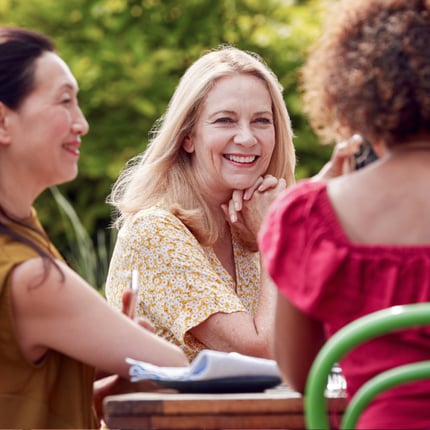
Feature Image: Getty.
Win a $1000 voucher!
Do you love trying new skincare products? Complete our survey for a chance to win a voucher in our quarterly draw!
Take survey →Anonymous
Author
No Comments
Be the first to leave a comment