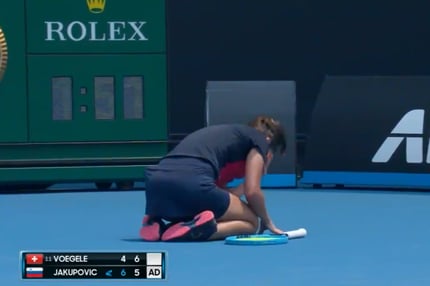
– With AAP.
1. How the world is reacting to the Australian Open’s hazardous smoke.
On Tuesday, the Australian Open qualifiers went ahead despite the poor air quality in Melbourne from the bushfire smoke.
The athletes struggled to breathe on court and Slovenia’s Dalila Jakupovic feared she would pass out, saying the smoky conditions were the worst she’s experienced.
Despite being one set up, the world no.180 was forced to retire mid-match at Melbourne Park on Tuesday due to the hazardous smoke lingering from bushfires in Victoria’s east.
“I was really scared that I would collapse. That’s why I went onto the floor because I couldn’t walk anymore,” Jakupovic said after dropping to her knees with a coughing fit.
“I don’t have asthma and never had breathing problems. I actually like heat.
“The physio came again and I thought it would be better. But the points were a bit longer and I just couldn’t breathe anymore and I just fell on the floor.”
Watch: Ben Lawson’s viral bushfires poem. Post continues after video.
An angry Jakupovic said it was “not fair” that officials asked players to take the court in those conditions.
“It’s not healthy for us. I was surprised, I thought we would not be playing today but we don’t have much choice,” she said.
The smoky scenes caused outrage from those on social media, and made worldwide news.
There are going to be good days and bad days with the air #AusOpen as the wind changes direction.
This was clearly a bad day, and they almost certainly should not have played.
Beyond players coughing or struggling to breathe in the moment, who knows what long term effects are?
— Ben Rothenberg (@BenRothenberg) January 14, 2020
I’m going to speculate that if this were a high-profile player, #AusOpen committee would have (probably) suspended play in its aftermath, called an emergency meeting, etc… etc… etc… https://t.co/EsYfDveo5c
— Mert Ertunga (@MertovsTDesk) January 14, 2020
Would never have started the top players in this soup would they?
— Daniel Brettig (@danbrettig) January 14, 2020
Oh my god,this is awful ???????? https://t.co/KfYoJzuXL8
— Katie Boulter (@KatieBoulter1) January 14, 2020
Shocked to see that qualifying matches have started @AustralianOpen What about the health of all the people that have to work out there, especially the ballkids? #wherearethelimits? pic.twitter.com/2oldEptT2g
— mandy minella (@mandyminella) January 14, 2020
Health authorities expect the air quality to bounce between the “very poor to hazardous range” until at least Wednesday night.
Tennis Australia says it will work with their medical team, the Bureau of Meterology and Environment Protection Authority Victoria scientists when making decisions about whether it’s safe to play.
“This is a new experience for all of us in how we manage air quality, so we have to listen to the experts,” TA boss Craig Tiley said earlier on Tuesday.
“We have installed measuring devices on-site for air quality.”
TA chief operating officer Tom Larner said any smoke stoppages would be treated in the same way as an extreme heat or rain delay.
“We will stop if conditions become unsafe based on medical advice,” he said.
Novak Djokovic spoke out about the situation last week, saying organisers will be forced to create new rules to deal with smoke.
2. Claremont victim Jane Rimmer’s hair has been ‘gifted’ to her grieving family.
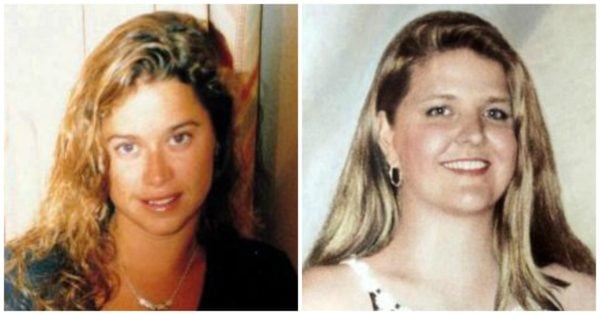
Ciara Glennon and Jane Rimmer are victims of the Claremont serial killings. Images: Western Australia Police.
A lock of hair was taken from Jane Rimmer during her first post mortem to give to her grieving family, the Claremont serial killings trial has heard, as police witnesses continue to be questioned over their handling of evidence.
DNA and fibre evidence is a crucial part of the prosecution's case against Bradley Robert Edwards, who denies murdering the 23-year-old Ms Rimmer, Sarah Spiers, 18, and Ciara Glennon, 27, in 1996 and 1997.
The defence argues evidence may have been contaminated.
On Tuesday, police involved in recovering Ms Rimmer's body from bushland and the two post mortems that followed were quizzed in detail in the Western Australia Supreme Court.
Former homicide squad detective Vicky Young testified she attended them all and performed the role of continuity, taking note of the proceedings from a short distance.
At the Wellard site where Ms Rimmer was found naked and partially covered with vegetation 55 days after she vanished, only one or two forensic officers and forensic pathologist Karin Margolius took a few steps off an unsealed road to examine the scene, Ms Young said.
She was emphatic when questioned by defence counsel during cross examination, insisting she did not enter the crime scene.
"I most definitely at no time entered that bush," Ms Young said.
She said she also kept her distance at the mortuary, abiding protocol to not step over a yellow line in the theatre room unless invited to do so, and wearing hospital scrubs and wellington boots to prevent contamination.
Ms Young said Dr Margolius handed her a clump of Ms Rimmer's hair, which she took home, shampooed, wrapped with an elastic band and place in a gift box to give to the childcare worker's family "out of an act of kindness and compassion".
Defence counsel did not ask about the lock of hair.
Ms Young also gave grim testimony about Ms Rimmer's substantially decomposed body, which was missing flesh in the neck area. Some digits were also missing due to animal predation.
The dental records of Ms Spiers, whose body has never been found, were on file and accessed that night but Ms Rimmer's dentist could not be reached.
She was confirmed as the victim the following day.
"We had two families on hold that night waiting to know if their daughter had been found," Ms Young said.
The trial also heard from former sergeant Barry Mott, who said there was no written protocol at the time about personal protective equipment, but he wore disposable forensic overalls and gloves at the Wellard scene.
He admitted he may have inadvertently brushed against the body while photographing the site.
Sergeant Mark Harbridge said he held up a light and did not wear gloves but did not touch Ms Rimmer.
He said he wore gloves, a mask and overalls during Ms Rimmer's post mortems, but said he did not get closer than 40cm to her.
Former detective Robert Kays did line searches around the crime scene and said in his 23 years of policing he never had reason to touch a body.
3. A New Zealand MP has called for politics to be taken out of climate policy.
The inconsistent nature of Australian climate policy cannot be fully explained by looking at which political party was in government at the time. A collection of moments over the last decade will offer insight into how we lack the leadership needed to cap our carbon emissions. pic.twitter.com/EpVXIyi22M
— The Project (@theprojecttv) January 12, 2020
A New Zealand MP has urged Australia to reintroduce a climate change commission to remove politics from the debate.
The Gillard Labor government set up an independent climate commission in 2011 but it was abolished two years later by Liberal successor Tony Abbott.
Last November, New Zealand Prime Minister Jacinda Ardern followed Julia Gillard's lead and introduced an independent Climate Change Commission to steer government policy.
Barbara Kuriger, who is leading the New Zealand delegation at the Asia Pacific Parliamentary Forum in Canberra, talked up the idea when quizzed by reporters on Tuesday.
"In New Zealand we've just set up a climate commission so we're taking it out of the political house of parliament," the NZ Nationals MP said.
"We have a group of qualified people who can bring in the science and work out what we need to do next and by doing that we're going to get some more objectivity on it.
"Let's just give it to a group who can have a look at the science and go for what is the most effective."
She said it was not effective for climate policy to change when governments rise and fall.
"We live on a three-year parliamentary cycle and so whenever the government changes we don't actually need our climate change policies to be changing because it's a long-term thing," she said.
"We needed a 30-year program ahead of us instead of a three-year program."
Prime Minister Scott Morrison said the government was delivering on climate action, overseeing record investment in renewable energy, and would meet its emission reduction targets.
"Australia has been carrying its weight and effectively overperforming in comparison to many other similar countries," he told reporters in Canberra.
Solomon Islands deputy opposition leader Peter Kenilorea Jr, who is also attending the Canberra forum, called on more leadership from Australia on the climate crisis.
"In the Pacific islands climate change is an existential threat for us," Mr Kenilorea said.
He said his nation was on the "frontline of climate change".
"We believe the science is clear that there is climate change occurring and it's human-induced. We see that in our communities every day," he said.
"We feel Australia has a strong voice globally and many of us in the Pacific see Australia as a big brother so we would like to see some leadership from our big brother on this particular issue."
4. Australians have been caught up in a Philippines volcano eruption.
Philippines' Taal volcano eruption spews lava and coats Manila with ash https://t.co/acHx0Lo7oE pic.twitter.com/W7JFF385hT
— TIME (@TIME) January 13, 2020
An Australian caught up in a Philippines volcano eruption has described the experience as "surreal" after ash clouds engulfed the town he was visiting.
Brisbane deputy principal Liam Beatty was returning from his cousin's wedding in Lipa City on Sunday when Taal volcano erupted for the first time since 1977.
The volcano began spewing ash and steam and 45,000 people were evacuated from surrounding areas, while officials say 200,000 more residents could be forced to flee if the eruption worsens.
Mr Beatty is staying with family in Tanuan - parts of which have been evacuated - just 14km from the volcano and 66km south of Manila.
"The clouds got bigger and darker as it grew and you could hear thunder and see lightning coming from within the volcano itself," Mr Beatty said.
"It looks like massive storm clouds forming which then gradually take over the whole sky. Then the ash came down - it became black even though it was still afternoon.
"The only thing I can compare it to is snowfall. It's not hot and doesn't hurt or anything but you can feel it."
Roads, houses, vehicles, trees and other infrastructure were covered in ash that transformed into sludge following rainfall.
At least 144 volcanic earthquakes have been recorded since Sunday, with 44 of the tremors felt at various intensities.
"I woke up around 3:30am and felt them go through. There was nothing falling off the shelves but tables were shaking enough to know it was an earthquake," Mr Beatty said.
"It's been pretty surreal being here, it's a similar feeling to the eeriness around to
Billi FitzSimons
News Writer
No Comments
Be the first to leave a comment