Maria Sharapova was just 18 when she was first dubbed world tennis number one.
In February 2020, she called time on her career after reaching that title five times, winning five Grand Slams, 36 titles, and being named the highest-paid female athlete in the world for 11 consecutive years.
Aged 33, Sharapova said it’s time to say goodbye to the sport that "showed me the world," telling Vanity Fair she is ready to "scale another mountain, to compete on a different type of terrain."
But the tennis great’s career hasn’t just been about trophies and titles – long dubbed the "ice queen" by the world’s media – a drug scandal in 2016 saw the Russian champion’s career buckle, and since then she’s struggled to reach the same dizzying heights she once dominated.
Watch: Maria Sharapova on the loneliness of sport. Post continues below
A "lonely" childhood.
Four-year-old Maria Sharapova loved to play tennis.
Born in Russia in 1987, Maria and her father Yuri fled a tumultuous post-Soviet Russia for Florida after her parents were told of her potential in the sport, and were recommended she train abroad.
With just AUD$1,000 in his pocket, Maria and her father moved countries, leaving her mother behind. She wasn’t able to join them for more than two years because of visa restrictions.
Aged nine Maria got a scholarship to train at the Nick Bollettieri Tennis Academy, but despite her natural skill, Maria grew up physically awkward – hanging from any beam she could find to try to make herself grow.
In her memoir she ponders if her height is down to the Chernobyl nuclear disaster: her mother was pregnant with her soon after, and "continued to drink the water and eat the vegetables," she writes.
Being separated from her mum took a toll.
"I used to be so lonely. I missed my mother terribly. My father was working as much as he could so he couldn’t see me either," Sharapova recalled in her memoir Unstoppable: My life so far.
Living and training with other kids was also tough. In her book, she talks of falling asleep much earlier than the other kids who were older than her, who, when they entered the room hours later, would wake her up and order her to clean up the space.
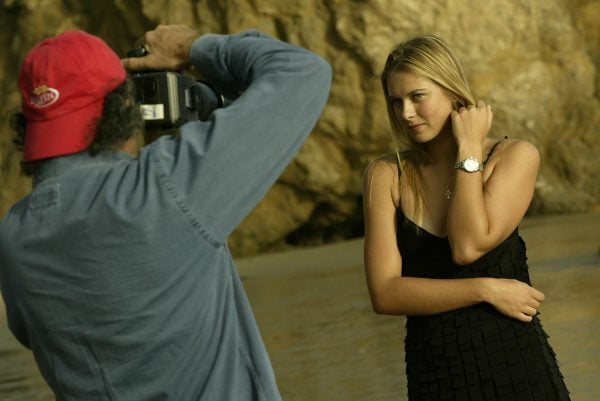
Growing up Maria Sharapova picked up many endorsements. Here she's modelling for a TAG Heuer watch ad on a Malibu Beach. Image: Anne Cusack/Los Angeles Times via Getty.Images.
"I learned how to take care of myself. I never thought about quitting because I knew what I wanted. When you come from nothing and you have nothing, it makes you very hungry and determined. I would have put up with much more humiliation and insults than that in order to steadfastly pursue my dream," she wrote.
Dizzying career heights.
Maria turned professional on her 14th birthday, becoming the first Russian woman to ascend to the top of the tennis rankings.
She became a global star in 2004, when she won Wimbledon aged 17, upsetting top-seeded Serena Williams.
In Vanity Fair in February 2020, Maria wrote: "I didn’t understand the magnitude of my victory until I was older — and I’m glad I didn’t," explaining that her edge in the sport was never feeling like she was superior to other players.
"It was about feeling like I was on the verge of falling off a cliff — which is why I constantly returned to the court to figure out how to keep climbing."
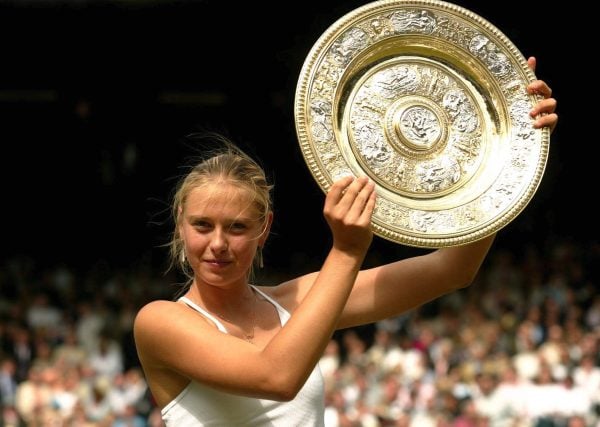
17-year-old Maria winning Wimbledon. Image. Photo by Bongarts/Bongarts/Getty Images.
She won the US Open the following year, catapulting her to world number one aged 18.
Her career went from strength to strength — she won 36 tour singles titles, an Olympic silver medal, and spent 21 weeks as world number one.
According to Forbes,she was the world's highest-earning female athlete for 11 consecutive years, earning the majority of her income from endorsements with companies like Nike and Evian.
In February 2020, Maria announced her retirement from the sport, having barely played in 2019 due to shoulder injuries.
"Tennis — I’m saying goodbye," she wrote on Instagram, and in her exclusive feature story inVanity Fair.
Her sporting colleagues are hailing her a "legend" of the sport, with Novak Djokovic telling media in Dubai she has the "mind of a champion."
"Her impact on the sport, not just women's tennis, but tennis in general, was great. It still is great," he said.
Fellow tennis star and Wimbledon champion, Petra Kvitova, wrote on Twitter: "It was a pleasure to share the court with you @MariaSharapova. We always had great battles when we played and I have so much respect for your hard work and the way you always fight for everything."
It was a pleasure to share the court with you @MariaSharapova
We always had great battles when we played and I have so much respect for your hard work and the way you always fight for everything.
You have achieved a lot in your life so far and I know this is just the start ???? pic.twitter.com/PLi1Od4Eru
— Petra Kvitova (@Petra_Kvitova) February 26, 2020
Doping, injury and feuds.
Maria has been dogged by injury since 2007 when her shoulder trouble first emerged. A second shoulder injury in 2008 kept her sidelined for the second half of the season, and she missed the US Open and Beijing Olympics. It would be an injury that would follow her until retirement.
In 2016, at the Australian Open, she tested positive to prohibited heart drug meldonium and was banned from the sport for 15 months.
At the time she had not realised that meldonium, which she said she had taken for health issues throughout her career, had been added to the World Anti-Doping Agency's banned list.
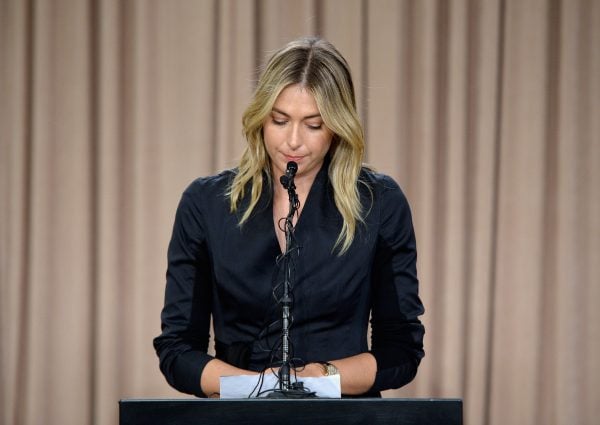
Tennis player Maria Sharapova addresses the media regarding a failed drug test at The LA Hotel Downtown on March 7, 2016 in Los Angeles, California. Image: Kevork Djansezian/Getty.
She returned to tennis in April 2017 after being handed some wildcards which drew criticism from other players, including Andy Murray and Eugenie Bouchard, who said she should not have been allowed to return.
In a BBC interview in 2017, Maria denied cheating, and said: "I don't think it's for them to really have an opinion, because they don't have the facts. So, you know, I think that those are the types of words that make headlines and they will be used as headlines.
"But ultimately, this is my career, and I faced it head on, and I admitted my mistake, and I went about it and I served my suspension and now I'm back."
She also drew criticism from the media throughout her career, being tarred with the nickname "ice queen" early on.
The Guardian’sKevin Mitchell wrote she "could freeze a room with her aloof grandeur" and "will be remembered as the ice queen of the sport, respected more than loved inside the game".
Tennis.com’sSteve Tignor described her career fall from grace as problematic, writing: "Instead of being remembered solely for her skill and her will, she leaves behind a cloudy, unresolved legacy, one that will likely always exist in the eye of the beholder."
Then there was the "feud", which also followed Maria throughout her career.
In her memoir, she mentions Serena Williams multiple times describing her as someone who has "marked the heights and the limits of my career — our stories are intertwined."
"It was Serena whom I beat in the Wimbledon final to emerge on the international stage at seventeen, and it’s Serena who’s given me the hardest time since," she added.
Serena dismissed the memoir's contents as "hearsay," adding that it was "a little disappointing".
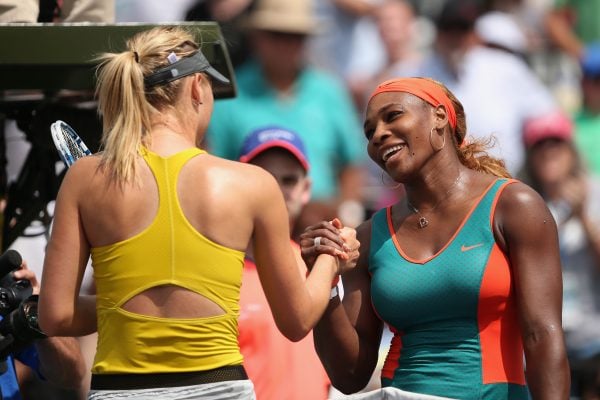
Maria says her career has "intertwined" with Serena's over the years. Image: Clive Brunskill/Getty.
Since her victory at the age of 17 and the rumour that Serena remarked: "I will never lose to that little b*tch again," afterwards in the locker room, the two tennis greats have been constantly compared.
Williams kept to her (rumoured) word, and by 2019 had beaten Maria Sharapova for the 19th straight time.
Word of a "feud" was fuelled by one of their infamous squabbles on the eve of Wimbledon 2013, when Serena told a press conference, "Maria starts every interview with: I'm happy or I'm lucky. It's a bore," to which Maria replied: "I have a great deal of respect for Serena and for what she managed to win. However, I think she should talk about her successes, rather than the whole rest," reported Tennis World USA.
"If she wants to talk about something personal, she could tell us about the relationship with a man who once divorced and who now also has a daughter. She could tell us this and not things that don't concern her," she continued.
Maria's retirement didn't come as a surprise to experts, with the former world number only playing two matches this year — losing in the first round of the Australian Open — sliding her ranking to 373.
From singers to tennis stars to Alexander.
As with any celebrity in the spotlight, Maria's dating life has always been tabloid fodder.
In 2008 she briefly dated lead singer ofMaroon 5Adam Levine, who she met at her 18th birthday
Gemma Bath
True Crime Conversations host
No Comments
Be the first to leave a comment