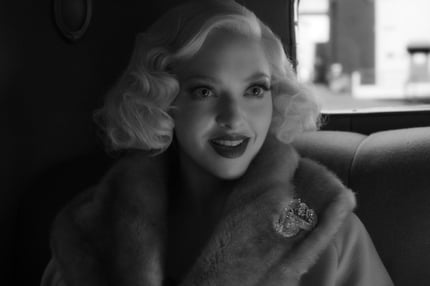
For many, Mank is seen as a love letter to classic Hollywood.
The film, whichhas been nominated for 10 Academy Awards, including Best Picture, Best Director, Best Actor, and Best Supporting Actress, follows screenwriter Herman J. Mankiewicz as he writes the screenplay forCitizen Kane.
ButMankisn't just a love letter to old Hollywood. In fact, it's much more personal than that.
Watch the trailer for Mank below. Post continues after video.
In the early 1990s, Jack Fincher wrote a script about the creation ofCitizen Kane.
Jack, a prominent journalist in the United States, consideredCitizen Kaneto be the best movie ever made. He was fascinated with the story behind the film, and he "loved to channel the greats" in his work.
Initially, Jack's son, director David Fincher, intended to make his father's movie after he completedThe Gamein 1997.
But with no studio keen on making a movie designed to be in black and white, the film never came to fruition.
Then, in 2003, Jack Fincher passed away.
In the years that followed, David Fincher continued his film career, directingZodiac, The Social Network, The Girl with the Dragon Tattoo,andGone Girl.
He also served as an executive producer and director on some of Netflix's biggest projects, includingHouse of CardsandMindhunter,which helped pavedthe way for the eventual creation of his father's passion project,Mank.
As Deadline put it: "[David] Fincher used the currency at Netflix to muscle throughMankand make it in black and white, exactly as Jack Fincher scripted it, a profound way to honour the memory of his father."
Listen to Mamamia's daily entertainment podcast, The Spill, below. Post continues after podcast.
In 2020, 17 years after his death, Jack Fincher got his first film credit asMankwas released in black and white on Netflix.
The true story behindMank.
Mankfollows the creation of the filmCitizen Kane.
Considered by many as one of the greatest films ever made,Citizen Kanewas produced and directed by Orson Welles, who co-wrote the screenplay with Herman J. Mankiewicz.
The 1941 film, which also starred Welles himself, followed the story of publishing mogul Charles Foster Kane, who was a fictionalised character based on several US media barons.
Following its release,Citizen Kanewas nominated for nine Academy Awards, with Mankiewicz and Welles winning the Academy Award for Best Writing (Original Screenplay).
But behind the success of the film,Citizen Kaneled to some of Hollywood's biggest controversies.
As detailed inMank,Welles, then just 24, was given complete creative freedom by RKO Pictures for his first film,Citizen Kane.For the project, Welles enlisted the help of screenwriter Herman J. Mankiewicz (or "Mank" as he preferred to be called), who is played by Gary Oldman in Netflix'sMank.
Mankiewicz was an exceptionally talented screenwriter. But he was also notorious in the industry for his gambling and alcohol addiction.
After working on screenplays for films includingThe Wizard of OzandMan of the World,Mankiewicz had became well involved in Hollywood's social circles.
As seen inMank,he had connections to newspaper tycoon William Randolph Hearst (played by Charles Dance inMank), and actress Marion Davies (played by Amanda Seyfried), who was Hearst's mistress.
It was these Hollywood connections that largely influenced the screenplay forCitizen Kane.After all,the film's lead character, Charles Foster Kane, was loosely based on Hearst himself after Mankiewicz fell out of favour with the newspaper publisher.
Mankiewicz's issues with Hearst later became a problem as the premiere date forCitizen Kanegrew closer.
At the time, Hearst, who was enraged about the main character in the film. banned his newspapers from referencingCitizen Kaneand even attempted to have the film shelved before it was released.
But Hearst wasn't the only figure causing drama in theCitizen Kanestory.
For decades, Orson Welles and Herman J. Mankiewicz's battle for screenplay credit onCitizen Kanehas sparked debate in Hollywood.
Although Welles chose Mankiewicz as his screenwriter for the film, he initially insisted that Mankiewicz take no credit for the screenplay.
According to Town and Country ,Welles "wanted sole credit so he could cannonball into Hollywood as its youngest triple-threat".
But Mankiewicz wanted a screenwriting credit, too.
Although both men eventually agreed on a shared credit for writing the screenplay, critics have long debated over who ultimately deserves the credit forCitizen Kane.
"It’s the greatest film ever made, it has the longest track record of representing what cinema can be, and who’s responsible for making it that way is a continuing story," Harlan Lebo, the author ofCitizen Kane: A Filmmaker’s Journey, told The New York Times.
WhileManksuggests Mankiewicz was the principal author of the script, others, including Welles himself, have suggested that how Welles revised the screenplay during production was what made the movie one of the best films of all time.
"At the end, naturally, I was the one making the picture, after all—who had to make the decisions. I used what I wanted of Mank's and, rightly or wrongly, kept what I liked of my own," Welles said, according toThis is Orson Welles.
And as the success ofMankshows, it's a debate that Hollywood isn't ready to let go of just yet.
Mank is available to watch on Netflix now.
Feature Image: Netflix.
Jessica Kingston
Author
No Comments
Be the first to leave a comment