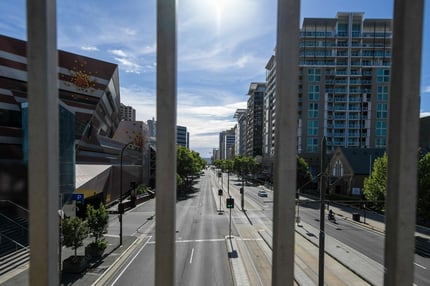
More than 1.6 million South Australians are today spending their first of six days under a strict new version of a coronavirus lockdown.
They're embarking on what the government is calling a "circuit breaker", to contain an outbreak in the northern suburbs of Adelaide after a six-month stint of no community transmission was broken over the weekend.
It all started with an ominous cough.
Watch: SA today recorded zero new cases. Post continues after video.
On Friday night an 80-year-old woman presented at Adelaide's Lyell McEwin Hospital.
A young doctor on shift that night heard the woman coughing and quickly ordered a test which came back COVID-19 positive by the Saturday morning.
Acting Chief Medical Officer Professor Paul Kelly says it was this quick thinking that was "absolutely essential in picking up that first case".
"The family member that went to that hospital and went to the Emergency Department with something else completely different, no respiratory symptoms, one of the doctors heard that person coughing and did the test and that is how we know that there’s something going on in South Australia very early," he said.
By Sunday, three of the woman's relatives had been confirmed COVID-19 positive.
By Monday the cluster had grown to 17, with 15 of those linked to the one family.
By Tuesday it had swollen to 20.
By Wednesday it was at 23, and today - the first day of lockdown - zero new cases were recorded but SA health is treating 17suspectedcases as cases.
Three people have been hospitalised but are stable, and there are more than 3200 close contacts linked to the Parafield cluster currently being traced.
More than 12,000 tests were conducted on Wednesday alone as the state tries to clamp down as quickly as possible on the growing outbreak.
Where did the cluster come from?
Health authorities have confirmed the cluster emerged from Adelaide's Peppers Waymouth Hotel, which is being used for quarantining arrivals into the state.
They say a cleaner from the hotel caught the virus from a hard surface, not from direct contact with anyone in quarantine, and then passed it on to her elderly mother. It's also believed she infected two security guards but neither were symptomatic.
The original source was an international arrival who touched down in Australia from the United Kingdom on November 2 and was tested on November 3.
South Australian Premier Steven Marshall has been quick to confirm that a contagion by droplet could not be classified as a hotel quarantine 'breach,' but said SA Health would conduct a "fulsome" review once the threat of the Parafield cluster was over.
How does the lockdown work?
As of midnight on Wednesday, South Australia entered some of the toughest coronavirus restrictions in the world.
A six-day lockdown was announced that afternoon giving just a few hours notice before a shutdown of everything except for supermarkets, bottle shops, medical and mental health services, petrol stations and childcare/schooling for children of essential workers.
No one is allowed outside to exercise, and only one person per household will be able to leave the home at any one time and they must be wearing a mask while doing so.
FIFO work has stopped for six days, regional travel is banned, aged care facilities are in lockdown, holiday homes are not available for rent, and weddings and funerals are banned.
"We need this circuit breaker, this community pause. We are at a critical point, but we will get through this," Premier Marshall said.
Forty sites across Adelaide have been listed as being of key concern, particularly a pizza bar, where a worker tested positive, two northern suburbs schools, a hospital and a swimming centre.
SA restrictions: Areas to be shut down for 6 days include: *all schools except for kids of essential workers *takeaway food *unis pubs cafes *elective surgery *open inspections *outdoor sport or physical activity *construction industry *weddings and funerals
— Joe O'Brien (@JoeABCNews)
The government says the pause in most community activity will significantly reduce the risk of the virus spreading further. It could also prevent the need for a much longer Victorian-style shutdown.
By way of comparison, Victoria locked down specific hotspot suburbs on July 1, when there were 60 cases present.
By July they'd locked down the entire Melbourne and Mitchell Shire, and by August regional Victoria was also in lockdown.
Why are authorities moving so fast?
At face value a statewide lockdown could seem like an overreaction considering the relatively low number of cases, but as South Australia's Chief Medical Officer Prof Nicola Spurrier explained, "this particular strain has had certain characteristics".
"It has a very, very short incubation period. That means when somebody gets exposed, it is taking 24 hours or even less for that person to become infectious to others and the other characteristic of the cases we have seen so far is they have had minimal symptoms and sometimes no symptoms, but have been able to pass it to other people," she said.
South Australian authorities have ultimately tossed up the options and decided that a lockdown is cheaper than a second wave.
"This is a particularly sneaky strain of this virus," said Premier Marshall. "A highly contagious strain... and if we don’t get on top of that very, very quickly it will get away from us and that will be disastrous for us in South Australia."
Epidemiologist Professor Adrian Esterman told Ninethis morning he's confident the shorter incubation period is not the result of a coronavirus mutation. Rather it's an existing strain that has hit "funny circumstances that made it change incubation period".
"[It's been shown that] in a super-spreading event the incubation period can be shorter," he added. "If there had been a major change in the virus, then I would have heard of it by now."
What is everyone saying?
At a micro-level, the lockdown has caused mayhem.
Couples with weekend weddings are in cancellation mode, with others like David Baldino and Jessabeau Thompson pulling off an emergency 7pm wedding last night, according to Adelaide Now, getting in just before lockdown.
A woman and her terminally ill mother who arrived in Queensland on Sunday morning for a final bucket list holiday found themselves locked out as borders went up around their home state. As Deb Duncan told the ABC, they're desperately trying to get home in time for her next dose of a drug as part of a clinical trial to treat her cancer.
Restaurants are closing with thousands of dollars of stock now rendered useless, the trucking industry is in "turmoil" after being forced to a standstill, and supermarkets have had to impose two-per-person purchase restrictions on certain items with the return of panic buying.
According to the ABC, some chemists reported selling almost 600 masks within hours of the impending lockdown announcement.
Gyms are on the forced closures list, with some regional businesses telling Adelaide Now they feel "blindsighted".
"We are very disappointed that our family-owned business is being forced to close in response to a COVID-19 outbreak occurring almost 450km away in metropolitan Adelaide," said Tough Fit Gym's Scott Thomas.
At a more macro-level, health professionals and politicians are split.
The premier's Labor party counterpart has backed the strict lockdown saying in a statement, "we're going to back their judgment, and never doubt their motives. We're going to comply with their requests, not because it's easy, but because it's right. We're going to remain calm, steadfast and resolute in tackling this challenge in a way that only South Australians can".
Gemma Bath
True Crime Conversations host
No Comments
Be the first to leave a comment