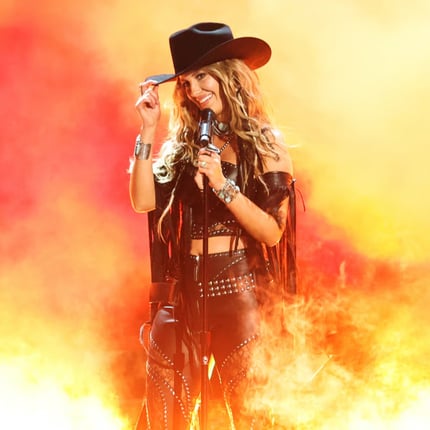
There is a version of success that social media has trained us to recognise instantly. It arrives in a single clip. It explodes across feeds. It feels sudden, almost accidental. One day you are unknown. The next, you are everywhere.
When a video of Lainey Wilson performing at a Jason Aldean show began circulating on TikTok, it seemed to fit that script perfectly. The camera angle caught her from behind. The internet decided it had found something worth obsessing over. Within days, her name was attached to a viral moment that had very little to do with songwriting and everything to do with her body.
"I guess I was having a good butt day," she tells Kate Langbroek on this week's episode of No Filter, laughing at the sheer randomness of it.
Watch: Prime Minister Anthony Albanese on No Filter. Post continues below.

The clip travelled far beyond country music circles. People who had never heard her name were suddenly debating her figure. Comment sections filled. Algorithms shifted. And from the outside, it looked like Lainey Wilson had become an overnight success.
What that narrative erases is the fifteen years that came before it.
By the time TikTok discovered her from behind, she had already spent a decade and a half trying to get people to notice her voice.
Lainey grew up in Baskin, Louisiana, a town of just 170 people. "We don't even have a red light," she says. "We have a caution light."
It was the kind of place where everybody knew everybody, where storytelling was currency, where you sat around the kitchen table hearing the same tales retold from slightly different angles. It was also where she first felt what she now describes as something close to a calling.
At nine years old, after a family trip to Tennessee, she told her parents Nashville was home. "I remember exactly where I was sitting," she says. "I remember telling my parents, 'This is home.' I just knew it."
That certainty sounds romantic in hindsight. At the time, it required stubbornness.
At nineteen, she moved to Nashville and lived in a 20-foot camper trailer parked outside a recording studio. Water, electricity and Wi-Fi came via extension cords and goodwill. It was not glamorous, but it was proximity.
She wrote constantly. She knocked on doors. She auditioned for American Idol "probably seven times" and for The Voice "a handful of times." She didn't make it past the early rounds.
She did whatever she had to do to stay afloat. For five years, she performed as a Hannah Montana impersonator.
"It kept some money in the bank," she says simply. During the week, she wrote songs. On weekends, she opened club shows, then ran out the back to sell her own merchandise.
There were moments when it felt irrational to continue. "There were definitely times where I was like, I must be absolutely insane to not be wanting to pack my stuff up and move home," she tells Kate.
And yet, even in that doubt, she describes carrying "this weird sense of peace." It wasn't blind confidence. It was something quieter. "I was just holding on to that feeling of like, this is what I was supposed to do."
The apprenticeship was not linear. The man who had first let her park her camper outside his studio, her mentor Jerry Cupit, became seriously ill and eventually passed away. He had been her connection to Nashville, the person who had encouraged her to sharpen her songwriting and stay the course. When he died, she found herself effectively starting over.
"This is the only guy that I know in Nashville," she remembers thinking. "What do I do now?" She sold the camper, because keeping it parked elsewhere would have cost as much as rent, and began again.
There is something unglamorous about beginning twice.
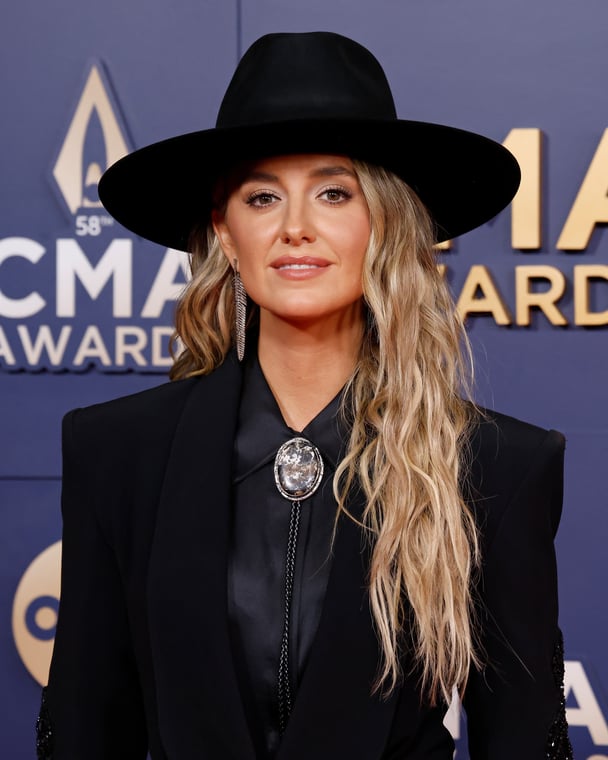
It is easy now to describe her rise as meteoric. She herself jokes that she is "literally a 10-year overnight success". But what she describes on No Filter is less explosion and more accumulation.
A publishing deal that allowed her to pay bills. A record deal that brought new pressure. "Honestly, that's when the hard work really began," she says. "I've been preparing for the race. Now I just entered it."
When her song Things a Man Oughta Know began climbing, when Yellowstone introduced her to a wider audience, when radio rotation expanded, momentum finally arrived. And then, layered on top of it, came TikTok.
The viral clip could have easily reduced her to a caricature. The internet is not always kind to women whose bodies become public property. She acknowledges that some of the commentary was funny, and some of it was not.
But instead of shrinking, she asked herself a question that reveals more about her than any viral statistic: "How would Dolly handle the situation?"
Dolly Parton has long been one of her north stars, not just musically but philosophically. "There's something about the woman," she says. "It's a real power. And a big part of that power is her kindness."
Watching how Dolly navigated fame — how she owned her image without letting it own her — became a blueprint. If attention was going to come, even sideways, she would meet it with humour.
"Whatever brings you to my music," she says now.
There is a subtle defiance in that line. The body may draw the eye, but the voice keeps the audience.
The speed of her ascent brought its own disorientation. In one year, she played more than 180 shows. She found herself seated at awards tables alongside artists she had once watched from her living room. The adrenaline that carries you through obscurity is not the same adrenaline that sustains you at the top.
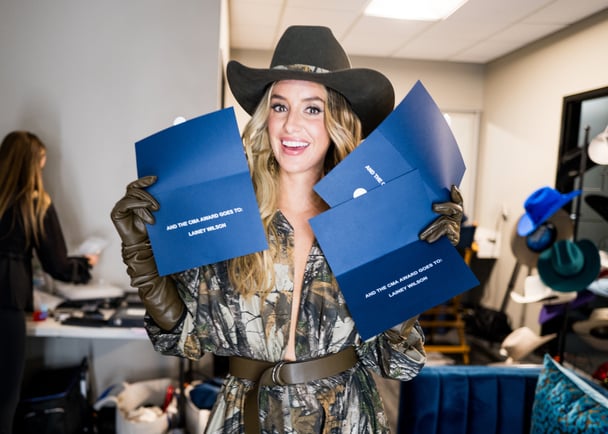
"I ran into Keith Urban, and I was so tired," she tells Kate. "I was just like, I'm tired." His response was short and cutting in the best possible way: "No whining on the yacht."
It wasn't dismissal. It was perspective.
The girl who had once lived in a camper trailer was now sailing in waters she had prayed for. The exhaustion was real, but so was the privilege.
What makes Lainey Wilson compelling in conversation is not the awards tally or the viral metrics. It is the through-line. The nine-year-old who "just knew." The nineteen-year-old in the camper. The twenty-something knocking on doors. The woman who could have walked away when her mentor died but chose to stay.
She speaks openly about faith, about the "divine" feeling she had as a child that she would be an "idiot not to listen to." She speaks about inheriting her work ethic from her farmer father, who woke before dawn regardless of whether the season had been good or bad. "Even if I wasn't making a dime, I'd still be doing it," she says. "Because I don't really know how to do anything else."
In an era that rewards immediacy, her story feels almost unfashionable. It is not a story about luck. It is not even really a story about virality. It is a story about sticking it out long enough for momentum to catch up.
You can listen to 'For 15 Years, No One Was Listening To Lainey Wilson. Now She's Everywhere' on No Filter, available wherever you get your podcasts.
Feature: Getty.
Mamamia wants to hear about how you study, learn and upskill!
Complete our 3 minute survey for a chance to win a $1,000 gift voucher in our quarterly draw!
Take survey →
Sign up to Mamamia Daily
Sent daily
Bree Player
Author
No Comments
Be the first to leave a comment