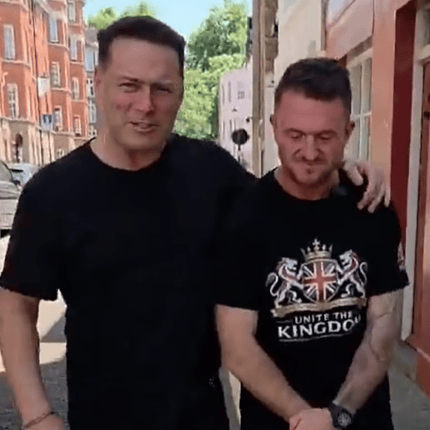
It's the interview that could cost journalist Karl Stefanovic his TV career: a sit-down with far-right figure Tommy Robinson, which was promptly taken down less than a day after it aired.
Stefanovic's independent podcast, The Karl Stefanovic Show, released a 55-minute interview with the British anti-immigration agitator, introducing Robinson as "one of Britain's most controversial figures" and telling him: "I really do admire your tenacity and the courage that you're showing in trying to stand up for what you believe is right."
The podcast reportedly sent Nine executives into crisis talks, culminating in the network deciding to cut ties with its long-standing breakfast show presenter on Wednesday, Nine newspapers report.
Stefanovic is reportedly negotiating the terms of his exit.
The host — one of Nine's most recognisable faces, with more than two decades at the network — reportedly has a $3 million contract.
Earlier, Nine said it was taking Stefanovic's most recent episode "seriously" and stressed the network had no involvement in the independent production.
The Sydney Morning Herald reports Nine was forced to act when the fallout threatened to trigger an advertiser boycott of Today.
Activist group Mad F***ing Witches vowed to run a campaign against Stefanovic and Nine, despite the removal of the podcast from streaming services, "because showcasing a person like Robinson (yep, we know that's a false name) has NO PLACE in Australia, and Nine should be clearly aware of this."
"Nine should be well aware: them taking Karl's podcast down won't stop us. In fact, it makes us even angrier they seem to think we're so easily fooled and silenced," they wrote.
"The truth is we're now even MORE determined to run such a campaign on Stefanovic (tentatively titled #KancelKarl), and we badly need your help if you want us to do so."
Listen to Mamamia's news podcast The Quicky unpack the story. Post continues below.
The deleted interview was re-published by One Nation Senator Pauline Hanson, who was Stefanovic's first guest when his show launched back in January.
Hanson framed the interview as a 'warning Australians needed to hear'.
"Tommy Robinson has a lesson for Australians," Hanson wrote.
"If we don't learn from the UK's mistakes on immigration and radical Islam, we are going to face the same destruction. This is exactly what Karl was trying to bring to Australia's attention."
Not everyone agrees with her.
So, who is Tommy Robinson?
Tommy Robinson is not his real name. Born Stephen Yaxley-Lennon in Luton in 1982, he adopted the alias in the mid-2000s.
Robinson co-founded the English Defence League in 2009, an anti-Islam street protest movement that drew international attention. He has since distanced himself from the EDL, but his views on Islam and immigration have not shifted.
His criminal record includes assault, using a false passport to enter the United States, mortgage fraud, and multiple contempt of court convictions.
The most recent contempt conviction sent him to prison in 2024, after he repeatedly defied a court order relating to a libellous video he made about a Syrian refugee teenager who had been attacked at school.
He's also facing an upcoming trial after allegedly harassing two journalists — allegations he denies. In addition, he's been repeatedly linked to the spread of online misinformation, something he admits to.
In 2024, Robinson told his followers that he had helped spread "fake news" after falsely claiming a 15-year-old Syrian refugee, filmed being attacked on a school playground, had himself attacked a girl at the school.
During the UK civil unrest following the 2025 Southport stabbings, which left three young girls dead and 10 others injured, Robinson posted that the attack was "more evidence to suggest Islam is a mental health issue than a religion of peace", amplifying false online claims that the suspect was a Muslim immigrant and an asylum seeker. Police ultimately confirmed the suspect was born in the UK.
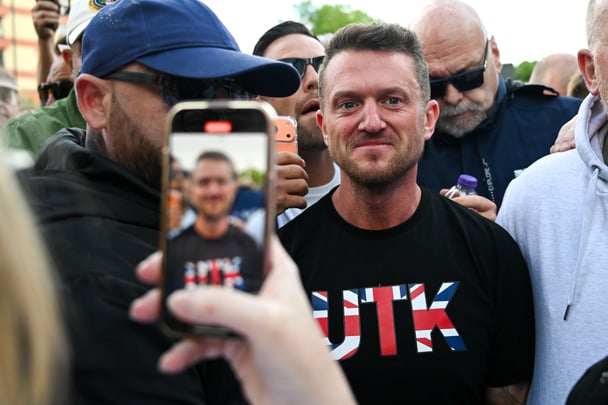
Robinson has been banned from multiple social media platforms for hate speech violations, though his X account was restored after Elon Musk bought the platform — and Musk has since publicly backed him, with Robinson saying the billionaire covered his legal fees in at least one case.
Once largely confined to the fringes of British politics, Robinson has seen his profile expand significantly in recent years. He has been a driving force behind the UK's Unite the Kingdom rallies, which drew tens of thousands of people to the streets of London in May and September last year.
The rallies centre on what Robinson characterises as the defence of traditional British values, national identity and sovereignty. Outgoing UK Prime Minister Keir Starmer accused Robinson and other organisers of "peddling hatred and division."
Critics and anti-extremism researchers describe him as one of the most influential far-right figures in Britain for more than 15 years.
What does he actually say?
In the interview with Stefanovic, Robinson describes a Britain fundamentally transformed by immigration and Islam — and he warns Australia is heading the same way.
He claims the UK's maximum-security prison system has been "taken over by Islam", alleging that 40 per cent of inmates are Muslim and some facilities function essentially as "ISIS training camps". UK Parliament statistics from June 2025 put the Muslim prison population at 18 per cent.
A central pillar of his activism is his campaign against what he calls "grooming gangs", which he describes as "groups of Muslim men kidnapping English girls [and] raping them". The UK government's own 2025 national audit into the issue found the ethnicity data was insufficient to draw conclusions at a national level.
His rhetoric that 'mass immigration is taking over the nation' is not just pointed at Britain. Robinson tells Stefanovic he can see the same "forces at work" in Australia.
Robinson frames his far-right position as a free speech fight. And Australia's One Nation leader Pauline Hanson's warm reception of the interview is not surprising.
The two share more than mutual admiration.
Hanson has spent years making similar arguments in the Australian context.
Following her re-election to parliament in 2016, she declared Australia was "in danger of being swamped by Muslims." Australian Bureau of Statistics data from 2021, five years on from this speech, shows just 3.2 per cent of Australians practice Islam.
Despite this, Hanson has twice worn a burqa into the Senate chamber to draw attention to her push to ban face coverings in public — a stunt that drew widespread condemnation.
More recently, she issued a partial apology to the ABC in February after suggesting there are no "good" Muslims, while simultaneously attacking the government for "bending over backwards for migrants".
Like Robinson, she frames all of it as plain-speaking — "telling the truth without worrying about political correctness."
But despite the growing tide of support for this rhetoric in Australian politics — Hanson has surged in popularity in recent weeks — there are other voices that condemn these views.
Home Affairs Minister Tony Burke condemned the comments as "wrong and cruel", saying they were unworthy of someone in public office.
Prime Minister Anthony Albanese said there was a direct link between this kind of commentary and violence.
"It legitimises it, it mainstreams it," he told the ABC. "Pauline Hanson is a divisive figure. She's made a political career out of seeking to divide Australians against each other. And what we need is more unity, not more division."
It's a message echoed by Race Discrimination Commissioner Giridharan Sivaraman, who told SBS the comments were "part of a long history of Islamophobia."
"When a public figure, a politician, demonises and dehumanises a whole group of people, that's a green light to violence from others," he said.
He continued: "It's making out that a group of people are somehow lesser or don't belong or are bad, and that's exactly what she's doing. That dehumanisation is what then incites or gives permission for violence to occur."
Sivaraman also called out Hanson's push for immigration to be cut, saying the calls had "xenophobic undertones".
"There's nothing wrong with having a debate about migration. It's a genuine policy issue, but there is plenty of evidence to show that completely stopping migration would be absolutely disastrous for the Australian economy," he told SBS.
Feature image: X/karlstefanovic.
Ailish Delaney
Acting Morning Editor
No Comments
Be the first to leave a comment