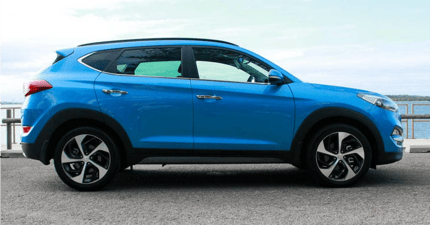
Peter Anderson road tests and reviews the Hyundai Tucson range with specs, fuel consumption and verdict.
In 2015, Hyundai dropped a bomb in the medium SUV market with the all-new Tucson. Replacing the flawed but much-loved (and much-bought) ix35, the new Tucson arrived to market in a state preceding Hyundais weren’t always in when launched – finished.
Not only was it finished, it was good. Very good. It looked great, had an excellent interior, appeared well-made and rode and handled like no Hyundai SUV before it. It also came with a few pieces of in-car technology that wouldn’t be matched for almost 18 months by other makers. With a range stretching from $27,990 to $47,450, the Tucson covers a lot of bases for a lot of buyers in a rapidly growing market sector – the medium SUV.
Does it represent good value for the price? What features does it come with?
There are four grades of Tucson – Active, Active X, Elite and Highlander, and across the range are three engines and three transmissions. All Tucsons have five seats, five doors, bluetooth, touch screen infotainment (sizes vary between 7.0 and 8.0-inches), a six speaker sound system, AM/FM radio, and CD player, reversing camera, rear parking sensors, cruise control and roof rails.

Active and Active X have the best iPhone and Android integration, featuring Apple CarPlay and Android Auto in a 7.0-inch touch screen. Elite models and above go without these, using a different head unit with its own software which does include GPS sat nav and basic music integration via USB and Bluetooth and is run from a larger 8.0-inch touch screen.
All prices are RRP unless specified and being Hyundai, drive-away deals are commonplace. Let's work our way through a model comparison by walking up the price list.
The range of Hyundai Tucson models kicks off with the Active manual and automatics, priced at $28,590 and $31,090 respectively (although $27,990 and $29,990 drive-away seems to be the go). The Active's basic features include 17-inch alloys, air conditioning, cloth trim, cruise control and a full-size spare.
The second tier in the range - and the biggest seller, swallowing over half of all Tucson sales, is the Active X. The manual transmission will cost you $31,150 and the automatic $33,650 ($29,990 and $31,990 drive-away). On top of the Active spec, you get 18-inch alloy wheels, a mix of real and synthetic leather seats, remote central locking, front LED fog lamps and folding heated mirrors. The six speaker stereo is the same as the Active with the Apple and Android integration.
Those in the back also get a rare treat - air conditioning vents at floor level.
Moving on up the price range we reach the Elite, which is available in front-wheel drive (FWD) with the 2.0-litre MPI motor and in all-wheel drive (AWD) with the 1.6 turbo petrol and 2.0-litre turbodiesel.
For MY17 The FWD Elite has the same 2.0 GDI engine as the Active X and will set you back $36,750. The wheels rise to 19-inches and the screen size up to 8.0-inches. You get keyless entry and start, electric tailgate with hands-free operation, sat nav, dual-zone climate control, LED headlights and a few other trinkets.
Add a 1.6 turbo engine and AWD (they come as a package) and the price rises to $39,750. The AWD diesel is pricier again at $41,750, and both pick up rain-sensing wipers.
The top-of-the-range Highlander comes in 1.6 turbo ($45,450) and 2.0 diesel auto ($47,450). Also rolling on 19-inch wheels, the Highlander has a bigger colour screen in the dash, LED lighting inside and out, heated and cooled electric front seats, panoramic sunroof and a huge boost in safety features with AEB, blind spot detection, lane change assist and rear cross traffic alert.
Colour choice is partially dependent on how much you want to spend, both on the base car and the paint itself. Metallic paint is $595 extra. There are eight colours to choose from in a fairly conservative palette. Having said that, cardigan wearers miss out on beige, but hippies with a penchant for purple, green, gold or orange are also out of luck. Available shades are in fact, 'Ara Blue', white (solid), black, grey, 'Ruby Wine' (a maroon-ey/red colour), 'Polar White' (metallic), silver and brown (not as bad as it sounds).
How practical is the space inside?
The Tucson range has slightly differing cabin storage options but they all share the same headline figures of 488 and 1478 litres of cargo space, the latter figure for luggage capacity with the rear seats folded. There are a couple of underfloor cubby holes in the boot space, too.
Beyond the boot size, they've all got four bottle holders and four cupholders as well as a good-sized centre console bin under the armrest. Beneath the air con/climate controls is a tray that will fit your smartphone without drama and also houses the USB port and two 12 volt outlets (although the Active X has only one 12 volt outlet). All have a 12 volt point in the boot.
In terms of interior dimensions, rear legroom is good for people over 180cm tall as long as the driver doesn't think they're Stirling Moss and have to sit as far back from the steering wheel as their straightened arms will allow. You can thank the 2.65m wheelbase for all that room. Those in the back also get a rare treat - air conditioning vents at floor level and additional knee level ones in the Elite and Highlander.
The Tucson is 4.475m long, 1.85m wide and 1.65m high (with roof rails).
Is there anything interesting about its design?
The Tucson is a terrific-looking car. Hyundai's styling has matured hugely in the last few years and the Tucson is a pointer to the brand's future - classy, Euro-influenced and with a strong personality linked to newer Hyundais as they roll through.
The lines are sharp, the headlights slim and the unpainted plastic applied around the wheelarches is just right - it doesn't look either penny-pinching or self-consciously masculine. It's also a cohesive exterior design, with links between the front and rear, a strong feature line to draw the two ends together and some great surfacing. Upper-spec models gain some chrome, most obviously in the grille.
Perhaps the only real criticism (and this is obviously subjective) is the chintziness of the alloys and cheap exterior detailing on higher models.
As out interior images show, the inside is lined with mostly good materials and plastics. The leather trim is a moving feast, with a mix of real and synthetic upholstery depending on build location (South Korea or Czech Republic) and model level. There's nothing wrong with the synthetic stuff, which is quite soft and resists heating up too much in summer.
What are the key stats for the engine and transmission?
Hyundai provides a choice of petrol and diesel engines but no full gas or petrol/LPG option.
In terms of engine specs, the Active, Active X and Elite FWD are available with the 2.0-litre four-cylinder GDI developing 121kW/203Nm. Pretty handy diesel specs. You've a choice of six-speed manual or automatic of Hyundai design and manufacture, but they're FWD only.
Early versions of the Active and Elite ran the older GDI engine until specifications changed in mid-2016.
Elite and Highlander AWD petrols pack a 1.6 litre turbo four-cylinder producing 130kW/265Nm, driving all four wheels through a seven-speed dual clutch transmission, again a Hyundai design. These are good power and torque specs for this engine size and is related to the Veloster Turbo's powerplant, but much more refined in the Tucson. Just a shame it isn't available in FWD Tucson models, even as an option.
All petrol engines get by with standard 91 RON unleaded and fuel tank capacity across the range is 62 litres.
A startlingly good feature across the entire range is the ride and handling.
The Elite and Highlander CRDi AWDs are powered by Hyundai's R-Series 2.0-litre four cylinder turbo-diesel, producing 136kW and a strong 400Nm, which is channelled to all four wheels via a six speed automatic transmission.
None of these engine and transmission combinations have stop-start technology to reduce consumption, but competitors, like the CX-5 and Tiguan, do.
It would be fun if the AWD system had more of a rear-wheel drive (RWD) feel, but alas, you can't have it all.
Towing capacity ratings are identical from Active to Highlander - 1600kg braked, 750kg unbraked.
The 1.6 and 2.0 petrol engine specs have an oil capacity of 4.0 litres, the 2.0 diesel 7.6 litres. The specified oil type is mineral, with a 15W/40 rating for both fuel types.
How much fuel does it consume?
CarsGuide's Richard Berry is running a Tucson Active auto with the 2.0 GDI on long-term test and so far it's returning 9.5L/100km against the claimed 7.9L/100km (manual and auto) in a mix of long highway runs (Melbourne to Sydney) and city running. For those who prefer to invert the standard measure to km per litre, that claim is 12.7km/L.
The Active X has the same claimed combined figure of 7.9L/100km. I ran a Tucson Active X automatic for six months and never bettered 10.5L/100km on standard unleaded in a mix of regular 80km/h running, lots of suburban battling and a little freeway work.
Hyundai reckons you'll get 7.7L/100km on the combined cycle with the 1.6-litre turbo GDI, and on our most recent test in a Tucson 30th Anniversary, we got 9.2L/100km, despite a 145kg weight increase over the GDI. Richard also managed 9.1L/100km in an Elite AWD 1.6 turbo.
For the 2.0-litre R-Series turbodiesel, Hyundai claims 6.8L/100km on the combined cycle. CarsGuide's last week long test yielded an impressively close 8.0L/100km, which is pretty good mileage, especially when bashing around town.
What's it like to drive?
The Tucson is a good car to live with. Like most Hyundais it is unusually easy to set the right position behind the wheel, with an excellent relationship between the pedals, wheel and the hip-point of the driver's seat. There's tons of adjustment to ensure you hit the spot.
Vision is good in almost all directions, apart from over the shoulder on the driver's side where the closing glass line tightens up. It's not an especially high car but feels high enough that you're above the traffic.
Although this isn't specifically an offroad review, ground clearance is 182mm with nothing on-board and you could almost u-turn in a normal suburban street with a turning radius of 10.6 metres.
A startlingly good feature across the entire range is the ride and handling.
Like Mazda, Hyundai has punted on buyers liking a multi-link rear rear suspension. It means a better balanced chassis (when done right) but more importantly, impressive ride compared to a couple of the segment's other cars which have cheaper, more compact torsion beam rear ends.
Multi-link-equipped cars cost more, but it's worth it. Australian Tucsons have individual spring and damper settings from Hyundai's very own local suspension tuning team.
The only bugbear with the FWD cars is an over-enthusiastic propensity to centre the steering wheel if you give it a little too much throttle exiting a corner.
Each Tucson has its own distinct driving character according to engine and transmission combination.
The Active and Active X
CarsGuide
Author
No Comments
Be the first to leave a comment