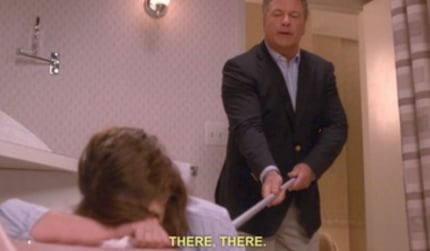
Image via NBC.
When you’re a kid, personal space just isn’t a thing. You cling to legs, bodies and arms, and snuggle in between adults on the couch. The mere concept of being too close to someone doesn’t really cross your mind.
Then, as we grow up, space becomes a little more… present. You start to feel it more. There are those friends or co-workers who lean in a little too close to your face when they’re talking; crowds, dancefloors and queues are incredibly stressful; and even our own family members can invade personal space.
Or maybe that's just me. I have to wonder — how do we know where personal space begins and ends? When am I being reasonable about my problem with personal space, and when do I need to just suck it up?
Scientists at the University College London carried out a study in 2013 that explored the two main kinds of personal space. The is called peripersonal space, which is the space that is close to us. The second is called defensive peripersonal space (DDPS), which is how we perceive incoming threats.
RELATED: Five coping mechanisms for antisocials
The study showed the more anxious someone is, the more personal space they need. I will testify to this. I'm a naturally anxious person, and I like my space. I can't stand it when someone I don't really know touches me by accident. If someone in an empty cinema sits to close to me, I am tempted to get up to move. Even cooking in the kitchen at the same time as someone makes my skin crawl. I know, I am completely ridiculous.
We imagine these famous misanthropes appreciate their personal space. (Post continues after gallery.)
Our favourite antisocial TV characters
Gregory House, House
Gregory House, House
April Ludgate, Parks and Recreation
April Ludgate, Parks and Recreation
Sherlock Holmes, Sherlock
Sherlock Holmes, Sherlock
Daria Morgendorffer, Daria
Daria Morgendorffer, Daria
Bernard Black, Black Books
Bernard Black, Black Books
Dr. Lilith Sternin-Crane, Cheers
Dr. Lilith Sternin-Crane, Cheers
Detective Rust Cohle, True Detective
Detective Rust Cohle, True Detective
The research also concluded DPPS will change depending on what situation you are in. For example, if walking alone on a quiet evening, your DPPS will inevitably be a larger space than, say, if you are on a crowded train.
RELATED: 20 things all anti-social people know to be true
So how close is too close in a more intimate environment? Evidently, our absolute limit to personal space is 20-40cm from our face, which, when you are talking to a friend over dinner, seems like a lot of space, right?
There has also been research into how much space we are comfortable with, depending on who or what is nearby. US anthropologist Edward Hall studied personal space in the 1960s, and developed this chart:

The chart details the four different types of personal space, and the distances in each space that we generally feel comfortable in.
Intimate Space
Catwoman is definitely crossing a line here.
Intimate space is 18-45 cm. It indicates a closer relationship, and is usually when people are hugging, talking quietly to one another or touching.
RELATED: Couples who do this one thing are happier and have better relationships
Personal distance
Personal space is 45cm to 1.2 m. This is the distance most people are comfortable with when they are with family or friends.
Check out a few of The Glow team's favourite celebrity sibling moments on Instagram (Post continues after gallery.)
Celebrity siblings on Instgram
Beyonce and Solange
Chris and Liam Hemsworth
Hilary and Haylie Duff
Poppy and Cara Delevingne
Ashley and Mary-Kate Olsen
Elle and Dakota Fanning
Karl and Peter Stefanovic
James and Dave Franco
Nicole and Sofia Richie
Social distance
Social distance is 1.2m-3.6m. This level of distance is often when people are with someone they know fairly well, like coworkers.
Public distance
Public distance is 3.6-7.6 m. An example of this would be a class full of students, or during a presentation.
Your personal space preferences can depend on many things, including what culture you come from.
RELATED: How I learned to deal with anxiety at work
So, as it turns out, I may be a little more paranoid about how much personal space I really need, especially with family and friends. But I don't think anyone will risk cooking in the kitchen with me anytime soon.
Do you have issuess with personal space?
Author
No Comments
Be the first to leave a comment