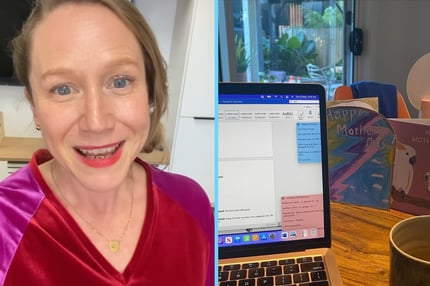
I had two years.
Two years, exactly, between the release of my last book,I Give My Marriage A Year, and my new book, The Couple Upstairs.
It was designed that way. Some authors, once they are lucky enough to have a deal in place with a publisher to put their work out in the world, also get a schedule. Two years is seen as a pretty good rhythm.
And two years probably sounds like a long time to write a book. If you’ve never met a writer.
No matter how interesting and unique we think we are, writers generally fall into one of two camps:
They’re either:
This book will take as long as it takes. Don’t rush my process, it could be next year, it could take a decade.
Or…
Give me a hard date, make it tight, I like to push to the pressure of deadlines. Three months, here we go.
Generally speaking (all of this is generally speaking, there is no fail-safe rule book for writing, no matter what someone might try to sell you), working journalists who write books fall into the second camp. If you’ve spent your entire career ruled by strict deadlines, you can’t work any other way.
For our camp, actions don’t happen without a deadline. Tell me I have to get out of bed without a time frame, and it’s unlikely to happen. I can bounce up at 5am if there’s a train to catch at 5.30, or I can lie there indefinitely, doom scrolling, until a child or a dog literally sits on my head. That’s how my brain is wired, that’s how things get done. Deadlines, deadlines, deadlines.
If you ask me to do something without a deadline, I’ll smile and say, ‘Sure, I’ll sort that out’. And you will never hear about it ever again.
So. Now we’re clear on that.
My new novel is calledThe Couple Upstairs. The fact that it’s on the shelves at all is a miracle and a mystery. Because in theory, I had two years to write it. But those two years, as it turned out, were 2020-2022.
You might remember, you might have heard. They were terrible, anxiety inducing years.
A pandemic closed us down and locked us up. Even in the good bits (the ‘good bits’ are a relative term, but consider them to be when, pre-jabs, case numbers were low and we could leave our homes, have a picnic, maybe venture beyond our LGA), our minds were particularly skittish. Not least because we were having to expend energy on learning things like what LGA we lived in. And what an LGA was.
As with the deadlines, writers went one of two ways.
I met one (a writer, that is) recently who loved the quiet years. A smaller life had, for her, removed distraction, focussed her in space and time. Allowed her brain to slow and hone in on her craft. “I feel almost guilty saying it,” she said. “But I enjoyed it, I went for walks and I wrote, and that was it.”
That’s not how my pandemic went, friends.
Mostly because for some stretches, I was locked up with my children. And every parent knows that being in close proximity to bored children is the enemy of getting shit done, because they don’t want you to do your shit, they want you to do their shit. In fact, theyneedyou to. They needed me to learn what Google classroom was, create 25 passwords, do their maths for them, feed them three times a day at least, distract them from their terrifying reality with Marvel movies about even more terrifying realities and they needed me to attempt to convince them that walks, and picnics, and walks with picnics, were fun.
Add in a long-considered move out of the city, the pain of separation from family overseas in a world of closed borders and the pressure to thrive in my full-time job in uncertain times… It barely needs to be said, but clear writing time was scarce.
So, how does this book - my closely-held novel about love, lust, longing, age and that fine line that hovers between a passionate relationship and a toxic one – exist?
Let me give you a few hard truths I learned along the way.
Holly Wainwright
Executive Editor
No Comments
Be the first to leave a comment