
Every week in clinic, I sit across from a woman who is losing weight.
She's feeling more confident in herself, she's thinking about that little Zimmermann dress that caught her eye in the window and she's rediscovering her love of Zumba at her local gym.
But amidst all this, she's quietly worried that something has gone wrong in her body.
It's not her blood sugar. It's not even her appetite. It's her sex life.
Watch: When weight loss medication ends a friendship. Post continues below.

She is on a GLP-1 medication. They go by many names, but GLP-1s are a class of drugs that've reshaped how Australia talks about weight.
The headlines are all about disappearing appetites and waistlines. But what's not making those headlines is the effect these drugs may be having on some women's sexual and reproductive health — and the search data tells us women are looking for answers in private because they aren't getting them anywhere else.
In fact, when you search for the impacts of weight loss medications, libido is the third most common concern, behind fertility and bone density. People are asking, "Why has my sex drive disappeared since starting weight loss injections?"
It's a question I now hear weekly in my pelvic health clinic. And it almost always comes with a wave of relief when I confirm that, no, she isn't the only one asking it, and yes, this is real.
Women deserve the full picture, and right now, sex is a part of that picture that may be missing.
Three ways GLP-1 medications can affect your sex life.
1. The L word (Libido): Along with a disappearing waistline may come disappearing desire. For many women, this is distressing, especially when they can't figure out why.
2. Lubrication. Rapid changes in body composition combined with the metabolic shifts that come with GLP-1s may affect natural lubrication for some women — something clinicians are increasingly observing, though formal research is still catching up. This can make sex uncomfortable, even painful, and that discomfort fuels the libido problem. If your body doesn't enjoy sex, it's not going to crave sex. Pain and low libido are a loop — one can drive the other.
3. Orgasm changes. I'm hearing women say it takes longer, it feels muted or it doesn't have the same intensity it used to. We don't have solid research explaining the mechanism yet, but if we know that orgasm relies on pelvic floor strength and coordination, and we also know that GLP-1s can reduce not just fat but also lean muscle, it's a connection that warrants further exploration. That isn't a diagnosis. It's a conversation worth having with a women's health professional rather than ignoring.
Why can rapid weight loss change desire and relationships?
Some of the changes that come with GLP-1s are physical; we know this.
But there's much less coverage on the psychological changes.
Losing a significant amount of weight quickly changes how a woman sees herself, and it's not always in The traditional Hollywood before-and-after montage. Sometimes a woman whose body has changed significantly within a few short months can feel more self-conscious naked, not less. Desire is built on a foundation of feeling safe and familiar in your own skin, and when your skin is changing by the day, that foundation gets shaky.
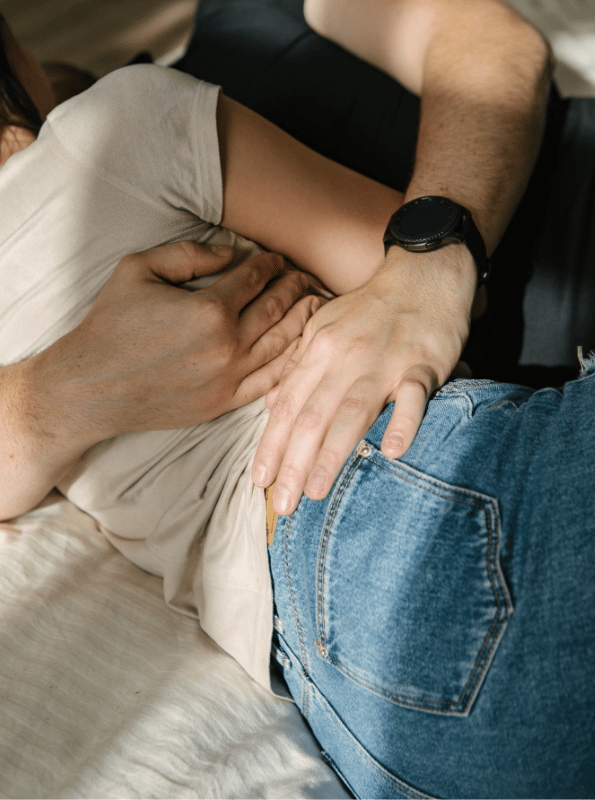
Partner dynamics can shift as well. When one person in a relationship changes their body dramatically, it can move something in the relationship, and it can be hard for either partner to put that into words, especially when no one has told them their feelings are valid. There are couples celebrating the weight loss outwardly, while the bedroom goes quiet at the same time, and they aren't always being given the education or support to understand this.
If you think a GLP-1 is affecting your sex life, what do you do?
If you're noticing changes, here's what I suggest as a starting points.
1. You're not imagining it and you're definitely not broken. Naming the changes that are taking place can take away a huge amount of the shame, and shame is historically and systemically what keeps women silent and suffering in sexual wellness.
2. Lubrication is fixable. A good quality lubricant is not a failure. It is a tool I recommend every couple use for almost every sexual experience. Why? It increases sensation. A water-based lube is great for everyday use and works with condoms and most toys. A silicone-based one lasts longer and is perfect if you want less reapplication or you're playing in water (just don't use this lube when using silicone toys). Skip oil-based lubricants if you're using condoms. And if dryness is more persistent, a vaginal moisturiser used regularly can help the underlying tissue, not just in the moment.
3. Talk to your doctor, because there ARE options. Sexual health is a part of healthcare. Too many of us forget this. Anything affecting your sex life is legitimate and worth raising with your prescribing doctor. Too many women assume sex is off topic. It's not.
4. Don't wait for your desire to come back. Consider desire less like Aurora in Sleeping Beauty waiting for a handsome prince to turn her on again, and more like building strength at the gym. It comes back when you train for it, not when you wait for motivation (or Chris Hemsworth) to walk through the door. Start rebuilding with gentle, pressure-free intimacy that is not aimed at anything. What the heck does that mean? Pleasure without pressure. No pressure for penetration, no pressure to go further than what you're comfortable with, just pure intimacy. If that feels too daunting with a partner, do it alone. Explore your body solo and find sensuality in solo play.
Listen: A candid conversation about sex, intimacy and why so many of us are still too embarrassed to talk about what's happening in the bedroom. Post continues below.
Hundreds of thousands of Australians are now using GLP-1 medications, and the number keeps climbing fast enough that the Therapeutic Goods Administration has been issuing ongoing shortage notices since 2022.
If even a portion of the women on these drugs are experiencing the changes I see in clinic, that is an enormous number of women navigating this alone, Googling at midnight, wondering what is wrong with them.
Nothing is wrong with them. The conversation is just years behind the prescription pad.
And it's time to catch up.
Heather Foord is an ex-journalist and founder of pelvic floor clinics across NSW, dedicated to helping women feel most confident in every stage of life. She holds a Masters in Health Science, Women's Medicine and is currently completing her Masters in Sexology.
This article is intended for general information only and should not be considered medical advice. Readers should speak with their doctor or qualified healthcare professional about any concerns relating to prescription medicines, sexual health or side effects.
Feature Image: Canva.
Win a $1000 voucher!
We want to hear from you about where you shop. Complete our 3 minute survey for a chance to win a gift voucher in our quarterly draw!
Take survey →Heather Foord
Author
No Comments
Be the first to leave a comment