If you want to support independent women's media, become a Mamamia subscriber . Get an all-access pass to everything we make, including exclusive podcasts, articles, videos and our exercise app, MOVE.
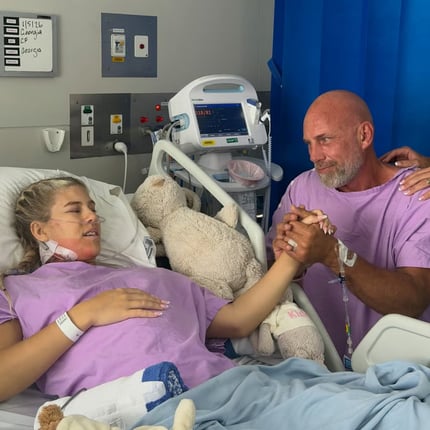
In a quiet recovery room, a young woman floats on a ketamine cloud, connected to a tangle of cords but already feeling better than she's felt in months.
A man, dressed in the same hospital gown and shuffling slowly, enters the frame.
The woman's eyes flutter open, and she reaches out to hold his hand as he bends down.
This is the beginning of the now-viral video 23-year-old Queensland woman Georgia Knight posted, just hours after receiving her father Troy's kidney in a transplant that saved her life.
Over 1.6 million people have liked the video on TikTok, with thousands of comments pouring in from all over the world in response.
Watch: Georgia seeing her father after kidney donation. Post continues below.

The phone call that changed everything.
Just six weeks earlier, Georgia had been about to be fitted for a dialysis catheter for her end-stage renal disease when she received a call from her father that would alter both of their futures.
"They called my dad on Thursday, March 19, to say that we have been successfully matched, and we've been scheduled in for an operation date in six weeks time," Georgia told Mamamia, adding that her dialysis appointment had been scheduled for the very next day.
"They allowed my dad to be the one to call me and tell me that we had been matched successfully and scheduled in six weeks time," she continued.
"It was 8:30 in the morning, which for me is like the crack of dawn, but Dad was just calling and calling and calling and when I picked up the phone he was just beside himself. We were so relieved."
Having struggled with anorexia as a teen, as well as endometriosis and Polycystic Ovarian Syndrome (PCOS, recently renamed as Polyendocrine Metabolic Ovarian Syndrome or PMOS), Georgia wasn't a stranger to health concerns, but it was during a hospital admission to address the latter at age 18 that doctors stumbled upon Georgia's kidney issue.
"I just kept presenting with poor kidney function, and that's how they found it," she explained.
"I was diagnosed with Stage 2 chronic kidney disease — Stage 5 being renal failure — and at that stage my kidney function was at around 55 per cent. For my age, it should have been up around 100 per cent."
Unfortunately, Georgia's disease progressed rapidly.
"I think it's forced me to grow up a lot faster than most people my age," she explained.
"You know, usually at my age, the only concern is what outfit you're gonna wear on a Friday night, what drinks are you gonna buy, how many morning matchas am I gonna have this week … This is just not a topic of conversation in my household."
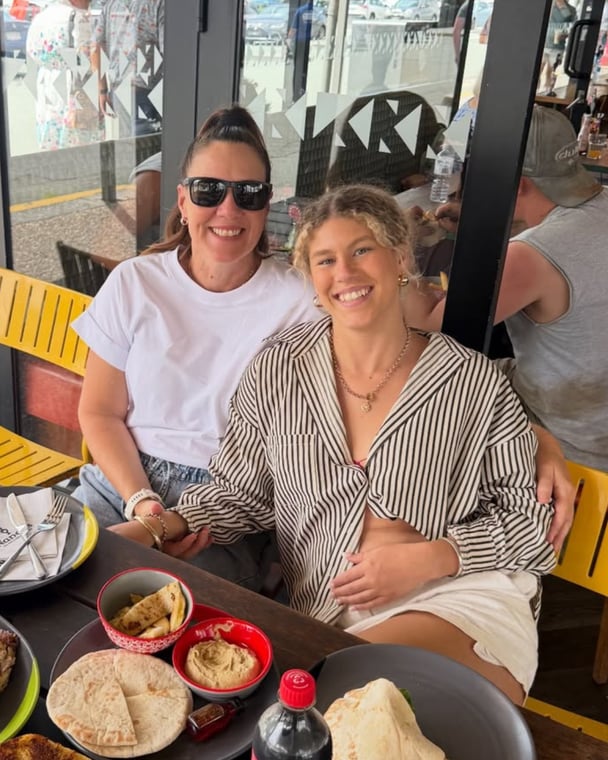
"Things just got very real and serious very quickly."
The disease quickly progressed to end-stage renal failure, bringing on severe symptoms such as: toxic, itchy skin, restless legs, fainting, and extreme nausea that forced her to stop socialising and eating.
"Things just got very real and serious very quickly and there was no space for general 23-year-old things to be happening in my home," she continued.
"I own a business in the beauty therapy space, I bought my first home at 21, completely self-funded, but nothing could seriously prepare me for the type of dedication and responsibility it takes to live with chronic illness.
"Looking after my health just became my number one priority."
For Georgia, it was the invisible weight of living with chronic illness that created the biggest challenges.
"One of the quotes that I absolutely live by is 'just because someone carries it well, doesn't mean it isn't heavy'," she explained.
"It's amazing the type of facade that people can put on, and I know that, because I've truly lived that life where you present well every day and then go home and cry yourself to sleep and scratch your skin off in the process, feeling entirely defeated whilst still showing up for the people in your life."
Listen: Dr Sonia Davison talks about whether diet and exercise can prevent dementia. Post continues below.
Survivor's guilt and a parent's love.
Georgia's joy at having found a donor kidney was tempered by a guilt she says has, at times, been all-consuming.
"You feel a lot of guilt for taking such a valuable organ from someone that you love and asking so much of someone, and potentially putting them in a position that would negatively affect their life," she explained.
"That was buckling for me. God, I just can't even put into words really the type of guilt that makes you feel."
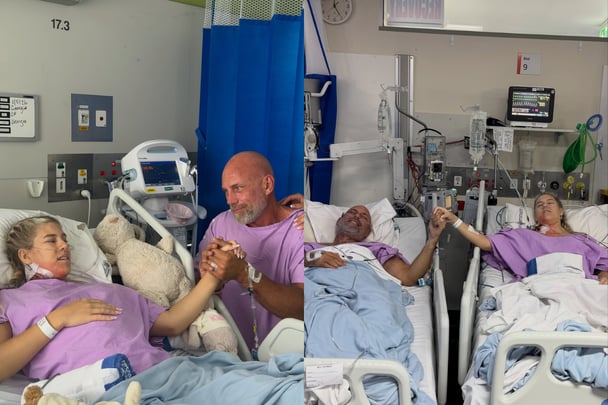
It's the reason why, in that recovery room, when Georgia opened her eyes and embraced her dad for the first time after the surgery, some her first words were, "I'm sorry."
It was her dad's reaction — one every parent can relate to — that sent eyes blurry all over the world in response.
"No, G, you don't get to say that," Troy responded, embracing his daughter.
"I've been really worried about you," she said.
"I know baby, that's why I'm here," he said.
"One thing that my brother and I were talking about at one point throughout this whole journey is the way that people glorify parenthood," Georgia, who dreams of becoming a mother herself, explained.
"Parenting isn't just parenting, it is just giving up anything for your children if they need it. [What my dad did] is just the deepest, most selfless form of love and I just don't think words carry enough weight for the situation."
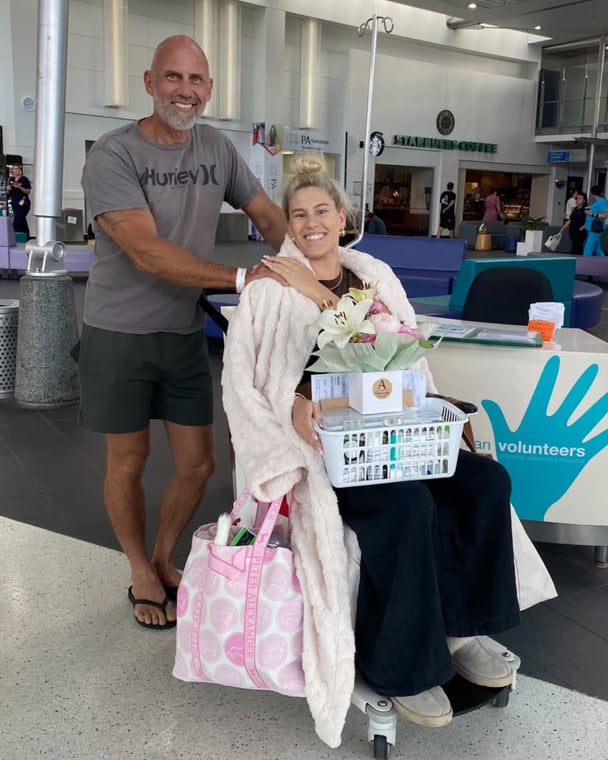
After a few ups and downs post-transplant, Georgia's own future is looking bright.
"I finally feel like I have control of my life again," she said.
"That to me is just like getting my power back and reclaiming my life again. It's something that's been completely out of my realm for quite some time now because being sick is so unpredictable."
She also emphasises the importance of organ donation — and the little-known fact that altruistic live organ donation is possible.
"One of the biggest misconceptions people have about organ donation is that registering as an organ donor on donatelife.gov.au means that you're signing up to donate while you're alive, but that's not the case at all," she said.
"In Australia, when you register through DonateLife, you're registering as a deceased organ donor after death in the circumstances donation is medically possible."
She explains that what many people don't realise is that living donation is an option too, particularly for kidneys.
"If somebody genuinely wants to explore becoming a living donor, they can speak to their GP, who can often refer them to their local renal outpatient team for assessment and testing.
It's an incredibly selfless thing to do and can completely change somebody's life. Most healthy, fit people who have really good kidney function can live an active lifestyle with only one kidney and notice almost no effects to the way that they feel. But for someone in need of a donor, this decision could be lifesaving."
Feature Image: @georgiakk8
Bek Day
Author
No Comments
Be the first to leave a comment