If you want to support independent women's media, become a Mamamia subscriber . Get an all-access pass to everything we make, including exclusive podcasts, articles, videos and our exercise app, MOVE.
The most important relationship in the second series of The Four Seasons isn't a marriage. It's the quiet, powerful evolution of its most overlooked character, and the unexpected female friendship that sets her free.
While the series is explicitly built on marital dramedy, Season 2's true emotional anchor is a transformative journey of self-discovery.
And at the centre of it is something Hollywood almost never gives us: two women choosing each other, over the wreckage a man left behind.
For anyone watching who has lived experience of coming out of a long-term marriage, as I have, Anne's storyline hits viscerally.
Watch: The Four Seasons Cast Reveals Season 2's Wildest BTS. Post continues below.
In case you missed Season 1, The Four Seasons is a show about a midlife group of friends whose luxurious, all-weather vacations are utterly derailed by a midlife divorce.
Specifically, it charts the heartbreaking collapse of Anne's (Kerri Kenney-Silver) 25-year marriage to Nick, played by Steve Carell.
We watch Nick move on at lightning speed with a much younger dental hygienist, Ginny (Erika Henningsen). Then, in the Season 1 finale, Nick tragically dies in a car accident.
Suddenly, Anne is forced into an impossible pocket of grief, confronted by the reality that her ex-husband's mistress is now pregnant with his baby.
The anatomy of divorce grief.
In Season 1, Anne is written almost entirely as a tragic, reactive figure; a literal punching bag for the plot. And I get it.
Because you do lose the plot, for a while.
When you have spent decades playing a specific role, only to have it abruptly stripped away, you lose the boundary lines of your own identity.
You genuinely don't know where you end, and the marriage begins anymore.
And it can be quite literally compared to the classic stages of grief; in Season 1, Anne put on a masterclass in denial, bargaining and rage.
Season 2 raises the stakes. We learn there is a massive conflict brewing between the two women in Nick's lives over his estate.
Because Anne and Nick were still technically married at the time of his death, Anne is legally responsible for his money, while the woman he left her for is carrying his child.
It is a suffocating, complex web of trauma, unresolved anger, and sudden widowhood.
What happens to Anne in The Four Seasons Season 2?
Here's what I've noticed after years of watching stories like this play out on screen: Hollywood has a formula. Scorned ex-wife. Younger woman. Cat fight. Rinse, repeat.
It's lazy, it's reductive, and frankly, it's never reflected the women I know. Because here's what those scripts always miss: when a child is involved, something shifts.
Women have an extraordinary capacity to bury their own pain, not because we have to, not because we've been conditioned to be self-sacrificing, but because the drive to protect is genuinely that powerful.
The instinct to do right can cut right through grief, anger, and years of accumulated hurt. That's not weakness. It's strength.
The Four Seasons actually understands this.
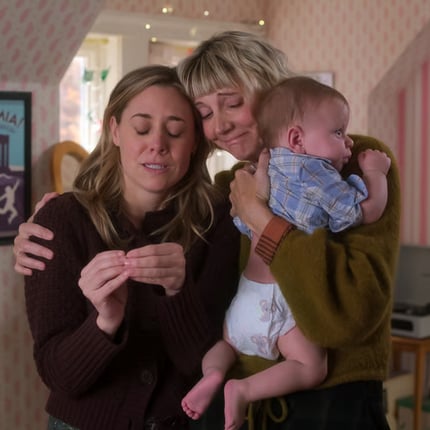
By the third episode, instead of serving us the predictable, petty conflict, the show uses the baby as an unexpected bridge. The two women bond, and as the series progresses, Anne not only befriends Ginny but invites her and the newborn to move in so she can help care for them. It redefines the show's entire dynamic.
Ginny inadvertently becomes the catalyst for Anne's liberation. The very person who shattered Anne's old life becomes the partner who helps her build a new one.
That is the power of sisterhood. And it is so rarely shown on screen with this much honesty.
The exhaustion of putting everyone first: the Thanksgiving flashback scene explained.

For years, Anne systematically put everyone else's needs ahead of her own; her husband, her daughter, and now Ginny and the baby. Season 2 is about the slow, messy process of dismantling that codependency.
The show highlights this through its dual holiday episodes. A pivotal pandemic flashback to a "Little Thanksgiving" reveals that Anne once threw a massive, not-so-socially-distanced holiday party for a heartbreaking reason: she was trying to drown out the noise of her marriage ending.
The flashback exposes that Nick's serial cheating stretched back long before the divorce. Anne knew, but she consciously chose to stay because she was utterly terrified of being alone.
Seeing her "jump scare" when Nick receives a text message brought a lump to my throat that I can't quite put into words. We have all been Anne at some point in relationships.
When she finally confronts him, she drops a line that is devastating in its vulnerability:
"You don't think I'm going to leave you, because you think I don't know how to live without you. And that is why this is so f***ing mean."
Fast-forward to the chaotic "Big Thanksgiving" in Episode 5, and the performance is entirely different. Her friends think Anne is throwing this high-stress dinner out of fragile grief, desperately trying to keep the old group's "vibe" alive.
In reality, Anne is drowning under the legal fallout of the estate, literally hiding financial documents in her freezer. The giant party is just a mask, a desperate performance of being "generous and fine" so no one sees her slipping underwater.
From performing to living authentically.

This culminates in a poignant arc where Anne curates her life through various staged photo shoots, sending snapshots to "a guy" to prove she is thriving. This broke my heart and made me feel seen all at once.
When you exit a long-term marriage, you almost always go through that exact phase. You desperately need the outside world to believe you are okay.
You over-perform happiness, aggressively seeking external validation because you don't quite possess it within yourself yet.
Ultimately, Anne stops performing.
During a group trip to Italy, after repeatedly being compared to La Befana, a depressing Italian Christmas witch, she decides she is entirely done living a tragic narrative.
Encouraged by Ginny, she makes a radical, fiercely independent choice to finally put herself first.
That's the arc. That's what makes Season 2 the ultimate vindication, for Anne, and for anyone watching who has lived the brutal, exhausting experience of being the phoenix who had to rise from the ashes.
But what I keep coming back to is Ginny. The fact that it is this woman, the one Anne had every right to resent, who becomes her greatest ally.
Not despite the baby, but because of him. Because when it comes to protecting a child, women find reserves of grace that defy logic. We choose the greater good. Not because we have to. Because we can.
That, more than any divorce arc or personal reinvention, is what makes The Four Seasons worth watching.
Feature Image: Netflix.
Win a $1000 voucher!
Do you love trying new skincare products? Complete our survey for a chance to win a voucher in our quarterly draw!
Take survey →Annaliese Todd
Lifestyle Producer
No Comments
Be the first to leave a comment