If you want to support independent women's media, become a Mamamia subscriber . Get an all-access pass to everything we make, including exclusive podcasts, articles, videos and our exercise app, MOVE.
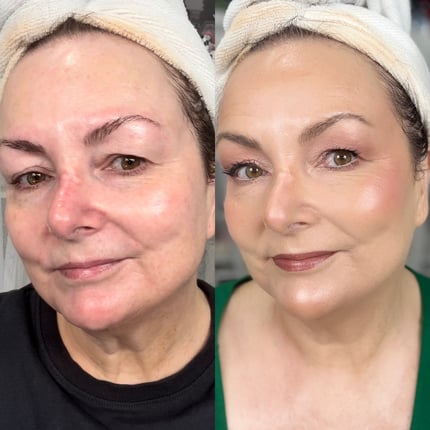
There's a moment many women hit somewhere in their forties or fifties where foundation suddenly seems to betray them.
The same product you wore religiously for years now looks dry by lunchtime. It settles into lines you swear weren't there yesterday. It clings to patches around your nose, separates on your chin, and somehow manages to make your skin look both shiny and flat at the same time.
That's when you assume the foundation is the problem. I did the same thing. It's literally how I started this journey into the beauty space after turning 50.
Watch: The hosts of You Beauty on the secret to long-lasting makeup. Post continues below.

As a beauty writer in my fifties, I've tested more foundations than I can count.
Luxury, pharmacy, viral TikTok favourites, professional formulas — I've tried all of them, searching for the one that would finally make my skin look like itself again. For a while, I really thought makeup had simply stopped working on me.
Eventually, I realised the issue wasn't the foundation. The issue was that my skin had changed dramatically, and I was still applying makeup like I was 35 (call it denial).
Why foundation suddenly stops working after 50.
I think this is the biggest foundation mistake women over 50 make.
We keep trying to force makeup to perform the same way it always has, without recognising that perimenopause and menopause fundamentally change the canvas underneath it.
Once you understand that, everything about foundation starts making more sense.
Menopause changes more than your skincare routine.
One of the biggest misconceptions around mature skin is that it simply becomes 'dry.' In reality, hormonal changes create a far more complicated situation than that.
As oestrogen declines during perimenopause and menopause, skin produces less oil, loses hydration more easily, and experiences slower cell turnover. Collagen levels decrease, the skin barrier becomes more fragile, and what once felt smooth and resilient can suddenly feel thinner, rougher, or oddly dehydrated.
Such a great time of our life.
A lot of women think they need heavier and heavier moisturisers or thicker foundations once they hit menopause, but dehydrated skin behaves very differently to dry skin.
Dehydrated skin lacks water, and when skin is lacking water, foundation has a habit of exposing every single issue. Texture becomes more visible. Makeup starts catching on areas you never noticed before. Products don't melt into the skin the same way they used to.
A foundation you adored at 38 can suddenly look powdery at 52 — not because the formula changed, but because your skin did.
The two makeup extremes women over 50 fall into.
This is when many of us start to swing to one extreme or the other.
We either start piling on more makeup — buying fuller coverage foundations, adding more powder, mattifying everything because we're worried about shine, and using primers designed to lock makeup in place for 16 hours straight — then wonder why our complexion suddenly looks heavier, older, and more textured than ever. Or we go completely the opposite direction and convince ourselves that foundation simply doesn't work anymore.
We resign ourselves to skin tints and BB creams, whether we actually like wearing them or not, because somewhere along the way, we were given the idea that women over 50 are only supposed to wear 'light' makeup.
Neither extreme is addressing the issue, though.
Why mature skin needs more prep, not more coverage.
Most women over 50 don't actually need more (or less) coverage. What they need is more preparation.
Forget what you learnt when you were younger — menopause changes the rules of makeup.
These days, I spend far longer preparing my skin than I do applying makeup, and it's made a bigger difference than any foundation launch ever could.
The skin prep shift that changed everything for me.
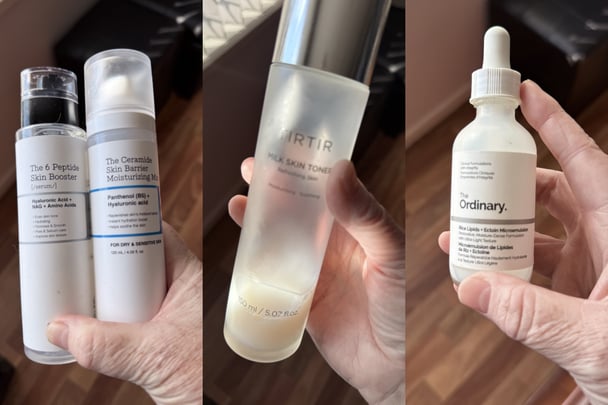
Hydration has become non-negotiable for me. I layer lightweight products rather than relying on one thick cream to do all the work. Milky toners, essences (squee, my favourite product category) and hydrating mists have become staples in my routine because they help restore water to the skin without making makeup slide around. I focus heavily on barrier support too.
Ceramides, glycerin, panthenol, and soothing ingredients that help the skin hold onto hydration properly — these are so much more important to my 55-year-old skin than actives.
Foundation technique matters more than ever.
I've also learnt that foundation application after 50 is far more about technique than perfection. When I was younger, I could aggressively buff full-coverage foundation across my face with a dense brush and somehow still end up looking polished. If I did that now, I'd look like I was wearing a mask by lunchtime.
For me, thin layers work better. Pressing foundation into the skin works better than dragging it around. A damp sponge often gives a more skin-like finish than a heavy brush. If using a brush, I either "prime" my brush (it uses less product) or go over afterwards with a clean, damp beauty sponge.
Also, spot concealing tends to look fresher than blanketing the entire face in coverage.
Let's talk about powder (because it's not the villain).
Now pay attention to this next bit! Contrary to what social media loves to tell women over 50, powder isn't automatically the enemy either. I said what I said!
I still wear powder almost every single day, and my makeup rarely looks cakey or heavy. The difference is that I no longer think of powder as the final step. It's simply one part of the overall balance between longevity, hydration, and skin prep.
Mature skin often still needs makeup to last. We still want the foundation to stay in place around the nose, through long work days, dinners, events and, yes, hot flushes. The problem usually isn't the powder itself. It's how much we're using, where we're placing it, and what's happening underneath it. It's also about what you do after (more on that later).
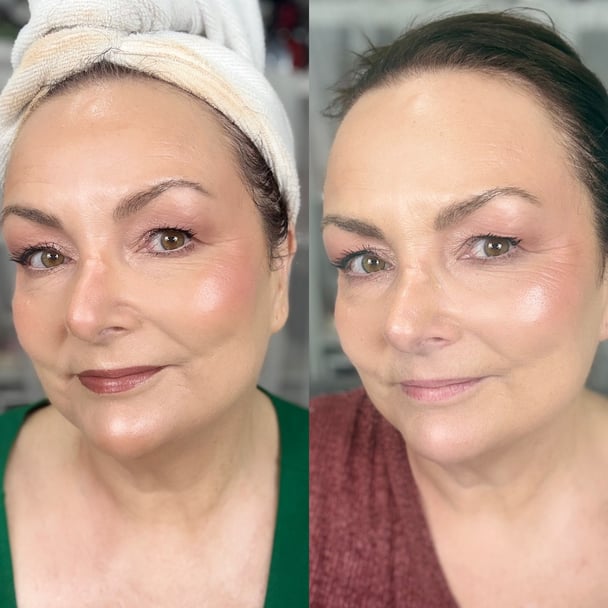
If the skin is dehydrated before makeup even begins, powder tends to emphasise every issue — but when skin is properly prepped and hydrated, powder can actually create one of the most beautiful finishes on mature skin: soft, refined, luminous, and long-wearing rather than greasy or slipping away by midday.
The real secret to glow and longevity after 50.
One of the biggest lessons I've learnt in my fifties is that glow doesn't come from avoiding powder altogether. It comes from understanding how to bring hydration back into the skin after makeup application, so everything melts together naturally.
The trick to makeup after 50 isn't necessarily less makeup — it's makeup that moves with your skin instead of sitting on top of it.
When skincare and makeup stop acting separately.
Another thing nobody really tells women is that skincare and makeup no longer operate separately once hormones start shifting.
Your SPF matters more. Your moisturiser matters more. Even how long you allow skincare to settle before applying foundation can completely change the finish.
I've had foundations I almost decluttered suddenly become favourites again once I improved my skin prep underneath them.
I know I'm not alone in this because I hear from women constantly who say the same thing: "Why does makeup suddenly look terrible on me?" The answer is usually not that they've aged out of beauty or that mature skin can't wear foundation anymore. It's that the canvas has changed, and nobody taught us how to adjust to it.
We're still following makeup rules written for younger skin.
Beauty after 50 needs new rules.
We need to remind ourselves: beauty after 50 isn't about trying to look 30 again. It's about learning what works for the skin you have now, not the skin you had twenty years ago (oh, even if we long for our perky chipmunk cheeks).
Funnily enough, once I stopped chasing the 'perfect' foundation and started focusing on hydration, skin prep, and application technique, my makeup started looking better than it had in years.
Now, I quite often say (with a full face of makeup) that my skin is skinning.
For more tried-and-tested beauty recommendations, subscribe to the weekly You Beauty newsletter, join our You Beauty Facebook group, listen to the You Beauty podcast or watch You Beauty on YouTube.
At Mamamia, we independently curate and write about products we rave about in our group chats and think you should know about, too. If you purchase a product we have recommended, we may earn a small commission.
Feature image: Supplied.
Win a $1000 voucher!
We want your opinion on what features you like in a car. Complete our survey for a chance to win a gift voucher in our quarterly draw!
Take survey →Teresa McNamara
Author
No Comments
Be the first to leave a comment