"Pain with periods is common," the doctor told Sally*, tossing the then-13-year-old a script for the contraceptive pill.
The teenage girl had been after answers for her heavy periods. For the crippling fatigue. For the pain that left her doubled over, unable to attend school. Instead, she was dismissed.
It would be a pattern for the next 13 years, until Sally was finally diagnosed with endometriosis — a chronic condition where tissue similar to the lining of the uterus (endometrium) grows outside the uterus.
Watch: Understanding Endometriosis and Hysterectomy Options. Post continues after video.

Endometriosis affects one in seven women in Australia, and is the leading cause of non-fatal disease burden among females due to reproductive and maternal conditions.
For years, Sally lived with this burden unknowingly. Made to believe she had a "low pain tolerance."
Her crippling pain was undermined and ignored until it was too late.
Now, Sally is paying the price. And she is not the only one.
This Endometriosis Awareness Month, four women share their stories.
The symptoms.
"The pain. God the pain."
Em knew her period wasn't 'normal' from a young age. Apart from the heavy bloating, she was constantly doubled over in pain. No one understood.
"I was met with faces that clearly were not experiencing the same," she told Mamamia.
Over the next few years, Em was put on a plethora of "restrictive diets." But nothing worked.
"It just got worse and worse."
"Weird" is the only way Ava* can describe her first few periods.
"They would go on for two weeks, I'd have two weeks off, and then get another period," she told Mamamia.
The contraceptive pill solved the irregular cycle. But the pain persisted.
"I was hospitalised a few times, it was so bad. And I had bloating every single day," she said.
Ava started to "feel like it was all in [her] head."
She retreated socially, "unable to trust" that her body wouldn't let her down.
"I became a shell, trying to get through each day rather than actually living."
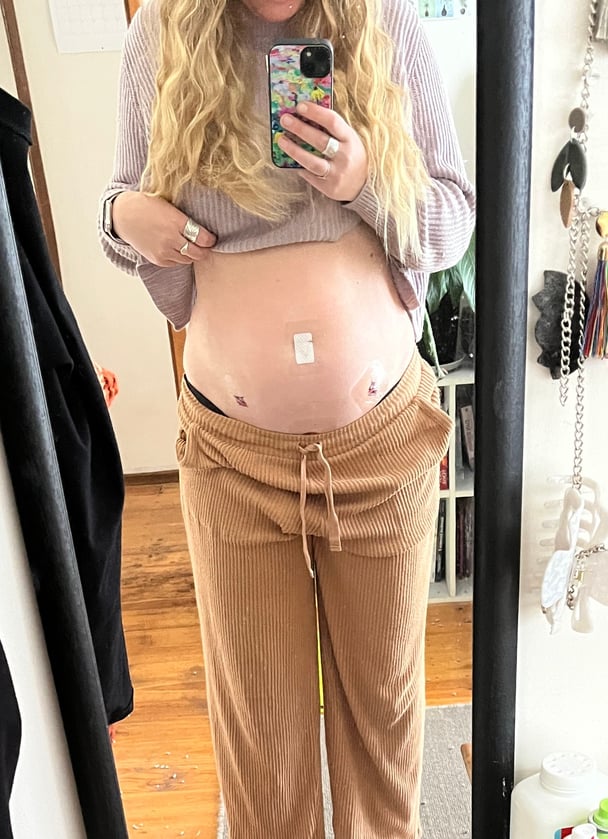
Kara still remembers telling her mum about her period pain.
"I would be doubled over with a heat pack and taking all the different kinds of over-the-counter pain meds. Yet I'd still be struggling," she told Mamamia.
The teenager would wake up in the middle of the night in agony, sometimes so nauseous that she would throw up.
"At times, I couldn't go to school," she said.
By 17, she'd started to lose her hair. And her iron became dangerously low.
"I went through a stage where I was constantly passing out. I even wore a heart monitor for a while."
Like Ava, she avoided social events, "terrified [she'd] pass out or throw up."
"It was a very isolating and lonely experience at such a vulnerable age."
The diagnosis.
It took Sally 13 years of appointments, tests, and self-advocacy before her "symptoms were taken seriously."
Finally, at 27, she was diagnosed with stage IV endometriosis.
Em and Ava were also in their late 20s and early 30s, respectively, when they were diagnosed.
"The first thing I said to the nurse was 'Did they find it?' through tears," Em recalled. "She held my hand and said, 'They did'. I've never felt such relief."
Sadly, their experiences aren't unique.
It takes, on average, over six years for someone to be diagnosed with endometriosis.
This is partly due to the dismissal of women's pain. But it's also because of how invasive the process is.
"There is no non-invasive diagnostic test that can identify all types of endometriosis," said Professor Caroline Gargett, a world-renowned stem cell researcher.
There are three types of endo: superficial (SUP), deep-infiltrating (DIE), and endometrioma (OMA).
For the latter two, a transvaginal ultrasound can be used. But, "the probe needs to be placed in the vagina, which is too intimidating for young adolescents," Gargett said.
Then there's superficial endo, which is often undetectable through ultrasound, meaning that laparoscopic surgery is the only option (i.e. a camera is inserted through a small incision in the abdomen.)
Like the probe, this form of 'keyhole surgery' is also "too invasive to be done in young adolescents."
"So there is a delay until girls become sexually active or mature young women."
The impact.
By the time Sally was diagnosed, in her late 20s, she worried it might be too late to have kids.
"Women with endometriosis may not be able to establish a family due to infertility," Gargett explained.
And the longer it takes to get diagnosed, the worse things can get.
"The disease can progress, requiring more complex and lengthy surgery to remove prior to IVF if they are infertile (they often are)," said the professor.
She added that, after the age of 35, "fertility drops rapidly and IVF rates decline markedly."
"Endo is a devil on fertility," Em said.
After surgery and months of trying to fall pregnant, Em was fortunate enough to welcome a son. But she and her partner have experienced three losses since.
"We are both immensely affected by the infertility struggles," she said.
Sally and her husband have also "been trying to start a family for seven years without success."
"IVF is now our only option," she said.
For Kara, who was diagnosed earlier than most (at 15), fertility was at the front of her mind from age 20.
"At first, I was resistant to stay with my partner because I knew he wanted a family, and I wasn't sure if I would be able to give him that," she said. "I also knew, after everything I had already been through medically and emotionally, there was no way I could handle IVF."
Aware that "things would only get worse," the couple started trying for a baby immediately.
"If it did not work naturally, we agreed we would look at other alternative options like fostering or adoption."
Now, 14 years later, Kara has been blessed with three children.

"It is a lifelong disease" — Caroline Gargett
There are also professional costs that come with endometriosis.
Some women "cannot hold full-time jobs or complete their education," said Gargett.
In Sally's case, to this day, she never knows when the pain will hit at work.
"I often feel like I need to overcompensate to make up for the times when I am unwell," she said.
"I also have to carefully save my sick leave and annual leave in case of flares, procedures or recovery time. That constant uncertainty can make it feel like I am always on the verge of losing my job."
Em's teaching career has also been affected.
"I've had to completely change the way I dress because you never know when you'll have a reaction. The period pain means teaching from a chair for that week."
Ava, meanwhile, exclusively works from home, where she can wear loose clothes and change seating positions regularly.
"I don't know how I would manage in an office now. I'm too scared of a workplace with a strict dress code and where I can't control my position."
"Women can become depressed from chronic pain" - Caroline Gargett.
For Kara, the most painful part of endometriosis is "being on the sidelines of life."
"So many hours and days in bed, unable to leave the house because of such a heavy flow, chronic fatigue, pain, nausea and vomiting. It breaks my heart."
The mother-of-three has grown so used to chronic pain that she didn't even realise her appendix had ruptured.
"I put the symptoms down to endo," she said. "I kept working, kept doing life. Laid down when I felt like I'd pass out, heat bags for the pain, and forged on."
The impact was almost fatal.
By the time Kara realised something was wrong and went to the hospital, her appendix "had been infected so long the tissue had started dying and adhering to [her] bowel."
The surgery took twice as long as it should have, and she needed a second operation.
But the surgeon gave Kara an impossible choice: it would either be a routine procedure, or her colon would have to be removed. They just didn't know which.
"I had to sign off on it, but they couldn't tell me what they would do, and they wouldn't make the decision until I was under," Kara said.
"I've never been so terrified before a surgery, and I've had many. I woke up in a panic looking for a stoma bag. Thankfully, they only had to remove fluid."
Where to now?
For so many women, it takes years of begging and invasive tests to get an endometriosis diagnosis; a diagnosis which infiltrates every aspect of their lives.
So, where to from here?
Professor Gargett is figuring that out. And she's going straight to the source… period blood.
"Menstrual fluid can provide an opportunity to develop a non-invasive diagnostic test," the scientist told Mamamia, "It contains endometrial tissue that can be analysed scientifically in many ways."
As well as diagnosis possibilities, period blood also has the potential to help with treatment.
"We can use the endometrial epithelial cells in menstrual fluid to make organoids," said Gargett (aka, microscopic models of a patient's uterine lining).
"These organoids can then be tested for drugs and hormones to see which ones work for women with endometriosis, personally. This could help hugely, as many women give up on hormones and drugs as they don't work for them. Or they have to try several for months at a time before it is concluded they don't work."
There's just one issue: money.
"Funding is a problem in Australia and probably elsewhere."
But with one in seven women suffering, it's clear something needs to be done.
For more resources and information about Endometriosis, visit Endometriosis Australia .
Feature Image: Supplied
*Certain names have been changed for privacy reasons.
Calling all past 3 months retail shoppers!
Complete our survey for a chance to win a $1,000 gift voucher in our quarterly draw!
Take survey →
Sign up to Mamamia Daily
Sent daily
Catie Powers
Author
No Comments
Be the first to leave a comment