If you want to support independent women's media, become a Mamamia subscriber . Get an all-access pass to everything we make, including exclusive podcasts, articles, videos and our exercise app, MOVE.
I went in for endometriosis surgery. I woke up with bowel cancer.
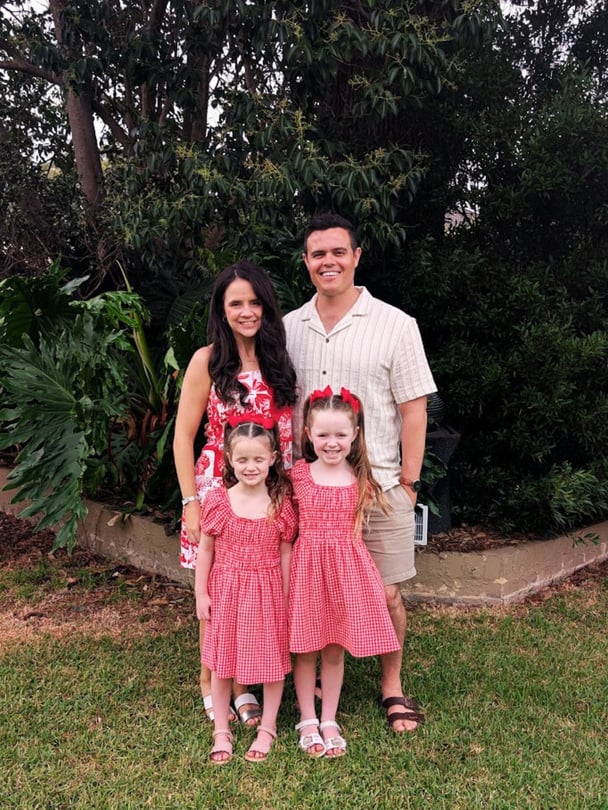
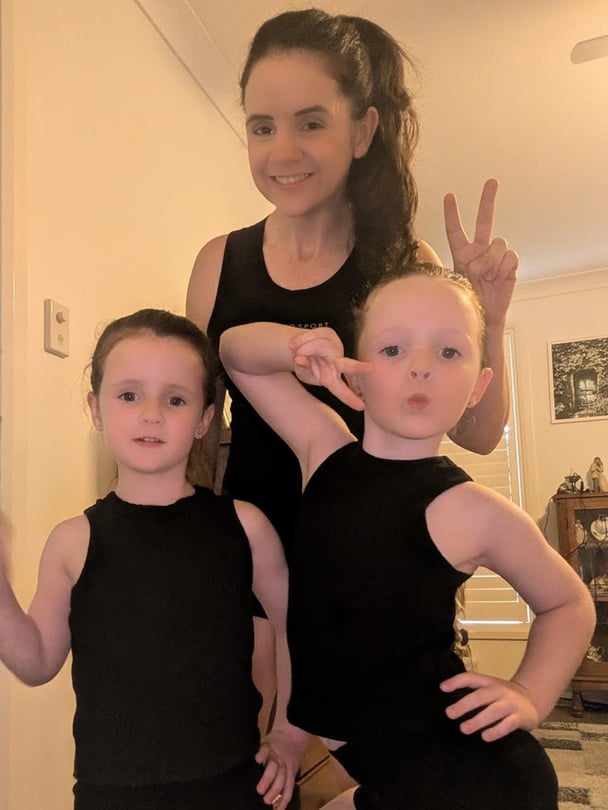
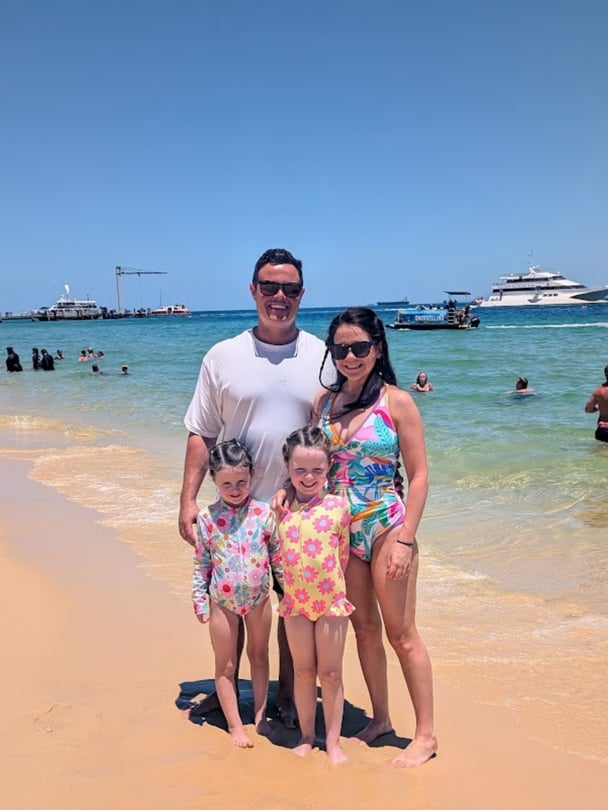
I'm 35. I have a husband and two young girls, four and six. I eat well. I exercise. I barely drink. I'm not overweight. I've never had a single puff of a cigarette. The diagnosis left me asking one question: what do you mean I have bowel cancer?
I hadn't taken a single sick day from work for the minor bowel symptoms I'd been having. They were manageable. No one knew except my family and a few close friends. People don't exactly talk about their poo.
We weren't going into "find out what was wrong." We thought we already knew. Endometriosis. Adenomyosis. That explained everything. Only it didn't.
Watch: Understanding endometriosis and hysterectomy options. Post continues below.

For two years, I knew something wasn't right. Nothing dramatic, just subtle changes in my bowel movements and cramping during ovulation and my period. Nothing Panadol and a heat pack couldn't fix.
We thought it was lactose intolerance. It became my normal.
Looking back, it wasn't normal.
I hadn't lost weight. I wasn't fatigued beyond normal mum life. No severe pain. No ongoing bleeding, except once, which is where this really starts.
Two and a half years ago, I had one bowel movement with blood. No pain, but it scared me enough to go to the emergency. After 18 hours, blood tests and a clear CT scan, I was told everything was fine. Likely internal haemorrhoids from having two babies in two years. I was 33.
A colonoscopy wasn't mentioned. Neither was cancer.
I followed up with my GP and asked about a colonoscopy. She reiterated that it was a one-off episode, my tests were clear, and specialists would likely be hesitant due to the small risks involved. It would probably just show haemorrhoids anyway.
A few months later, I went back with intermittent diarrhoea. Not constant. Not painful. Just annoying and usually linked to my cycle. Again, the tests came back "normal". I was told it was likely lactose intolerance or hormonal. I asked if it could be linked to the bleeding. I was told no.
So I cut out dairy. Nothing changed.
Another visit. Slightly elevated results this time, but still not enough to alarm anyone. I asked for a referral to a gastroenterologist. He wasn't concerned either. My symptoms weren't severe. I wasn't losing weight. I was healthy and too young for bowel cancer. He was the third doctor to tell me that.
He said he could do a colonoscopy for peace of mind, but it wasn't necessary. And honestly, who signs up for bowel prep and a camera up your butt if the professionals are telling you it's not needed? At that point, I started to feel a bit crazy. Maybe it was anxiety. Maybe I was overthinking it.
So I kept going. The symptoms weren't getting worse. Life was busy.
Then my GP changed practices, and I was referred to a new GP, a sliding door moment that literally saved my life.
We went through everything. I asked if it could be endometriosis. I'd been tracking patterns and it seemed possible. She agreed and sent me for a deep infiltrating endometriosis scan. No endometriosis was found, but adenomyosis was.
Finally, relief. An answer.
She referred me to an endometriosis specialist. She did another scan and this time found endometriosis. My ovary was stuck to my uterus. Adenomyosis confirmed again.
I wasn't crazy.
My endometriosis specialist was uneasy about the bleeding episode and referred me to the colorectal surgeon she works with. Endometriosis can grow on the bowel, so he may have needed to be involved during surgery anyway.
He said we would do an endoscopy and colonoscopy to rule out Crohn's disease, coeliac disease, ulcerative colitis … and cancer.
He told me it was about a 1 in 1,000 chance.
Tiny.
I even asked if we could delay until November. He said no problem, no rush.
Only there was a rush. We just didn't know it.
November came. It was meant to be a four-hour surgery. I sent my husband home to do school pickups. I remember telling the surgeons I was scared of what they might find.
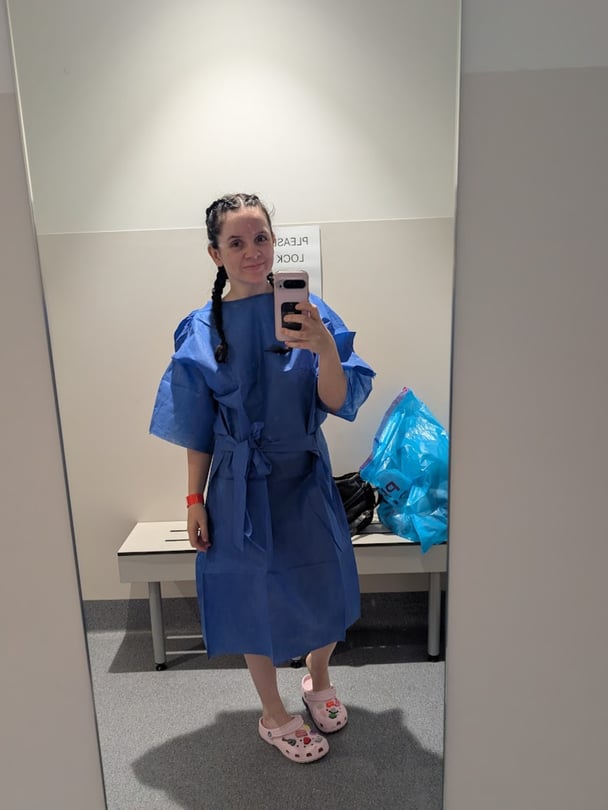
When I woke up, I knew something was wrong. I wasn't in pain. It had only been 45 minutes.
The surgeons were standing at the end of my bed in recovery. I will never forget their faces.
"We couldn't do the surgery. We found a 3cm tumour on your transverse colon."
Cancer.
Transverse colon. I didn't even know what that was.
They handed me the phone and I told my husband, who was picking up our daughters from school, "I have bowel cancer".
We had gone in for endometriosis.
The weekend that followed was the worst of my life. CT scans. Blood tests. An iron infusion. Waiting to find out if it had spread. I kept looking at my girls, thinking, how much will they remember if I'm not here?
On Wednesday, the surgeon said, "I have good news. It hasn't spread. There is no evidence of metastatic disease."
I dropped into my chair.
Ten days later, I had major surgery. They removed 40cm of my bowel. The tumour was the size of a golf ball. Stage 2 or 3. we had to wait.
Five days later we got the results.
Stage 2A. Low-risk features. No chemo needed.
I have a 5–10 per cent chance of recurrence. Good odds. But I only had a 0.1 per cent chance of getting bowel cancer in the first place. I'm trying to focus on the 90–95 per cent chance that surgery cured me.
The doctors who told me I was fine weren't negligent. They followed the guidelines for someone my age with mild symptoms and mostly normal tests.
But bowel cancer is rising in younger people, especially women, particularly those with symptoms that overlap with pregnancy, endometriosis or IBS.
We're told it's hormonal. Post-pregnancy. Food intolerance. Anxiety.
Sometimes that's true.
Sometimes it's not.
I still have symptoms, which means it's likely my original symptoms were caused by endometriosis. We just happened to find the cancer. We weren't looking for it and that's what still feels surreal.
Now I'm doing everything I can to reduce the risk of recurrence. I'm eating well, cutting out processed meats, limiting ultra-processed foods, barely drinking, and exercising, probably more than I ever have. I want to give my body the best chance possible. I'm also trying to slow down, spend more time with my family, say yes to travel, and not wait for "someday".
And I plan to raise awareness along the way.
A lot of people speculate about what causes bowel cancer. I'm still waiting to see a geneticist to understand whether there's a reason in my case. What I do know is that it takes 10–15 years for the bowel to change from normal to polyp to cancer. This had been developing in my body for a long time.
Maybe it was genetics. Maybe the environment. Maybe diet. The truth is, we don't always know.
My diagnosis took an emergency visit, a gastroenterologist, two GPs, two CT scans and two surgeons. A lot of people would have stopped. If I had, I wouldn't be here.
Endometriosis saved my life, and so did my doctors.
Listen: The strangest places endometriosis has been found. Post continues below.
I feel like the luckiest unlucky person.
Unlucky to have bowel cancer at 35. But incredibly lucky to have people who pushed and found it before it was too late.
1 in 1,000 is a statistic.
I'm not a statistic.
This is my life.
And sometimes the tiny chance isn't tiny at all.
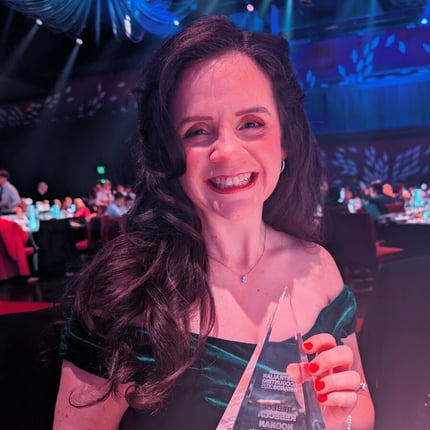
Feature Image: Supplied.
Calling all drivers!
We're keen to understand what you value in a car. Complete our survey now for a chance to win a $1,000 gift voucher in our quarterly draw!
Take survey →
Sign up to Mamamia Daily
Sent daily
Rebecca Noonan
Author
No Comments
Be the first to leave a comment