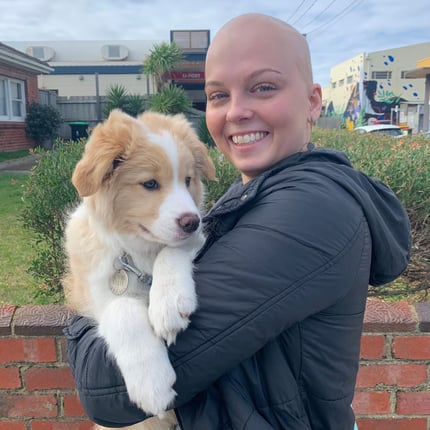
If you want to support independent women's media, become a Mamamia subscriber . Get an all-access pass to everything we make, including exclusive podcasts, articles, videos and our exercise app, MOVE.
When Emily was 26, her life was blissfully, beautifully ordinary.
She had just wrapped up an incredible eight-month solo backpacking trip around the world, landed her dream job at a local florist, and was happily navigating life with her partner of five years.
She was young, unburdened, and entirely convinced that time was on her side.
"I didn't have a lot of cares at the time," Emily recalled. "It was a fairly carefree sort of lifestyle."
Then, a moment in the shower changed everything.
Speaking to Mamamia's WELL podcast, Emily opened up about the raw, confronting reality of being diagnosed with a terminal illness at such a young age.
And the brutally honest truths about sex, early menopause, and marriage, she is determined to bring to light.
Watch: How cancer changed Emily's relationship. Post continues below.

The shower discovery that changed everything.
It's the exact scenario we have all been told to look out for, but don't actually expect to experience ourselves. Emily was just 26 when she felt a lump.
"I was having a shower, and found a lump," she said. She didn't think too much of it, just that something was a little "not right".
Like many young women, she put off looking into it at first. But after mentioning it to her parents, she booked a visit to her GP.
The doctor felt the area, assured her it was likely nothing to worry about, but ordered an ultrasound just to be safe.
During the scan, the entire energy in the room shifted. The technician lingered heavily over a spot Emily hadn't even pointed out before abruptly leaving to find a supervisor.
"The supervisor came in, she had a look and said, 'Look, I'm not meant to say much, however, I would suggest that when you get your results, you go straight and have a biopsy,'" Emily said.
Four hours later, her GP called, asking her to come back to the clinic that very night.
"He explained what the results had shown and said, 'Without a biopsy we can't confirm anything, however...' I think his exact words were, 'It would be stupid not to be worried.'"
"It was very scary at the time, being 26... I was imagining the worst, and the worst is cancer, but 26-year-olds don't get breast cancer, so what else could it be?"
The crushing isolation of a COVID-era diagnosis.
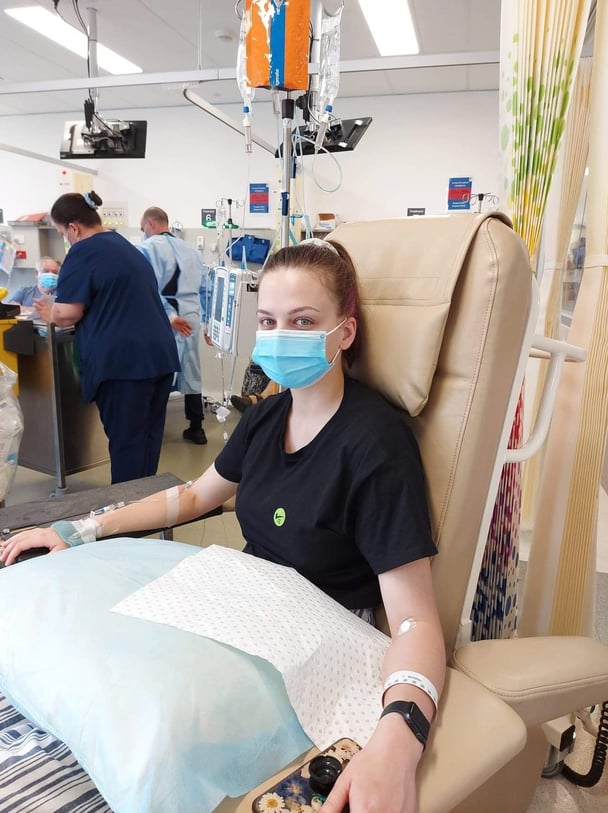
The weeks that followed were a whirlwind. Because the world was in the thick of the COVID-19 pandemic, hospital restrictions meant Emily had to face the single most terrifying moment of her life completely alone.
"I remember going into the room and sitting down with the specialist and being told the biopsy results came back, they're stage 3 breast cancer," Emily recalled.
"And then she asked me to take my top off and lie back on the bed. I was crying at this point, and I was like, why am I lying here with my top off? You've just told me I have cancer, and I felt very vulnerable. Because it was COVID, I actually wasn't allowed to bring a person in for that initial moment."
Eventually, Emily was allowed to call her mum in from the car. "Mum was able to take on all the information that I don't remember," Emily said.
In that one sitting, she was hit with an avalanche of life-altering choices: fertility preservation, egg harvesting, immediate chemotherapy, radiation, genetic testing, and bilateral mastectomies.
To save her from spiralling, her specialist gave her one non-negotiable rule: Don't Google.
"She explained that anything I found on the internet wouldn't be relevant for a person of my age and my experience," Emily said. "So the statistics that you see are probably not relevant for someone in their mid-twenties."
Listen: To Emily's full story on WELL. Post continues below.
Living with the ultimate unknown.
That initial diagnosis was six years ago. Three years later, at just 29 years old, the cancer progressed, leaving her with a terminal metastatic breast cancer ( MBC) diagnosis.
For the past three years, she has been navigating this heavy reality, managing her daily health with targeted tablets and monthly injections.
But a stage 4 diagnosis carries a psychological weight that standard treatments can't fix: the complete absence of a timeline.
Emily doesn't know her outcome. She carries the uncertainty every single day.
"In the back of my head, there's always that thing of, 'I don't know how long I've got', so I don't want to hold any resentment towards anyone, especially my husband," she explained.
Rather than letting the unknown paralyse her, Emily writes her goals down in a notebook, actively ticking items off her bucket list.
"I just find that it makes me feel really fulfilled and gives me something to look forward to even when things are feeling pretty dark."
Marriage, guilt, and the 'third person' in the relationship.
Emily and her husband, Lane, have been together for nearly 11 years.
As Emily shared, facing a terminal illness so early in a relationship completely rewrites the script of a young marriage.
"He never signed up to have a partner that would have metastatic breast cancer, and that's quite a difficult thing, at least for me to process, because there's a little bit of guilt around it on my end," she said.
"Our relationship definitely looks different than it did [in our] early twenties... there's a lot more hardship in the background than we ever thought there would be."
Lane has been her absolute rock — a calm, steady presence when she needs to vent or express her deepest frustrations. Together, they make a deliberate choice to keep cancer from becoming a 'third person' in their marriage.
The taboo realities of early menopause and intimacy.
One of the most fiercely guarded, rarely discussed side effects of young cancer treatment is what happens behind closed doors.
Because of her medical regimen, Emily was plunged directly into medically induced early menopause. She has been living with the symptoms for six years.
"Cancer changes things, and unfortunately, it does come into the bedroom," she said honestly.
The physical changes and surgical scars took an inevitable toll on her body image, but as she shared with Mamamia, Lane refused to let her pull away.
"When I'm feeling particularly self-conscious or just... having difficulties with how I now look, he's the one in the background telling me that he thinks I'm beautiful."
"Intimacy does look different for us now. There's more emphasis on those smaller moments," Emily explained.
"I love doing those mundane things with him. He's just my favourite person to spend time with. So we go to the supermarket together, or we go to the gym together, and it's those little things that I actually really value, and I find intimacy in those small moments. Intimacy doesn't have to be necessarily in the bedroom."
Dismantling the 'warrior' myth and the real cost of cancer.
Emily is determined to break down the societal tropes that get thrown at cancer patients. She gently rejects the well-meaning "warrior" or "heroic fighter" labels.
"I appreciate it when people have such positive things to say... but I do want people to remember I wasn't given a choice," she said. "If I wanted to still be here, I had to do everything that they threw at me... It's not because I wanted to be strong in this way, it's just I've had no choice but to be."
When asked what the single greatest piece of advice she could offer to any couple or individual staring down a medical crisis, Emily's words are a necessary reminder for us all:
"Communication would be my number one thing, and go and do the fun stuff. Life's too short, so book the holiday and take the dog on the trip to the beach, even though it's cold, because he wants to go. We just try to fill in the days with the enjoyable moments."
Well, Mamamia's health brand for women, is shaped by the health experiences of women just like you. Sign up to the Well newsletter to receive your weekly dose of trusted health expertise without the medical jargon, ask a question, or share your story.
Through her advocacy work with Breast Cancer Network Australia (BCNA), and her personal project, My 13 Truths to Living with Metastatic Breast Cancer, Emily hopes to raise awareness that for the metastatic community, there is no "finish line."
BCNA provides information and support to those diagnosed and their supporters, offers opportunities to connect with others going through a similar situation, and works to influence a stronger healthcare system to ensure all Australians affected by breast cancer receive the very best care, treatment, and support.
Feature Image: Supplied.

Win a $1000 voucher!
We want your opinion on what features you like in a car. Complete our survey for a chance to win a gift voucher in our quarterly draw!
Take survey →Annaliese Todd
Lifestyle Producer
No Comments
Be the first to leave a comment