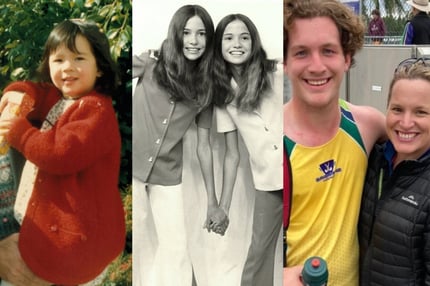
When she was 27, journalist Sarah Dingle's mother told her - in a rather nonchalant way - that her father was not actually her biological father.
That, in fact, Sarah was donor-conceived with anonymous donor sperm.
At first, Sarah didn't believe her. She thought her mum was telling a joke; a weird, pretty off-colour and out-of-character joke, but a joke nonetheless.
"I made her say it several times because I couldn't take it in. And by the time she said it for, I don't know, the third time or something, I had to accept that I should pay attention to what she was saying," Sarah tellsMamamia.
"By the time I started to take it in, everything in the room went a bit strange, the sound went 'woooooo'. And I felt like I was about to faint or I'd sort of lost oxygen. It's one of those moments where, it's such a cliche, but the only word I can use to describe it is 'surreal'. And you start to go, 'Is this really my life?'"
What followed was a 10-year odyssey to find out who her biological father was - and ultimately expose the profoundly disturbing lawlessness of the fertility industry here in Australia. Sarah, who is now 39, wrote her experience in her book Brave New Humans: The Dirty Truth Behind the Fertility Industry and participated inSBS'sdocumentary series Australia Uncovered.
Watch the trailer for Australia Uncovered Season 2. Story continues below.
Unlike some other donor-conceived people who feel they don't quite belong, Sarah had no inkling at all that her dad, who died when she was 15, was not her biological father.
"My mother's Malaysian Chinese. My father, that I thought was my biological father, was Anglo Saxon. I'm Eurasian; I don't really look like anyone. And when you're from two different cultures, you never feel like you quite fit anyway, so perhaps any sort of questions I might have had I just attributed to that," Sarah explains.
"I never questioned anything about my family. At all. Which is why it hit me really, really, really hard."
After trying to find out more information from the fertility clinic where she was conceived, Sarah discovered that the donor conception codes, which contained information on who her biological father was, how many children had been conceived from his sperm and who these other children were, had been destroyed by the clinic.
Sarah would go on to learn that this practice was not uncommon, and that it is difficult to hold fertility clinics accountable due to the lack of clear regulations - then or now.
"There's no national laws. There's a set of guidelines, which clinics are supposed to adhere to - which they have not adhered to. And the other thing to say about those guidelines is that they're self-policing. So if you're not obeying those guidelines, the only organisation that is going to check up on you is the peer body for the fertility clinic," she says.
For anyone else, coming across a big hurdle like destroyed donor codes might have stopped them from proceeding any further - but not Sarah. Her journalist's brain would not let the issue rest.
As she investigated deeper, she made another startling discovery - her friend, Rebecca Ronan, who Sarah had met after Rebecca reached out as a donor child herself, was not just a friend: they were half-sisters. While they may not look alike, there are so many other things the two have in common.
"I think I've struggled with it more than Bec has. There's absolutely no guidebook to this kind of thing, which is something people say often, but there really is no guidebook for finding out as an adult that you have many, many, many, many siblings, and you already know one of them," Sarah contends with a laugh.
"I think I flipped out and withdrew a bit at first because I was like, 'I actually don't know the significance of this'. I don't know how to behave. I don't know what I should do. And Bec's more of an extrovert, much more of an extrovert than I am anyway. We are [closer] but it's different too because our lives have changed since then."
Both Sarah and Rebecca now have children of their own. "And the weird thing is when we get our daughters together, once again, they don't look anything alike but they are the same person."
The half-sisters have also found other siblings. "It covers the whole range, so people that we know exist but we are not allowed to contact, people who we know are siblings and we've made contact but we have not met them, and then people who we know are siblings and we've met them," Sarah says.
"And there's more to come; there will always be more to come. I will, and Bec will, never have any sense, at any point in our lives, that we finally know the full extent of our family. We will just have random siblings popping up until the day we die."
Together with Rebecca, Sarah tracked down their biological father. In 2016, they found him. As it turned out, he had left a letter with the fertility clinic for any future children who might come looking for him.
"Yes, half of you came from me: your father wanted you but couldn’t get you, and it was I who did him the favour he needed most. Yes, I will let you know where that half of you came from. Yes, I will gladly meet you if that’s what you want. Yes, I will show you my life, and I will tell you about myself and my relatives. And I will always let you have any medical information you may need," the letter read.
The clinic had never provided the letter to Sarah, Rebecca, or anyone else.
After coming into contact with their biological father, the sisters agreed to meet up with him at a restaurant. Sarah recalls being understandably nervous.
"I have this thing that I do, where before I meet someone really important in my life, I get nervous and then I get lost and then I'm late," she says, laughing. "I wasreallylate to meet Bec. I don't think I was quite as late to meet my biological father but yeah, I was really nervous walking into the restaurant."
Their first meeting may have been a little fraught, but Sarah maintains a good relationship with her biological father today. It is of course not the same as the one she had with her father; no-one will ever take his place in her heart.
Given the struggle she went through to find her biological father and the abuse of power by fertility clinics, Sarah would like to see changes in federal law. And, in the absence of federal law, nationally consistent laws - currently, different states have different laws regarding donor conception.
"That is incredibly unfair. Why do you get to know your biological father if you're a donor-conceived person in Melbourne but not if you're donor-conceived of the same age in Hobart? Why are you judged aslesserand as incapable of having that knowledge?" Sarah says. She would also like records to be kept and held in perpetuity, rather than an "arbitrary period of five or 10 years, or destroyed at will".
"I want laws that implement minimum standards to uphold the basic human rights of the child... we're not asking for the moon or the sun or the sky; we're asking for basic human rights. The right to know your biological parents. The right to know who your biological siblings are so that you don't, I don't know, accidentally sleep with them!"
Accidental incest is something that Brisbane mother-of-five, Shannon, has thought about often over the years. Her children were all conceived via the same anonymous donor, starting with her eldest, Zac, almost 20 years ago.
Shannon, who is gay, had very limited options for donors back then because many men were not willing to father children for homosexual couples. As she recalls, she and her partner sat in a room with a geneticist, trying to see if they would be eligible for a donor. Shannon was 23 at the time.
"It was very much a case of, 'You tell us what you're looking for, briefly, like what would you say are your top three things. And then we'll see what we've got.' I told the geneticist first and foremost that my partner [at the time - the couple have since broken up] and I wanted someone who was willing to be identified when the kids were older because to us that was really important," Shannon tellsMamamia.
"And then we basically just tried to match characteristics of my ex-partner, along with the fact that 'sporty' to us was really important because I'm a very sporty person and also it's just a great way to meet people. It's a great life skill and it brings so much enjoyment."
Aside from that, Shannon asked for "medium skin" because she's got "your typical pasty English, Irish fair skin" and really wanted her children to have skin protection in the sunny climes of Australia. Blue eyes would be nice because her partner at the time had blue eyes and so did her mother.
The geneticist flicked through her book of donors.
"At that stage, donors could nominate whether or not they wanted to donate to lesbians, and many didn't. And so she came up with only two that she told us met that criteria. There was one who liked footy and surfing and was a sports administrator at a school. And that sounded really good to me because my parents are both teachers. And honestly, that was all the information we had. We didn't get to read the profile," Shannon says.
"I can remember trying to sort of look and her sort of pulling [the book] away a bit. I felt that it very much had the feeling of the 'under the table, we keep this information, we tell you only what you need to know'... I was very young. I just assumed that was the process. I certainly wasn't going to ask any questions because I was just grateful that we were given access, based on the fact we were a same-sex couple.
"So we just kept our mouths shut and did as we were told, and blindly trusted that everything was as it should be, and that the clinic knew all the rules and regulations. We were just grateful."
Listen to Mamamia's parenting podcast How To Build A Human. Story continues below.
It was only after Shannon had given birth to Zac that she began to gauge just how unregulated the fertility clinics were. She was at a daycare with her son and chatting with the owner when talk turned to donors.
"She said something about this other couple [who was also same-sex and had a child at the daycare] and how they had been certain that they were going to have a girl, which they were excited about, because their donor was a surfer so he spent a lot of time in the ocean. I don't know whether it's an urban myth or whatever that if men spend time in lower temperatures, they're more likely to produce girls. And I said, 'Oh, that's interesting. Because our donor liked surfing too'," Shannon says.
After comparing a few notes on the donor, it became obvious that there were a lot of similarities.
"It was just this huge, big punch in the stomach. Just the shock. I don't mean in a negative way. It wasn't positive or negative. It was just this penny dropping," she recalls.
"And I just went, 'Oh, my goodness.' And we just left it. We didn't say another thing about it. We just sort of both looked at one another. Both absolutely gobsmacked. Just not really game to talk about it any further. And then she said, 'Look, I'll go away and I'll talk to the girls and find out what their donor number was'."
The donor numbers did indeed turn out to match, meaning that little Zac had a half-sibling. Once she'd had time to process the news, Shannon decided it was a very positive outcome.
"You know, it felt like a really nice connection. Surreal, but after I'd gotten over the shock, I didn't feel any kind of threat by it. I just thought, 'Well, isn't that lovely?' And what a coincidence, small world. The other family, on the other hand, went the other way," she says.
"I've learned over the years that this is a very polarising issue for a lot of same-sex couples, because some really want to embrace the donor sibling factor. Others feel it threatens their nuclear family. And that ended up being the reason why they pulled [their little girl] out of care, and eventually moving away. And we have not had any contact with them or anything like that, which really hurt me. It really upset me at the time. I now have a much greater understanding of their perspective and their freedom to make that choice.
"I do wonder whether they'll ever tell their kids, because they had another set of twins after that, with the same donor. Everyone has their own views on the importance of that information. Some people feel it undermines the relationship of the mums. I have a different view. I just feel like it is that child's genetic information. It's factual. I don't think it does any good to hide it."
Shannon had always been intent on her kids knowing who their biological father was, once they turned 18. It was the one criteria she was adamant about when choosing a donor.

Sign up to Mamamia Daily
Sent daily
Adrienne Tam
Author
No Comments
Be the first to leave a comment