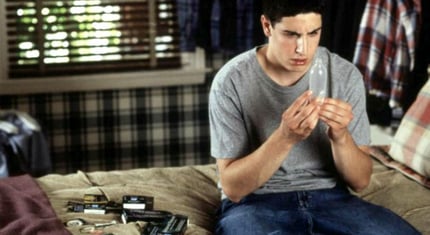
Image: American Pie.
“It’s like showering in a raincoat.” “I don’t get as much pleasure.” “It kills my erection.” Hands up if you’ve ever heard these protestations fall out of a man’s mouth the moment a condom wrapper comes into view?
For anyone who doesn’t want to put themselves at risk of an STI (so… that’s all of us?), and who doesn’t want to fall pregnant, putting on a condom is a vital step in the practice of safe sex. Yet there are grown men out there who try to bypass it, using the excuse it impairs their sexual performance and robs them of pleasure.
RELATED: Meet the new female condom that’s “guaranteed” to give you an orgasm.
If you’ve always suspected this was complete bullshit (yep, us too) you’ll be pleased to know science is on your side. Sorry, men.
According to the results of a new study in The Journal of Sexual Medicine, heterosexual men who blame condoms for difficulties during sex are more likely to experience general erectile dysfunction than those who don’t.
As The Daily Beast reports, researchers surveyed approximately 500 men aged between 18 and 24. Of this group, 38 per cent reported no effect of condoms on their performance, while 32 per cent said condoms affected their ability to maintain an erection. (Post continues after gallery.)
Memorable Sex Scenes
Titanic
Titanic.
Friends With Benefits
Friends With Benefits (Castle Rock Entertainment)
Sex And The City
Sex And The City (HBO)
Girls
Girls (HBO)
Bridesmaids
Bridesmaids (Universal Pictures)
American Pie
American Pie (Universal Pictures)
Gone Girl
Gone Girl (20th Century Fox)
Friends
Friends (Warner Brothers Television)
The 40 Year-Old Virgin
The 40 Year-Old Virgin (Universal Pictures)
It turns out the men who reported condom-associated erection problems were significantly more likely to also report erection issues during sexual encounters when they weren’t wearing a condom. The study authors speculate there could be a couple of reasons for this.
RELATED: This 23-year-old just solved the condom problem.
“[M]en who first experience loss of erection when they use condoms might worry about [difficulty] experiencing erections more generally,” they write, adding that this concern could make men more vulnerable to erectile problems.
The proper use of condoms could also be a contributing factor. Interestingly, a number of the subjects reported erectile difficulties during the process of putting on a condom — and a third of those surveyed said they’d never been taught how to use a condom correctly, which is kind of alarming.
Don't let anyone try to talk you out of safe sex.
Putting on a condom can be a little fiddly at the best of times, so it's understandable that lacking confidence in this area could make a man feel a bit nervous or self-conscious.
RELATED: Is there any truth to these contraception myths?
That said, it's no excuse for attempting to talk a partner out of practicing safe sex and, in the process, putting their health at risk. Men do experience erectile difficulties, so rather than pointing the finger at condoms, it's important to see a doctor to explore why it might be occurring and what can be done to resolve it.
This isn't the first time researchers have investigated whether condoms affect the quality of sex; in 2013, a study team analysed data from more than 1600 men and women whose most recent sexual event involved intercourse. (Post continues after video.)
When it came to factors like sexual arousal, ease of erection, pleasure and orgasm, there wasn't a whole lot of difference between those who had worn condoms and those who hadn't, although the use of lubricant with or without a condom did influence results among men.
So next time a guy tries to convince you to let him go bareback because condoms don't feel as good, simply respond with the timeless wisdom of the Spice Girls: "Be a little bit wiser, baby. Put it on, put it on."
Has a man ever tried to talk you out of using condoms?
Popular forms of birth control
Contraceptive pill
The Pillis the most popular form of birth control. There are two types: the combined pill, containing two hormones, and theprogestogen-only, or mini, pill, which only contains one female hormone. The combined pill works by preventing the ovary from releasing an egg each month. The mini pill changes the mucus at the entrance of the uterus, which stops sperm from entering. Both are 99.7% effective; however, they don't offer protection from STDs.
Intrauterine device
IUDs are small, T-shaped devices that are inserted into the uterus by a doctor in order to prevent pregnancy. There are two types of IUD: copper, which affects the movement and survival of sperm in the womb while changing the lining of the womb;and hormonal, which releases progestogen (a synthetic version of the naturally-occurring hormone progesterone) into the uterus. Although IUDs have a success rate of more than 99%, only around 2% of Australian women currently use one.
Condoms
The male condom is a barrier contraception that prevents both pregnancy and the transmission of STDs. They work by collecting semen so it doesn't enter theman's partner's body. Condoms are 95 to 99% effective at preventing pregnancy.
The female condom
The female condom is a pre-lubricated sheath, which loosely fits inside of the vagina. The condom has a removable ring, which helps to insert the sheath and keep the condom in place. A larger ring remains on the outside to cover the opening of the vagina. They are designed to fit all women and can only to be used once. Due to misuse of the product it is only 79 per cent effective.
Diaphragm
Like the male condom, the diaphragm is a barrier method of contraception. It's a shallow silicone dome that's inserted into the vagina andcovers the cervix, which is the entrance to the uterus. It's held in place by the pelvic muscles, and works by preventing sperm from entering the uterus. After sex, diaphragms need to remain in placefor another six hours, in which time the sperm inside the vagina die. This method is 88 to 94% effective at preventing pregnancy, although this rate increases with experience.
Birth control implant
This is a 4cm-longimplant that is inserted into a woman's upper arm, just under the skin, by a doctor. It releases a hormone called etonogestrel, which prevents ovulation and thickens the mucus in the cervix, which can stop sperm from entering. Contraceptive implants - usually sold as Implanon - are removed under anaesthetic every three years, and are close to 100% effective.
Author
No Comments
Be the first to leave a comment