Image via iStock.
By: Andrew Whitehouse , University of Western Australia .
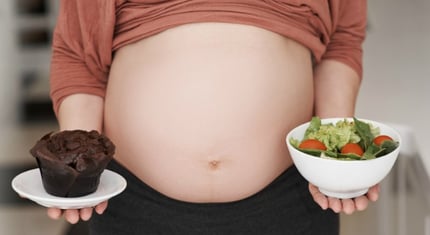
There aren’t too many topics about pregnancy more controversial than what a mother-to-be can and can’t eat.
No sooner does a couple announce the news of an impending arrival than a woman is bombarded with a list of rules about what she is and isn’t allowed to put in her mouth.
RELATED: Just how dangerous is the paleo diet for your child?
“Don’t eat foods containing soft cheeses, cold meats, soft-serve ice-cream, salads, raw egg, unwashed vegetables…but don’t worry, just take it easy and enjoy the ride”. Yeah, right.
While this must drive women barmy, one question that’s always intrigued me is about the flavour of the food. The mother and a developing fetus are so tightly connected, an intriguing question is whether a woman’s food choices during pregnancy can influence what the child likes to eat after birth.
So, what science is out there? (Post continues after gallery.)
Celebrity Pregnancies
Duchess Catherine
Princess Charlene of Monaco
Duchess Catherine
Sonia Kruger
Amanda Peet
Kourtney Kardashian
Kelly Rowland
Zoe Saldana
Hayden Panettiere
Gwen Stefani
Asher Keddie
Liv Tyler
Kirsten Bell
Mila Jovovich
Strange-smelling newborns
The first scientific hint that specific elements of a mother’s diet may affect the developing baby came through intriguing reports from hospitals of infants who were born with distinctive smells.
One of the most famous series of case studies came from an Israeli team, who described four newborns with distinctive odours reminiscent of a meal the mother ate just prior to giving birth.
RELATED: You can now buy perfume that smells like a baby’s head.
Two mothers in this case series had given birth to babies that had a distinct smell of cumin. After a quick quizzing, the mothers told the researchers that in the days leading up to delivery they had both eaten “schug”, which is a Middle-Eastern hot sauce containing cumin, garlic, salt, oil and pepper.
The newborn of another woman had a sharp odour of fenugreek, a leguminous plant with seeds that have a slightly sweet, nutty flavour. Similar questioning found that, just prior to delivery, the mother had eaten a good serve of “hilbeh” – a Yemenite dish prepared from fenugreek.
These case reports provide our first hint of evidence that this old wives’ tale may indeed be true. A mother’s diet may have a lasting effect on her baby.
Princess Charlotte would surely have smelt of tea and scones yes?
The next step is to explore the biological mechanisms through which this may occur.
Flavouring the amniotic fluid
Food and drink that we ingest are broken down into small molecules by our stomach and intestines, and are then absorbed and transferred to our blood stream. During pregnancy, molecules in the mother’s blood stream, including those that may produce a smell, can be passed to the bloodstream of the fetus through the placenta and umbilical cord.

Inside the womb, the fetus sits within a membrane (amniotic sac) that is filled with mucous-like fluid (amniotic fluid). The developing baby is able to urinate into the amniotic fluid, which means that at least a portion of the odorous molecules that originated with the mother can be transferred to the baby via the placenta and umbilical cord, and end up in the amniotic fluid.
After bathing in a sac full of smelly fluid for forty weeks, it would be no wonder that a fetus would also come out of the sac with a bit of a pong.
Julie Mennella and colleagues from the United States were the first to demonstrate experimentally that a woman’s diet can change the odour of the amniotic fluid in the womb. The researchers identified ten women who were about to undergo a routine amniocentesis.
RELATED: Now placenta is being used as a hair treatment
Amniocentesis is a procedure in which a small sample of amniotic fluid is drawn out of the amniotic sac by a large needle to undergo medical testing. All of the women were in the second trimester of their pregnancy.
About forty-five minutes before their amniocentesis, five women were asked to swallow a capsule that contained garlic extract, while the other five woman swallowed a capsule containing milk. The researchers then formed an “odour panel” of thirteen adults, who were presented with one sample of amniotic fluid obtained from a woman who ingested a garlic capsule, and one from a woman who ingested a milk capsule.
The panel didn’t know which sample was from which woman, and their job was to make as series of judgements about which of the two samples smelt more like garlic.
The results were unequivocal. Almost without exception, the judging panel chose the sample of amniotic fluid of the women who ate the garlic capsules as smelling more garlic-like. The garlic extract that the women took prior to the amniocentesis had made their amniotic fluid take on that smell.
The reason it is important for us to know that amniotic fluid can be “flavoured” is because by the second trimester of pregnancy, a fetus is able to swallow amniotic fluid. A near-term fetus can swallow up to 1000 ml of amniotic fluid per day, which is about 50% of the entire volume of fluid in the sac.
RELATED: Kourtney Kardashian reveals she eats placenta pills
The swallowing not only helps regulate the amount of fluid in the amniotic sac, but can also assist with the development of the baby’s digestive and respiratory systems. (Post continues after video.)
Is it possible that by swallowing flavoured amniotic fluid in the womb, infants develop a preference for those flavours after birth?
Author
No Comments
Be the first to leave a comment