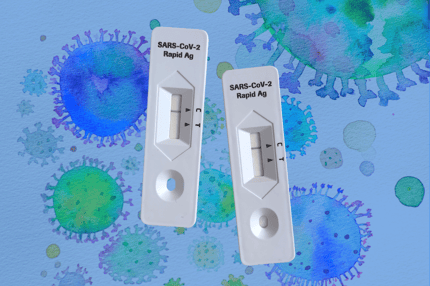
Are you experiencing a bit of a runny nose? Sore throat? A spicy cough? Perhaps a little bit of a temperature?
There is every chance you may have COVID-19. But for some, they've taken a COVID test only to discover they are not positive, leaving them feeling pretty damn confused.
Simply put: what the hell is going on?!
Watch: Dr Lucy Morgan on what it's like to have COVID-19. Post continues below.
For the past couple of years, we have been monitoring our health in a way many of us have never had to before.
If you are someone who keeps having COVID symptoms but continually tests negative to the virus, could you actually be manifesting those symptoms? Or is it a sign that COVID is around the corner?
We asked the experts for you.
Firstly, what symptoms should we be looking out for again?
If you think you are COVID-positive, here are some of the symptoms you might be experiencing: fever, cough, a sore throat, shortness of breath, a runny nose or congestion, headaches, fatigue, muscle or joint pains, nausea or loss of appetite, vomiting and last but not least, temporary loss of smell or altered sense of taste.
Now that's quite the list! And of course it doesn't just stop there for everyone.
Given that PCR and RAT tests are now (finally) easier to access for most people, it's better to be safe and get a test as soon as you experience any of these symptoms.
That's step one.
Your test is negative, but you still have those symptoms.... now what?
If you're in this position, you aren't alone.
As Sydney GP Dr Brad McKay toldMamamia'snews podcast The Quicky, "generally when I've had discussions with patients, they'll often say, 'Oh yes, I had a negative RAT test. But every other family member that I was living with all had COVID and they tested positive. I had exactly the same symptoms as everybody else in the household.' In that case, we've said to those patients despite the test, let's just assume that you had COVID. If it looks and smells and tastes like COVID, you probably had COVID."
If you definitely aren't COVID-positive, you may simply have caught another virus. Delightful.
"There's all sorts of different viruses that are still out there just in very low numbers. We've had very few cases of influenza around the country over the past couple of years. Now that COVID is finally among us, there remains a lot of anxiety in the community about not only getting it but also how quickly one is recovering from it, if you will ever contract it and what's considered normal," said Dr McKay.
Are you just paranoid?
Has being absorbed in this COVID-normal world for the past few years left us paranoid about the state of our health? The resounding answer seems to be,yes.And it could potentially be leading us to over-analyse.
Dr Rachael Murrihy is a clinical psychologist and director of the Kidman Centre, a department within the Faculty of Science at UTS dedicated to understanding the prevention and reduction of mental health problems in young people aged five to 25.
"Each time we have a wave come through in a spike of cases, this creates an air of uncertainty in the community, which leads to more anxiety," she toldThe Quicky.
Listen to Mamamia's news podcast, The Quicky. Post continues after audio.
As Dr Murrihy noted, anxiety is when our body has a rush of chemicals - aka the fight or flight response - which can manifest itself in a range of physical and cognitive symptoms. And one symptom of anxiety is hypervigilance.
"I saw a great Twitter post where someone said, 'I don't know if I have a scratchy throat or whether I've swallowed to check so many times that now it's sore.' You can't talk yourself into having COVID per se, but you can talk yourself into having anxiety symptoms, which can amount to physical symptoms," she said.
"Hypochondriasis is when we worry about having an illness that we don't have. And we can be convinced that we have it. So for example, people who worry about a heart attack, just that worry alone can bring on symptoms associated with a heart attack. So whilst it's not a real heart attack, the symptoms like heart palpitations, chest pain - those symptoms are real. But they are symptoms of anxiety."
Dr Murrihy concluded, "symptoms of anxiety or headaches, migraines, tingling in the extremities, fogg

Sign up to Mamamia Daily
Sent daily
Isabella Ross
Senior News Writer
No Comments
Be the first to leave a comment