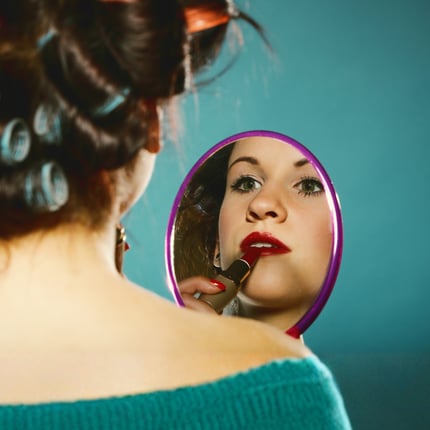
Hello and welcome to the over-pathologisation of human anatomy.
Because if there's one thing we all desperately needed, it was a bigger vocabulary to describe our deepest insecurities!
We no longer have round cheeks, we have "excess buccal fat." No more strong noses, just "dorsal humps." Light features? No, silly, that's called "low visual weight".
This hyper-clinical lexicon has become so normalised that it's leaked out of operating theatres and onto our screens.
Words like "cosmetic injectables" and "jawline-altering procedure" are thrown around with reckless abandon. We talk about our features the way a mechanic talks about a faulty alternator.
And, sure, we all know the debate: is normalising cosmetic work empowering or damaging?
I don't think we really have a clean answer for that yet. But I do think the more we talk about our appearances in clinical dosages, the more we risk two things.
Watch: Understanding Cortisol: The Science Behind Stress Hormone. Post continues after video.

Firstly, we risk conflating aesthetics with medical deformities. In other words, treating a perfectly normal characteristic like it's a broken bone that requires resetting.
I've seen people on TikTok describe downturned eyes as a "negative canthal tilt".
If I was ten years younger, I wouldn't have read that as a beauty preference, I would have booked an appointment with a surgeon. Hyperbole aside, I would have at least spent a significant portion of my evening convinced something was medically wrong with my face.
And that brings me to the second problem. Social media has a way of taking genuine medical conditions, stripping them of context, and moulding them into trendy buzzwords to sell a lifestyle.
Case in point: the 'cortisol face' trend on TikTok.
It started with influencers hyper-fixating on "adrenal fatigue" and cortisol levels (known as the body's stress hormone), claiming that intense workouts were spiking cortisol and leading to "puffy faces."
Soon, regular creators started applying the theory to their personal lives; specifically, their breakups.
They shared before and after photos: 'high cortisol face' with him, 'low cortisol face' without. A post-breakup glow up. De-puffed. Clear skin. No more frown lines from scowling at their incompetent partners (their words, not mine).
It's trends like this where we lose all medical nuance. Trust me, I'd be more than happy to blame my cortisol spikes on a toxic ex-situationship.
But the reality is far more complex; just ask Dr Aakriti Gupta, a medical and cosmetic dermatologist and board member of the Australasian Society of Cosmetic and Procedural Dermatologists.
"There's no medically recognised diagnosis called 'cortisol face'," she told Mamamia.
*Pretends to be shocked.*
"Cortisol has become a convenient buzzword online, but the reality is that facial puffiness is usually multifactorial and often far less dramatic than social media makes it seem," she added.
"The biggest issue with the 'cortisol face' trend is that it takes a complex physiological process and reduces it to a single cause."
Gupta explained that when cortisol "levels remain elevated over long periods, it can influence fluid balance, inflammation, sleep quality, appetite and fat distribution."
But it's not as simple as leaving f**kboy Josh and suddenly getting a supermodel jawline.
In the case of a "post-breakup glow-up", cortisol is probably lowered due to basic lifestyle changes.
"When people leave stressful environments or relationships, they often start sleeping better, exercising more regularly, eating differently, and drinking less alcohol," said Gupta."These changes can reduce inflammation and fluid retention, which may improve facial puffiness and skin quality."
She added: "In many cases, what social media is calling 'cortisol face' is actually a reflection of overall health, stress, sleep and lifestyle patterns interacting."
It's also, dare I say, a tad reductive to claim your puffiness was purely cured by dumping a toxic man when people with severe, chronic conditions are genuinely suffering. There's a massive genetic component to our health, alongside medications and regular hormones.
"In true medical conditions associated with very high cortisol levels, such as Cushing's syndrome or prolonged prescription steroid use, we can see a characteristic 'moon face' due to both fat redistribution and fluid retention," Dr Gupta explained, noting that other important causes of facial swelling include "thyroid disease, allergies, sinus disease, autoimmune conditions, kidney disease, steroid medications and true endocrine disorders."
This points to another danger of weaponising medical buzzwords online, where we end up completely masking real medical issues.
"One concern is that people may start self-diagnosing significant facial swelling or weight changes as 'just stress' and miss more important underlying causes," said Gupta.
So, welcome to the over-pathologisation of human anatomy. A world where we've blurred the line between beauty standards and medical conditions so completely that we can no longer tell which is which.
Feature Image: Getty (Stock image for illustrative purposes only)
Win a $1000 voucher!
We want to hear all your shopping secrets! Complete our 5 minute survey for a chance to win a gift voucher in our quarterly draw!
Take survey →Catie Powers
Author
No Comments
Be the first to leave a comment