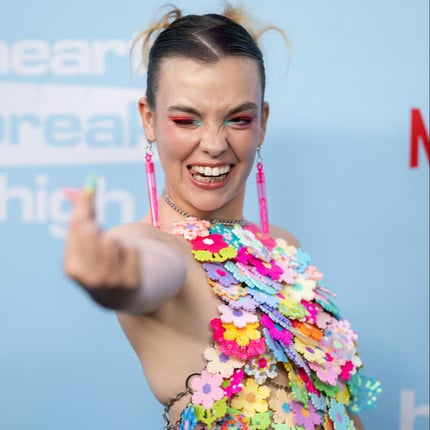
At a glance, Chloé Hayden looks like someone the world already understands.
Scroll through her Instagram and you'll see the version of her that feels instantly recognisable. Soft lighting, glossy hair, a beautiful young woman moving easily between red carpets, horses, a fairytale wedding and a life that looks, on the surface, aspirational in all the ways we've been taught to recognise.
It is exactly the kind of image people feel comfortable with — and that, Chloé knows, is part of the reason they listened.
"I am very privileged to be in the body that I'm in," she told Kate Langbroek on No Filter. "Because I'm white, because I'm conventionally attractive, because I appear able-bodied… it's much easier for people to listen to me than it would be to listen to someone else."
It's not a throwaway comment. It's a framework for understanding everything that followed.
Watch the trailer for Season 3 of Heartbreak High here. Post continues below.
Because when Chloé stepped into the role of Quinni in Heartbreak High, she didn't just become one of the first autistic characters many audiences had ever connected with, she became a version of autism that felt safe enough to accept.
"Quinni was an extremely palatable version of autism," she said.
She described the character as "Manic Pixie Dream Girl autism". Cute, romantic, non-threatening. A version of neurodivergence that didn't ask too much of its audience, that didn't challenge them beyond what they were already willing to give.
"That's palatable," she explained. "It's an easy, digestible way for people to go, 'Okay, I can accept autism.'"
What's striking is not just the honesty of that observation, but the way Chloé holds it. There's no rejection of Quinni, no attempt to distance herself from the role that changed her life. Instead, there is a clear understanding of what Quinni was, and just as importantly, what she wasn't.
Because while the character opened a door, Chloé is careful to point out that it was never meant to be the whole room.
"We now need to move away from that," she said. "We need to offer those positions to Black autistic people, non-speaking autistic people and autistic people who live in bodies and present differently to the way that I do."

It's a shift from representation as introduction to representation as expansion. From something that feels accessible to something that feels accurate.
And it's a perspective that makes more sense the more you understand where Chloé came from.
Long before she became the person people look to for answers, she was a child who couldn't find herself anywhere.
She was bullied relentlessly, moved through 10 different schools and spent years trying to exist in environments that made it clear she was different, and that difference was not welcome. By the time she was 13, she had left the school system entirely. That same year, she was diagnosed as autistic.
But even with that diagnosis, there was no roadmap. No version of herself reflected back at her in a way that felt real or possible.
So she created one.
As she told Kate on No Filter, she began studying the people around her with a kind of precision that was less about curiosity and more about survival. She watched how they spoke, how they moved, how they reacted, and then taught herself to mirror it.
"I would watch YouTubers and study the way that they moved their hands, the way they spoke, their intonations," she said. "And then I would go to the mirror and copy it exactly."
Listen to the full episode with Chloé here. Post continues below.
It's the kind of detail that, in hindsight, reads like the origin story of an actor. But at the time, it was something much more fundamental. It was about learning how to exist in a world that hadn't yet made space for her as she was.
"The only way that I could survive in this world was by copying other people."
That tension between who she is and how the world receives her has not disappeared. If anything, it has become more visible.
Because while Chloé is now one of the most recognisable autistic women in the world, visibility does not remove expectation. It reshapes it.
"There are a lot of people who expect me to have this energy and this passion 24/7," she told Kate.
It's the expectation that she will always advocate, always educate, always represent. That she will carry not just her own story, but everyone else's as well.
And it's one she is learning, in real time, to resist.
"It's not my job to advocate for everyone all the time."
Instead, she speaks about something quieter, but far more sustainable. The idea that no one person should have to hold that responsibility alone.
"If I need to step down, someone else can step up," she said. "That's what community is."
It's a reframing that shifts the focus away from a single voice and towards something collective. Something that allows space for more stories, more perspectives, more truth.
Because if Quinni was the version of autism the world was ready to accept, Chloé is asking what comes next.
What happens when representation stops being comfortable. When it begins to reflect the full spectrum of experience. When it asks more of its audience than simple acceptance.
It's a question she continues to push, even when it comes at a cost.
As she told Kate, there have been moments where people within the industry have warned her to be quieter. To be more careful. To "not bite the hand that feeds you".
But for Chloé, the point of being in the room was never to stay quiet once she got there.
And in her full conversation on No Filter, she shared the pressure, the pushback and the reality of continuing to speak when it would be easier not to — and what it's cost her to keep saying it.
Feature image: Getty.
Want to win a $1000 gift card in just 8 minutes?
Obsessed with all things beauty and skincare? We’d love to hear from you!
Take survey →Bree Player
Author
No Comments
Be the first to leave a comment