Thanks to our partner, 1001 Optometry
Noticing the tiny shifts in our kids' behaviour is basically a parenting superpower.
A rash that's still lingering, a sudden phase taking longer to fall asleep, or your sports-mad tween no longer wanting to go to training. We spot it all.
But while we're quick to check a temperature, there's one vital area of our kids' health where the sneaky signs of change are incredibly easy to miss: their eyes.
We're talking about myopia, otherwise medically known as short-sightedness (where close objects are clear but those in the distance look blurry). It currently affects one in five kids in Australia, though given it develops so slowly, you might not catch your kids complaining about it.
Mamamia spoke to Margaret Lam, Head Optometrist at 1001 Optometry on why this might be.
"Usually vision changes happen very slowly, so they may not identify or know anything is wrong — they can assume everyone sees the way they do," she told Mamamia.
"It can be very progressive before it is noticed or identified."
Lam said that because "children are incredibly adaptable", they can compensate for any vision issues by changing their habits or behaviour, making parents' observations particularly important.
"Parents can see subtle clues that a child is struggling to see clearly," Lam said. If caught early, she assured that myopia could be managed.
Lam told us the potential myopia signs to watch for that are worth investigating with your optometrist.
1. The 'creeping closer' phenomenon.
What it looks like: Sitting right in front of the TV, holding things like homework right up to their nose, or suddenly wanting to sit at the very front of the classroom.
"One of the sneakiest signs is a child gradually moving closer to things," Lam explained. "This is a clever workaround that kids figure out, trying to minimise the impact of their vision problems."
"That 'creeping closer' behaviour is absolutely worth paying attention to."
2. The daytime squint
What it looks like: Narrowing their eyes when looking at the TV, struggling to recognise faces across the playground, or looking extra intensely at the board in the classroom. You might even notice them tilting their head or frowning like they're trying to solve a maths question, just to see something across the room.
"Squinting is the eye's way of trying to partially sharpen a blurry image," said Lam.
If you notice your little one constantly narrowing their eyes just to watch their favourite show or read a sign, their eyes are working overtime, and worth getting their eyes checked with an optometrist.
3. They're suddenly disengaged in class.
What it looks like: Reports from their teacher that they've become more distracted, day-dreaming, or reluctant to do schoolwork.
Before jumping to conclusions, consider this: "A significant amount of information that a child processes is through their vision," Lam advised.
"A child who seems disengaged, distracted or reluctant to do schoolwork may not necessarily be misbehaving or lacking focus; it could be because they're having difficulty seeing."
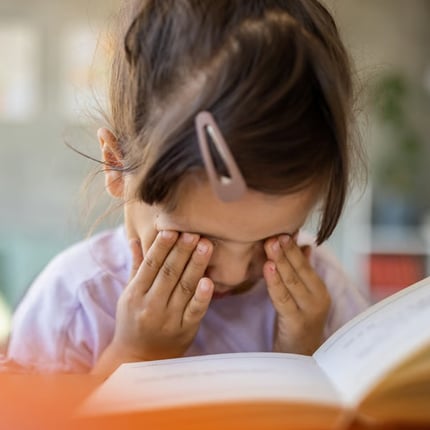
4. Constant eye-rubbing.
What it looks like: Your child frequently rubbing or wiping their eyes (that isn't just tiredness). It might look like they're trying to rub away sleep, even when they've had a solid night of shut-eye.
"Although it can have many causes, such as allergies, tiredness, dry eye or irritation, it can also be a sign of vision fatigue. Especially if it happens alongside other clues: squinting, headaches, sitting close to screens or difficulty seeing things far away," Lam explained.
Think of it as physical fatigue. When a child has undetected myopia, their eye muscles are working in overdrive all day just trying to bring the world into focus. By the afternoon, their eyes are literally exhausted.
5. Frequent headaches.
What it looks like: Your child regularly complaining of a sore head after a day at school, during homework or after screen time. You could also spot a sudden drop in concentration, or moodiness after more visually demanding activities.
"If they may become irritable after visually demanding tasks, these are all symptoms to investigate further with a professional," advised Lam.
Kids don't always have the vocabulary to say, 'Hey, my vision is blurry,' so if you're noticing a physical "fallout" that's presenting as a headache, it could be linked to eyestrain.
What should parents do next?
Firstly, deep breaths. Lam emphasised that parents should be aware, not alarmed.
"An occasional habit may not mean much. But if there is a pattern, especially with squinting, sitting close, headaches, holding things close or difficulty seeing at a distance, then it is worth booking an eye test," she said.
A handy step before your optometrist appointment can also include checking out Magnif-eye by 1001 Optometry.
The AI-powered education tool allows you to upload a few photos of your child's eyes from your phone's camera roll, better understand potential vision habits and learn the myopia risk factors. While it doesn't replace a professional in-store eye test or give a diagnosis, it's a quick and useful way to gain some eye health information prior to your appointment, and know the risk factors.
Early detection is crucial because myopia progresses as children grow.
Left untreated, it can increase their lifetime risk of more serious eye health issues, so catching it early means it can be monitored, and management options can be discussed.
Learn more from 1001 Optometry's Magnif-eye tool .
This information is general in nature and does not replace the advice of a healthcare professional. As with any suspected eye condition, always seek health advice from a qualified optometrist.
Featured image: Getty.

Shona Hendley
Contributor - Parenting
No Comments
Be the first to leave a comment