
This is an edited extract from The Energy Game by Amantha Imber. Available from Penguin Random House .
I never thought I'd fantasise about being hospitalised.
Yet there I was in June 2024, confessing to my friend Sabina, a clinical psychologist, about the recurring daydream I couldn't shake. I'd been imagining being sick enough to warrant a week-long stay in hospital. Nothing permanently damaging. Just serious enough for no responsibilities, no access to my devices. Somewhere my colleagues couldn't reach me, where I'd receive flowers and sympathy, and where the most demanding decision of the day would be between lime or orange jelly.
Not exactly #lifegoals material. But it had become strangely comforting to imagine.
Watch: Finding a middle ground between burnout culture and completely detaching from work.
Sabina had a name for it. "The hit-by-a-bus fantasy." Bad enough to force the world to give you permission to stop, but not so bad that it does permanent damage.
The fact that my fantasy included flowers was apparently a nice touch. At least my fictional medical emergency had decent production values.
What I noticed, as I started telling some friends about this conversation, is that none of them looked shocked. Many of them had their own version. One had been imagining a minor car accident. Another dreamed of an illness that would require a two-week residential stay at a facility where she wasn't allowed to parent, work or think.
These are not (often) women who want to die. They just want a break.
I am an organisational psychologist and CEO. For twenty years, I've consulted to companies including Apple, Coca-Cola, Disney, Google and Lego on how to boost productivity and wellbeing. I had somehow failed to notice my own burnout creeping in. The irony was almost funny. Almost.
My personal life was flourishing. Friends and family in great health. Recently engaged to the most wonderful man I've ever met. Daughter thriving in primary school.
Professionally, I felt like I was dragging myself through quicksand while wearing lead boots. Every task required immense effort. Challenges seemed insurmountable. The weight of responsibility for my company, Inventium, had become crushing.
At the peak of my burnout, each morning was a battle. I'd developed a co-dependent relationship with my alarm's snooze button. In the week before a pre-booked two-week holiday, I'd wake up and run the same internal argument. Could I call in sick today? How would that look to the team? I wasn't sure I could even make it through one more day.
I kept pushing through. The daily mental tug-of-war was itself exhausting me further, and both sides were losing.

The physical toll was significant. An active life had long been my norm. Now I was constantly run down, getting sick more often, suffering gut cramps. My neck and shoulders were perennially sore. I was clenching my jaw so tight that my dentist suggested sleeping with a mouthguard when he noticed one of my teeth was starting to crack.
I'd also started crying at my desk. The new sensitivity was a shock. I remember receiving a slightly critical email from a colleague that sent me into a stress spiral, and I cried openly at my laptop. That would have been water off a duck's back for the old me. But crying at my desk had become a weekly, then daily, activity.
I had become a master of ignoring the early warning signs, until my body, mind and emotions told me THIS IS ENOUGH.
What I was experiencing wasn't fatigue. Burnout is an emotional, psychological and physical depletion that leaves you with rock-bottom motivation and overwhelming apathy. It's the body and mind saying, "I've tried to send you warnings via email, text and carrier pigeon, and since you've ignored all of them, we're going nuclear".
The hit-by-a-bus fantasy is one of those warnings.
It appears when the only culturally acceptable reason to stop working is to be physically incapacitated. Saying "I'm exhausted and I need a week off" makes you feel like you're failing. Saying "I had surgery" makes you a hero who receives cards and lasagnes delivered to your door.
No wonder our brains do the maths and start secretly wishing for the second one.
I want to be careful not to make this sound like one profound conversation that transformed my life. Recovery from burnout isn't linear. It isn't quick. But the intensity of what I experienced made me a very motivated researcher and experimenter.
The "me" who is writing this barely resembles the version from 2024. I've transformed from someone who considered medical emergencies a viable holiday option into someone who has not just recovered but rebuilt. I don't just have energy again. I have more energy than I had before I burnt out.
I wake up without dread. I work without constantly watching the clock. I have bandwidth left at the end of the workday for my daughter, my husband, my family and my friends.
My dentist no longer worries about my teeth cracking from jaw clenching.
If you're fantasising about a car accident, a hospital stay, or a diagnosis that would absolve you of all responsibility for a week, there are two things you need to know.
Listen: Let's unpack why modern rest no longer feels restorative. Post continues below.
First, you are not broken. You are not being dramatic. Your brain is doing what brains do when they've been running on empty for too long. It's looking for an exit.
Second, you don't need to wait for an exit. You don't need a medical emergency to justify rest. You don't need permission from your calendar, your boss, your partner or your mother to stop. The fact that you are secretly wishing for something terrible to happen to you is, in itself, the permission slip.
I'm going to assume that taking an extended break isn't on the cards for you right now. Most of us don't have the luxury of a six-month sabbatical to "find ourselves." Deadlines don't pause for our energy slumps.
But you've already proven you can keep pushing through. The harder question is whether you're brave enough to stop before your body makes the decision for you.
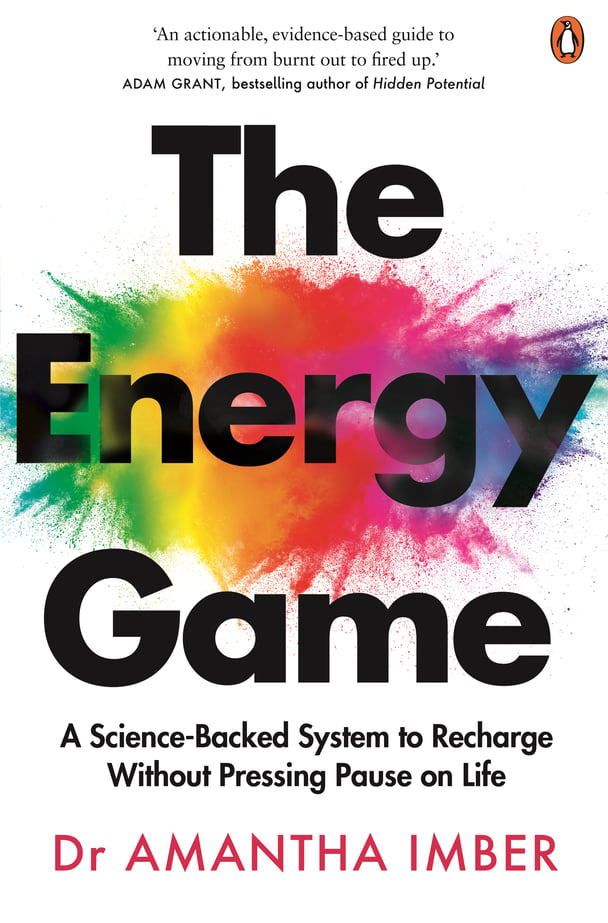
This is an edited extract from The Energy Game by Amantha Imber. Available at Penguin Random House , $36.99, from 7 July.
Feature Image: Supplied.
Win a $1000 voucher!
We want to ask you a few questions about laser hair removal and professional skin treatments.… Complete our quick survey for a chance to win a gift voucher in our quarterly draw!
Take survey →Amantha Imber
Author
No Comments
Be the first to leave a comment