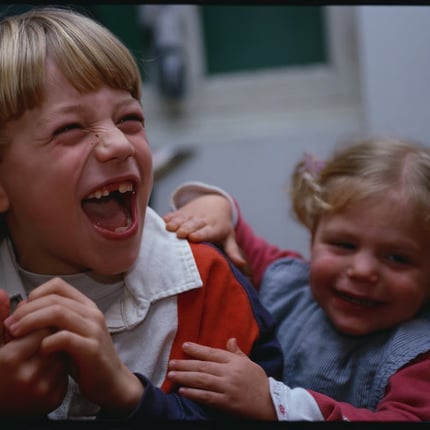
I still remember the feeling of walking through primary school holding my brother's hand.
He was two years older, tall for his age, confident in a way I never was.
Teachers adored him and other kids seemed to orbit around him. He was school captain, dux, captain of the football team. Smart, funny, good-looking.
The kind of kid adults would smile at and say, "he's going places."
And I was his little sister, absolutely glowing just being related to him. If someone realised we were siblings, I'd stand a little taller.
That was my brother, the golden child, the boy everyone loved. Sometimes now I think about that version of him and honestly wonder where he went, because the man who exists today feels like a stranger to the person I grew up with.
Watch: How to Help Someone with Addiction. Post continues below.

The cracks started in high school, although none of us realised that was what we were seeing at the time. He went to a good school and did well academically at first.
Teachers expected big things from him and our parents did too. Then he injured himself playing footy in Year nine and stopped playing altogether.
Looking back, that feels like the turning point. Football had been his outlet, his identity, his social world.
Without it, he seemed bored and restless, like he didn't know where to put himself.
He started hanging around a different crowd, partying more, drinking too much, experimenting with drugs.
His grades dropped and suddenly the kid who'd always been ahead of everyone else didn't seem to care about anything.
He wanted to leave school in Year ten, which completely shocked my parents.
They pushed him to stay, talking about wasted potential and future opportunities, but every conversation seemed to end in yelling.
Doors slamming, nights where no one slept properly, tension thick in the house.
At the time, it felt like normal teenage rebellion, the kind families survive all the time.
In hindsight, it feels like the beginning of something much darker, something none of us knew how to stop.
After school came drugs, real trouble with the law, heavier drinking, then meth, eventually heroin. Arrests. Court appearances. Prison. And through all of it, we were just trying to keep up, trying to understand how the golden boy turned into someone volatile and unpredictable, someone who sometimes frightened us.
The hardest part was that he didn't disappear all at once. Every now and then, we'd see flashes of the brother we knew. He'd get clean for a while, start joking again, be gentle with Mum, protective of me, like he used to be.
We'd start to hope things were finally turning around. Then something would happen, the wrong friends, money problems, a breakup, and he'd spiral again.
Each time hurt just as much as the first.
It felt like mourning someone who was still alive, grief without a funeral, loss without closure.
You're constantly adjusting to a new version of the same person while still loving who they used to be. You don't get the clean break that grief normally gives you. You just carry it around.
He's 35 now and still in and out of prison.
Sometimes he's working, sometimes homeless, sometimes couch-surfing. Addiction has carved its way through his body and his personality.
He's missing teeth now. He's gaunt. He dresses in a way that instantly signals trouble to people who don't know him. He talks differently too, all slangy drawl and defensiveness, like he's constantly on edge, ready for conflict.
Strangely, after everything else, the thing that broke my mum the most was the face tattoo.
You'd think the drugs or the jail time would have been worse, but seeing her beautiful son permanently marked like that seemed to make something finally sink in for her.
It was like she realised the boy she'd raised wasn't coming back, or at least not in the way she remembered him.
My childhood friends know all of this because they lived through it with us. They remember the brother I adored and they watched the slow unravelling.
They understand. But the friends I've made later in life don't know, and if I'm honest, I don't want them to.
I hate admitting that, but it's true. If I'm dating someone new, I avoid bringing them to my parents' house if there's even a chance my brother might show up.
I've changed plans, made excuses, suggested meeting somewhere else. I worry about what people will think about my family, and by extension, about me.
Will they assume we grew up badly? That my parents failed? That I'm somehow damaged too?
Addiction carries this invisible stigma that attaches itself to everyone nearby. People judge even when they try not to, and I feel awful for caring, because I do love my brother.
When he's sober, and we're talking quietly, when he's just being himself, I can still see the soul of the boy who held my hand at school and scared off kids who teased me.
The brother who made everyone laugh at family dinners. Those moments are rare now, but they still exist, and that's what makes everything so complicated.
Because loving him doesn't erase the embarrassment, and the embarrassment doesn't erase the love. Sometimes, I'll see him in public and my first instinct is to look away, to hope he doesn't notice me, not because I don't want to talk to him but because I'm scared of how it looks, of who might be watching.
And then I hate myself for feeling that way. What kind of sister is embarrassed by her own brother?
The guilt is constant. I feel guilty that part of me wants distance.
Guilty that I worry about how his life reflects on mine. Guilty that sometimes I wish I didn't have to carry this story with me at all.
People say addiction is a family disease and I understand that now. It seeps into everything. Holidays, birthdays, relationships, ordinary conversations. There's always tension and worry.
Is he okay? Is he using again? Will he show up? Will there be a scene?
Even when he's not physically there, he's there in the background of everything. And there's no guidebook for how you're supposed to feel. Society tells you family is everything and loyalty should be unconditional, but nobody talks about the messy middle ground where love and exhaustion and shame and grief all exist together.
I don't want to cut him off because addiction is lonely enough without family disappearing too. But I also want peace and stability, a life that doesn't constantly revolve around crisis management.
I want to introduce the people I love to my family without anxiety twisting in my stomach, and admitting that sometimes makes me feel like a terrible person.
I wonder if he knows how much we miss the old him, or if he misses that person too.
Addiction changes people, rewires priorities and personalities, but somewhere underneath I still believe my brother is there. I just don't know if we'll ever truly get him back.
In quieter moments, when he's sober and reflective, he apologises. He says he never meant to hurt anyone and wishes things had turned out differently. I believe him, and that's why it hurts so much. Because this isn't some villain in our family story.
It's my brother, a kid who had everything going for him and somehow lost his way, a man battling something bigger than all of us.
I wish loving someone was simple, that families were either functional or broken, good or bad. But most of us live somewhere in between. I love my brother. I'm proud of the person he once was. I'm heartbroken by the person addiction has turned him into. And some days, if I'm being completely honest, I'm embarrassed.
All of those things can be true at once, and I'm still learning how to live with that.
For more health information, listen to Mamamia's health podcast, Well.
If you or anyone you know needs to speak with an expert, please contact Lifeline (13 11 14) or download Sobriety App – I am Sober, an addiction buddy useful for quitting any activity or substance.
Feature Image:
Anonymous
Author
No Comments
Be the first to leave a comment