Thanks to our partner, Dry July
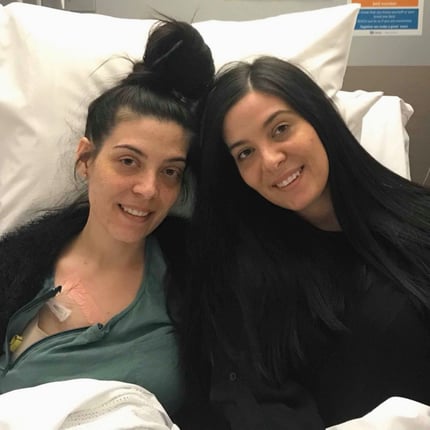
Emily Taylor was the person who finally convinced her identical twin, Christina, to go to the hospital.
The sisters were as close as you can get. They shared the same friends, and in Newcastle, locals would constantly mistake Emily for Christina.
"People would say hi to me thinking it was her, and I would always just wave back because I didn't want her to look rude," Emily told Mamamia. "She was a hairdresser, so she was just everybody's friend."
In 2018, their world turned on its head.

One day, when Emily came home from work, Christina told her she was feeling sick.
Emily had the immediate sense that something wasn't quite right; her twin wasn't the type to complain, and had been feeling a persistent pain in her stomach for a while.
"I ended up forcing her to go to the hospital," Emily said. "I thought it could be her appendix, like it could explode. I'm not a doctor, but to me, it didn't sound normal."
It wasn't Christina's appendix. The 29-year-old underwent several tests, including an endoscopy and colonoscopy, to rule out dietary issues.
It wasn't that either.
The colonoscopy found Christina had stage four bowel cancer.
Emily's mum broke the news to her about her twin.
"She rang me and said it was cancer," Emily said. "It was pretty shocking. Originally, her symptoms were put down to Irritable Bowel Syndrome (IBS) or 'women's health issues' — it [the colonoscopy] wasn't expected to find anything."
Bowel cancer is the second most common cancer in Australia and is typically diagnosed in people aged 70 to 74. However, experts are observing a worrying rise in younger patients. The risk of being diagnosed with bowel cancer before the age of 40 has more than doubled since the year 2000.
Early detection is vital when it comes to bowel cancer, as 90 per cent of cases can be cured if caught early enough, according to Cancer Council NSW.
The reality of treatment.
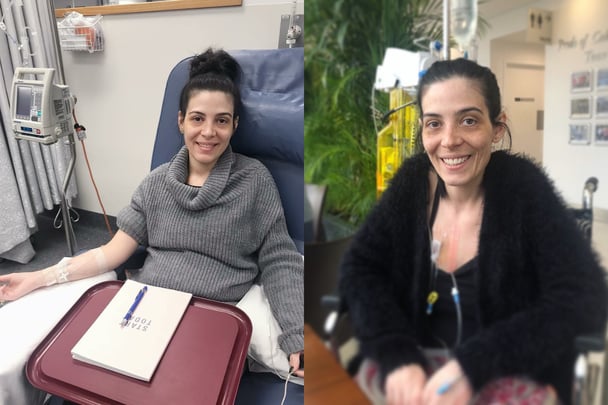
Christina's treatment plan was aggressive from the outset. Because of the location of the cancer and her young age, doctors started with chemotherapy to shrink the tumour before attempting a highly complex operation in Sydney known as HIPEC surgery.
"They basically open you up, cut everything out, and they do kind of like a 'warm chemo' inside you while you're open," Emily explained. "It's basically like curative surgery."
Initially, it looked like the surgery was a success. Christina's medical team informed the Taylor family that they had managed to get all the cancer.
However, subsequent tests showed the cancer had returned, and as Christina was fighting other health issues — such as fluid on the lungs — chemotherapy couldn't be resumed.
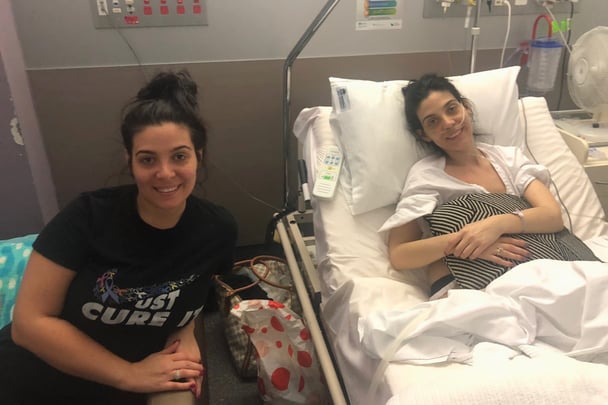
"They won't do chemo if your wounds are still healing," Emily explained. "So it was just a waiting game."
"We had the attitude of 'we'll just keep fighting'. We did that for a bit — she ran out of time, I guess, but she fought until the end."
In 2019, just a year after her diagnosis, Christina passed away at just 30 years old.
Learning to exist without her twin.
As her twin, Emily found losing Christina especially isolating.
"I had a built-in best friend, and then you don't have that anymore," Emily said, explaining that her understanding of grief had completely changed. "It doesn't go away. You're constantly living with it. People don't understand that until you go through it."
One thing Emily is grateful for is her support network.
"I still have that same circle of friends Christina and I shared, and my family is really close, so we're all kind of navigating it together. It would be pretty hard if I didn't have that."
Emily is also refusing to let her sister's story fade into memory.
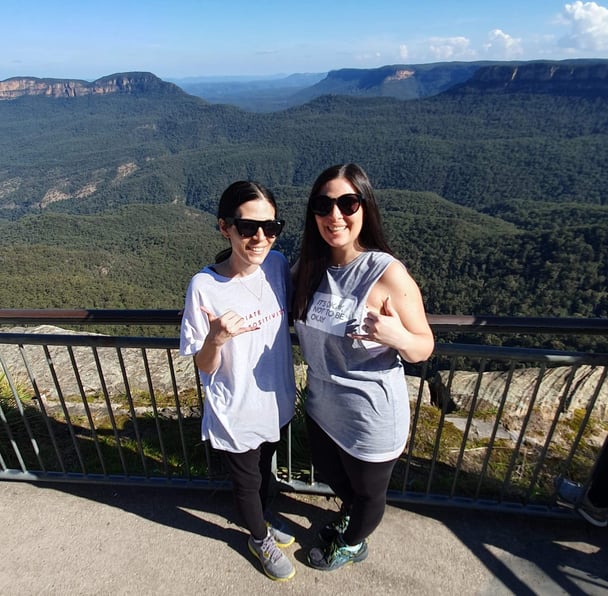
One way she honours the bond they shared is by travelling to different locations on their birthday each year, a tradition inspired in part by the special memories they made together.
"We went away to the Blue Mountains before she passed away," Emily said. "That was our last holiday together, which I'm really glad we got to have. I always like to go away for our birthday and celebrate with a holiday."
Emily's dedication to Dry July also helped her find a sense of community and purpose. She first signed up for the fundraiser in 2018, under the team "Christina's Cancer Warriors".
"The first one we did, Christina was in the hospital, so we were doing it together and were campaigning for awareness," Emily said.
Emily has taken part every year since her sister's death and is about to mark her ninth year of participation.
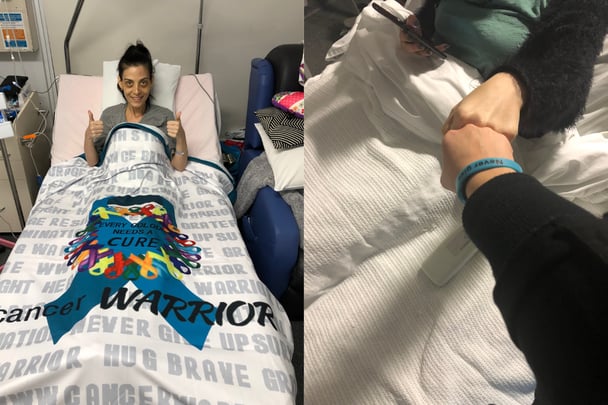
Going without alcohol for 31 days might seem like a simple health challenge from the outside, but for Emily, the stakes are so much higher as the funds raised go directly toward improving the comfort, care and well-being of people affected by cancer.
"Put yourself in a cancer patient's shoes," Emily said. "I think some people think, 'Oh, it's so hard — I can't drink for 31 days', or they do it just for the health impact.
"What you're also doing is showing support for people going through cancer at a time when they need it most. Giving up alcohol and raising money is a drop in the ocean in comparison to what they're going through."
Emily said that for anyone supporting a loved one through cancer, the most important things are continuing to show up, being patient and protecting your own mental health.
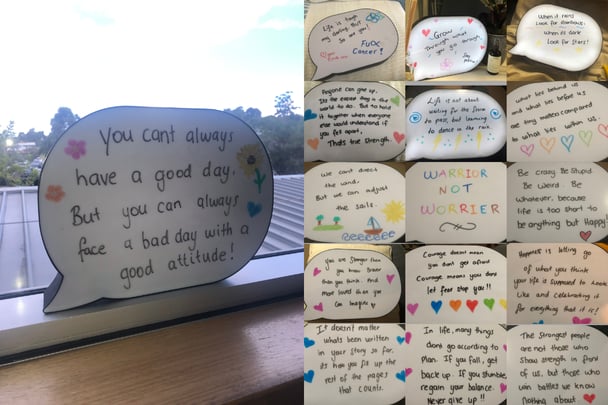
"You can't pour from an empty cup," she noted.
Ultimately, Emily wants her sister's story to serve as a wake-up call to young Australians to break the taboo surrounding bowel cancer and talk about the "embarrassing" symptoms.
"It's just such a taboo topic… symptoms can be quite dismissed," Emily said, adding that colonoscopies are vital for early diagnosis. "It's just a procedure, there's nothing wrong with it, and it could save your life."
For Emily, continuing the fight is the only option because she knows exactly what Christina would think of the community rallying behind her legacy.
"She would be quite proud," Emily said. "I think she would be very happy that it's spawned into something quite amazing."
Sign up for Dry July or make a donation to help raise essential funds for cancer patients and their families.
Feature Image: Supplied.

Raffaella Ciccarelli
News and Weekend Editor
No Comments
Be the first to leave a comment