
When Stacy first had her breast augmentation, the mother-of-two was delighted with the results.
But three years after the 2008 surgery, it became clear that something was terribly wrong.
The UK mother’s breasts had come away from the implants — which sat underneath the muscle on her chest — and drooped far below them.
“I describe it as I look like I have four breasts rather than the usual two as my boobs have fallen away from the implants,” Stacy says.
Stacy after her 2008 surgery, before her implants dropped.
Stacy, 27, says the ordeal lowered her confidence so drastically, she began to cover up her figure.
“Now I would do anything to make them flat. I wear sports bras or support bras so I don’t draw attention to them,” the West Sussex woman admits on the latest episode of reality show Extreme Beauty Disasters .
“I wouldn’t dream of having a sexy night as I just look terrible. It’s not attractive or feminine, it’s a big mess.”
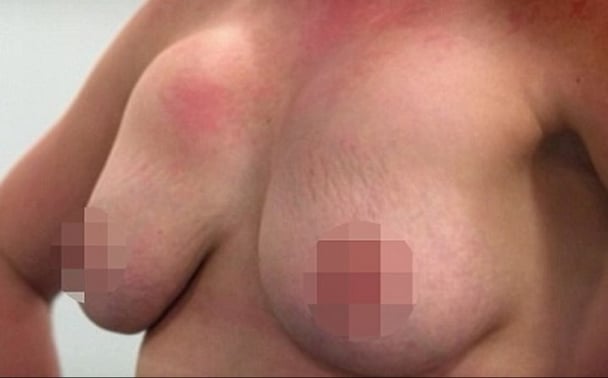
Fortunately for Stacy, cosmetic surgeon Dr Vik Vijh was able to remove the implants.
In doing so, however, the doctor discovered Stacy’s implants had begun leaking and were made of Poly Implant Prothese (PIP), a dangerous product that’s two to six times more likely to rupture than other types of silicone implants.
PIP implants were recalled worldwide in 2010, and last year a global class action claim was brought against TÜV Rheinland, the German company who certified the implants.
Stacy.
Stacey has since recovered from the surgery.
Today, she’s happy with her breasts, which Dr Vik Vijh replaced with smaller, safer implants.
“I feel normal again I can wear low cut tops and not worry about an implant sticking out,” she says. “Now I feel like a woman again.”
But given the choice again, Stacey said she would never have undergone surgery in the first place.
“I would do anything to go back to how I was before I had them done,” she says. “They were saggy but the problems I have had and the way it has made me feel, I would do anything to go back to that and have never had a boob job.”
Her story comes as the Australian Society of Plastic Surgeons (ASPS) launches a fresh campaign urging Australians to think carefully before undergoing cosmetic surgery.
“Our message is to ‘think over before you make over,’” ASPS President Dr Tony Kane says. “Alarmingly, some people seem to spend more time researching a new hairdresser than they do their surgeon and rush into surgery they later regret.”
Since 2011, Australian plastic surgeons’ code of conduct has imposed a 10-day cooling off period. Now, amid concerns that more and more Australians are having cosmetic procedures without fully understanding the risks, the ASPS is now calling for that period to be extended to 14 days.
“Despite a growing number of reports in the media of poor or disastrous outcomes, and sadly, even deaths, people are still rushing into cosmetic surgery with little consideration for their safety, often putting financial considerations ahead of their health,” Dr Kane says.
British Association of Plastic, Reconstructive and Aesthetic Surgeons (BAPRAS) recently launched a “Think over before you Make Over” campaign along with survey findings revealing that of the two million British considering cosmetic surgery each year, a fifth aren’t aware of the associated risks.
Frighteningly, things aren’t so different here.
“(A)n Australian survey would reveal similar results,” Dr Kane says. “People need to understand that cosmetic surgery is not trivial. It is serious, invasive surgery requiring anaesthetic and like any other surgery, involving an element of risk.”
The Australian Society of Plastic Surgeons encourages anyone considering cosmetic surgery to ask some simple, but crucial questions:
UK woman Alison, who was left with an inverted breast after a breast augmentation left her with multiple infections, tells her story on Extreme Beauty Disasters:
Would you ever consider surgery? Do you think women need to pay more heed to the associated risks?
You may also be interested in reading:
[post_snippet id=324408]
Author
No Comments
Be the first to leave a comment