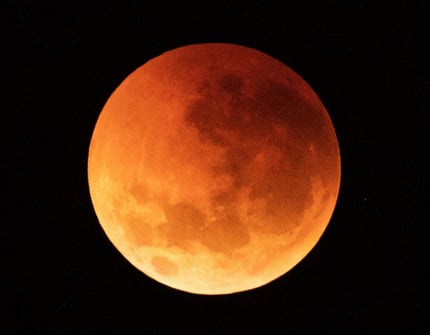
Australians who looked skyward before sunrise were not left disappointed, as the moon glowed blood red for the longest lunar eclipse of the 21st Century.
The total lunar eclipse, or ‘blood moon’ began at 5.32am AEST on Saturday, lasting for one hour and 43 minutes, as the sun, Earth and moon aligned.
“It was really nice, a very clear eclipse,” Sydney Observatory curator Dr Andrew Jacob told AAP.
“The moon was a lot paler pink than I expected – a beautiful sight in the western sky.
“It was a nice long one, and as twilight came and the sky brightened up, the moon dropped into the clouds.”
At least 200 people flocked to Observatory Hill in Sydney’s CBD, and also to Dover Heights in the east, as the moon moved into the Earth’s shadow, becoming darker and turning redder as sunlight passed through Earth’s atmosphere.
“What we’re seeing is essentially all the sunrises and sunsets on the Earth, dramatically projected onto the surface of the moon,” Australian National University astronomer Brad Tucker told AAP on Friday.
Dr Jacob said: “Anyone on that night-side of the Earth would be able to see the moon go into the eclipse.”
“They’ll see it at the same time, beginning at the same moment.”
Those in Australia’s west, where alarms were set from 2am, got to see the end of the eclipse’s totality, he said.
“The Earth doesn’t rotate far enough this time around for anyone in North America – the US and Alaska – to see the eclipse but there are other eclipses that we don’t see, there’s always a little bit of the Earth that misses out.”
This marks the second total lunar eclipse this year visible from Australia, with the next one predicted for 2021.
“(But) the really spectacular eclipses are the total solar eclipses, you have to travel to see those, they’re really localised,” Dr Jacob said.
“In ten years, in 2028, there will be a total solar eclipse which will pass over Sydney.”
Technically speaking, the blood moon is an incredible phenomenon, but a picture tells a thousand words.
Blood Moon time – Sydney Australia #BloodMoon #lunareclipse #MoonEclipse #moon #MoonEclipse2018 pic.twitter.com/tz8CnVBJpD
— Maik Kleinert (@MaikKleinert) July 27, 2018
The Moon in full eclipse alongside the Milky Way and above Mars during tonight’s #LunarEclipse #BloodMoon @ProfBrianCox pic.twitter.com/ohuIHDgOlY
— Matt Robinson (@Astro_Matt27) July 27, 2018
Great pic of the #bloodmoon next to the statue of Hera in Greece! Via AFP. #lunareclipse pic.twitter.com/J1PbBsQffm
— Rami Mandow ????️???? (@CosmicRami) July 27, 2018
A “blood moon” eclipse over the temple of Apollo in Corinth pic.twitter.com/DqYATH45xk
— AFP news agency (@AFP) July 27, 2018
Latest visuals of lunar eclipse through Nehru Planetarium (Source NASA) #BloodMoon #BloodMoonEclipse #LunarEclipse pic.twitter.com/J3WSKv0Fgm
— Harish Harry (@Prabhas_Swag) July 27, 2018
Another great pic of the #BloodMoon from one of our forecasters in #Queensland, just in case you missed it! pic.twitter.com/93UvuQITUz
— Bureau of Meteorology, Queensland (@BOM_Qld) July 27, 2018
People around the world caught a glimpse of the “blood moon” caused by the longest lunar eclipse of the century. It won’t be visible in North America, but here’s what it looks like: pic.twitter.com/fUIGs7maCa
— AJ+ (@ajplus) July 27, 2018
In pictures: Blood moon around the world https://t.co/cRQmVNgcfj #LunarEclipse #BloodMoon #EclipseLunar pic.twitter.com/2aAfds6nA6
— BBC News (World) (@BBCWorld) July 27, 2018
Blood Moon, Istanbul
????????????❤️❤️❤️ pic.twitter.com/4nwd5aUvwI
— Üsküdarlı (@ebubekiryaman) July 27, 2018
For more on what the blood moon means for your ~emotions~ read our explainer here.
AAP
Author
No Comments
Be the first to leave a comment