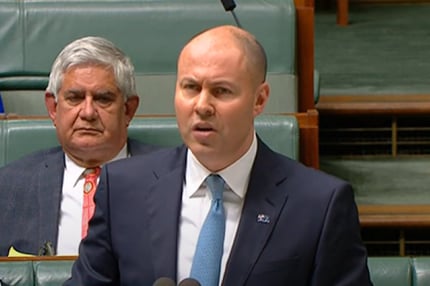
All eyes were on Treasurer Josh Frydenberg tonight as he announced the 2020 Australian Federal Budget.
With Australia in its first recession in 30 years, the budget outlined the Government's plans to steer us through the COVID-19 pandemic and kick-start the economy.
"In 2020, Australians have been tested like never before. Fires, floods and a global pandemic. Lives lost, businesses have closed, jobs have gone," said Frydenberg.
"Two world wars would not bring Australia to it’s knees, and neither will COVID-19."
Overall, the budget focuses on creating more jobs for Australians, particularly women who Frydenberg said made up the majority of people who lost their jobs due to the global pandemic.
"Our economy has been hit, and has been hit hard. In the space of one month, one million Australian’s lost their jobs."
Here's everything you need to know about the 2020 Federal Budget, including who the winners and losers are with the proposed measures.
The losers.
The Australian economy.
While last year the Government were excited to announce the first surplus in years during the Federal Budget, funnily enough 2020 hasn’t delivered the same result.
Instead, the Government reported a disappointing $213 billion deficit.
But the hope is that there will be around a five percent ‘bounce back’ for the economy, if the budget outlined this year is approved. How? Frydenberg noted income tax cuts, cash bundles and an investment in around one million jobs to be created with helpful wage subsidies as methods to get the Australian economy back on its feet.
The unemployed.
Unfortunately, unemployment is set to peak at eight percent in the December quarter.
However, the Government are planning a deliberate shift from temporary support (AKA Jobseeker supplements) to strong long-term fiscal buffers so that the country can be prepared for the next economic hit. Essentially, the Government want to get more people into jobs as that can place Australia in a much stronger economic position.
JobSeeker and JobKeeper recipients.
Unfortunately, it seems there is no plan to extend JobSeeker or JobKeeper payments.
For JobSeeker recipients, the additional coronavirus supplement of $250 a fortnight will cease at the end of December, while JobKeeper payments will end in March next year.
Parents looking for further childcare support.
There was nothing new in the budget for childcare sector, outside of providers impacted by the stage four restrictions in Victoria. The childcare sector was excluded from the JobKeeper program in July, and instead they were substituted to a "transitional support" payment which will continue into 2021.
Women.
We know that women have been hit immensely hard by coronavirus job losses, and Frydenberg reiterated that before listing out 'investments' the Government are making into women, and particularly women in work.
However, some post-budget calculations have revealed that only 0.038 per cent of the 2020 Federal Budget was actually focused on women.
To understand the true reason why women have 'lost out' in the Federal Budget, read our explainer here.
The winners.
Young Australians looking for jobs.
The treasurer announced a $4 billion JobMaker Hiring Credit scheme to help get young Aussies into work.
There will be a wage subsidy of $200 a week for those under 30 years old and $100 a week wage subsidy for those over 30 years old, with the only requirement being that the employees must be working at least 20 hours a week.
All businesses will be able to access this subsidy, bar the major banks. In addition, $1.2 billion will be injected into apprenticeships, along with a further 50 per cent wage subsidy for new apprentices and trainees.
The Government is expecting this will create around 450,000 jobs for young Aussies.
Low to middle income earners.
Tax cuts are set to be delivered to around 11.5 million workers within weeks as a cash injection of $17.8 billion.
Workers will see the lower tax rates come into play on their pay packets as early as mid-October if the Senate approves the plan.
What does that look like for low to middle income earners? Well those earning under $40,000 a year will be paying 20 per cent less tax and those earning $80,000 will pay 11 per cent less tax.
These income tax cuts will be brought forward and backdated to July 1st, if approved.
Brielle Burns
Author
No Comments
Be the first to leave a comment