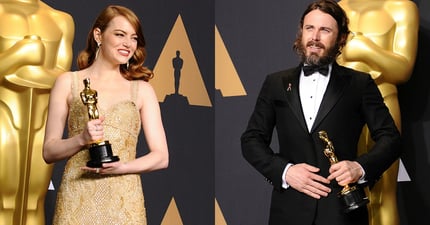
When you look at this week’s Best Actor and Actress winners, what’s the one thing you notice?
(Apart from, you know, the fact one has had sexual harassment allegations levelled at them and the other, well,hasn’t.)
“Their ages!” I hear you say. And you’d be right. Oscar-winning actress and star ofLa La Land, Emma Stone, is just 28.Manchester by the Seastar Affleck is 41.
Without the wisdom of context and an army of statistics, that fact would be fairly unremarkable. The age gap isn’t significant to warrant headlines on its own, and perhaps it just took Affleck a little longer to find his stride in the industry and emerge from a shadow cast so heavily from his older brother, Ben.

Image: Getty.
But, of course, we're lucky enough to have both context and statistics, and suddenly the story of their ages is far more important than meets the eye. And precedent is important.
As American journalist Kyle Buchanan pointed out on Monday night, seven women in their twenties have won the Best Actress Oscar since 2000, while just one man in his twenties has won the Best Actor Oscar ever, in the entire history of the awards.
That man was Adrien Brody, who was 29 at the time and turned 30 three weeks after the awards.
The intersection between ageism and sexism in Hollywood is not new. Some of the most well-known actresses on our screen know their time - and their prime - is limited, and that dynamic roles are few and far between by the time they hit 30.
As men like Affleck have the time and space to hone in on their craft and have a career that's more of a slow burn, women know they mustrush.
Want to debrief on all things Oscars? The Recap is for you. Post continues after audio.
Statistics will tell them if they haven't peaked by 25, not a lot will happen after then. Unless, of course, they'd like the option of playing a witch, like Meryl Streep was offered three times in the one year. She was 40, and had Oscars to her name already.
“I was not offered any female adventurers, or love interests, or heroes or demons,” the screen legend said in 2015 when she finally conceded to play a witch inInto The Woodsat age 65.
“I was offered witches because I was ‘old’ at 40.”
And then there's Maggie Gyllenhaal, who told The Wrap in 2015 that at 37, she was "told recently [she] was too old to play the lover of a man who was 55".
"It was astonishing to me. It made me feel bad, and then it made me feel angry, and then it made me laugh," she told the website.
“I was offered witches because I was ‘old’ at 40,” Meryl Streep says. Image via Getty.
Statistics on their own are frustrating, deflating, and only one more example of how the world is skewed to men. It's their place, it's their time, it's their space to succeed. But it's the stories behind the stats that are a little more confronting to write, read and listen to.
"Yes, I'm sure that's true," Helen Mirren said about Gyllenhaal's statements about sexism in Hollywood.
"I'm sure that's true. It's f--king outrageous. F--king outrageous! It's ridiculous, honestly. It's so annoying."
Outrageous, absolutely. Just ask Sally Field.
In 1998, Field starred alongside Tom Hanks inPunchlineas his love interest. Six years later, she was playing his mother inForrest Gumpeven though there's only a decade between the two.
And as we remember this year's Academy Awards for the last few moments of the show, it's important to remember the big things, too. Hollywood isn't the real world, and the industry is full of money and privilege — but privilege and deep inequality aren't mutually exclusive.
Just ask Meryl Streep.
Author
No Comments
Be the first to leave a comment