Thanks to our partner, AFP
Most people think they know what a career at the Australian Federal Police looks like.
Blue uniforms. Maybe the occasional high-speed chase. But the reality is far from what you see on TV. Behind the badge is a world of covert operations, international collaboration, and decisions that can literally save lives, or, change them forever.
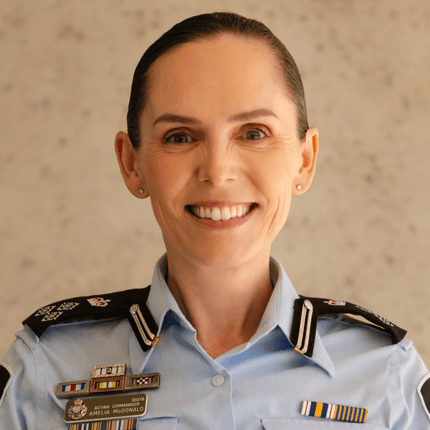
Amelia McDonald remembers the moment she realised a career with the Australian Federal Police was her calling — not because it matched her expectations, but because it offered a depth of purpose, flexibility and opportunity she hadn't thought a single career could hold.
It was early in her time with the AFP's Counter Terrorism and Special Investigations Command in Sydney. The days were long, the stakes high, and the cases politically sensitive. They worked on chasing leads that could take them anywhere — from quiet suburban streets to the heart of international investigations.
"[I was] working on very complex, politically sensitive jobs — [and] it was so much about the people that I worked with," she told Mamamia.
"We were such a strong team environment, I couldn't have imagined working in just a normal desk job anywhere."
The cases that stayed with her.
Amelia's career has included some of the AFP's highest-profile and most challenging investigations.
Beyond her role in the Counter Terrorism Command, she served as a Family Investigative Liaison Officer. In this role, she worked closely with families impacted by major international tragedies, including the downing of Malaysia Airlines Flight MH17 in 2014, which killed all 298 people on board, including 38 Australians, and the Christchurch mosque shootings in 2019.
"Being able to support families through one of the most traumatic times in their lives is a real privilege," she said. "With MH17, for example, I was able to support from an investigative perspective, ensuring I represented the families interests and balancing their needs, while also supporting the broader investigative process."
Amelia also participated in disaster victim identification following the 2009 Samoa earthquake and tsunami, working in the South Pacific alongside qualified forensic officers and local communities.
"It was incredibly confronting, but so rewarding to be able to identify those who tragically lost their lives and assist in repatriating their loved ones," she reflected.
When asked what helped to ground her during such emotionally heavy assignments, Amelia said the AFP's team environment played a crucial role.
"Definitely my colleagues, they are amazing, and I'm very grateful for my loved ones and family," she said. "They ground me in terms of what's important."
What a day in Human Intelligence looks like.
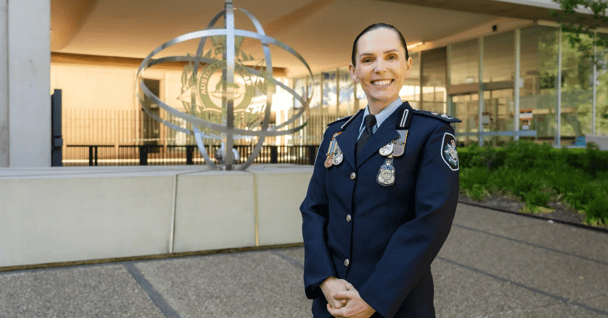
As Acting Commander overseeing the AFP's Human Intelligence Operations, Amelia's day-to-day responsibilities are wide-ranging.
She manages the undercover program, human source operations, and covert online capability, both domestically and internationally — work that involves collecting intelligence and evidence for investigations, and managing highly sensitive information.
Human Intelligence is the part of policing most of us only recognise from TV. While it's often dramatised in films like The Departed, the reality is much more meticulous — built on significant, rigorous planning and constant monitoring to keep the team safe.
"No two days are the same," Amelia said.
"We can have multiple operations running concurrently, onshore and offshore. It's not uncommon to have several deployments occurring in multiple locations, with information coming in thick and fast. I have a wonderful leadership team, and we all work very, very well together — to not only protect the community but gain intelligence to support our colleagues throughout the organisation."
Her daily tasks include setting directions and expectations, receiving briefings from superintendents on operations, reviewing risk assessments, representing her command in internal and external forums, and ensuring the safety and security of her teams.
Much of the work, she noted, is deeply people-focused. At Amelia's level, the role is less about the fieldwork itself and more about holding responsibility for the people behind it — balancing operational outcomes with the very real human cost of covert policing.
"Due to the covert nature of the work, so much of what we do is ensuring our capability is protected and that we support and protect those who support our command."
More than adrenaline and uniforms.
For women, particularly younger professionals or parents, the AFP might seem intimidating or narrowly defined.
Amelia said it's anything but — with room to pivot as your life and priorities shift.
"There are so many roles in the AFP, and you don't need to fit the mould of a person you might see on the street in a blue uniform," she said. "I have a degree in commerce and had no experience in defence or law enforcement before joining. I come from a marketing and guest services background, and using the skills that I'm strong at, I pivot to my colleagues who are stronger in other areas.
"You don't need to lose your identity. I didn't need to lose my femininity. I'm currently standing here talking to you in heels and a dress."
The AFP is also flexible and family-friendly.
"The flexibility the AFP offers is second to none — whether it be leave, additional leave we are entitled to, flexibility in terms of home-based work, compressed work, part-time work," she said.
"Many of our members have family obligations, and it's all taken into account.
"For me, I've been able to move into roles that were less demanding in terms of travel or after-hours responsibilities in periods where I have needed that, like when my children were very young."
Pride in the badge.
After nearly two decades at the AFP, what continues to resonate most with Amelia isn't the high-profile cases or the adrenaline; it's the people and the purpose.
"The most pride would be walking into National Headquarters each day and knowing that I've worked across many commands that continue to protect the community, and that I've met so many wonderful, intelligent people, not only members of the AFP but international and domestic colleagues," she said.
"I'm just so grateful and proud to be a member of the AFP for the amazing work we do nationally and internationally."
For Amelia, it's the combination of purpose, challenge and teamwork that makes a career at the AFP more than a job; it's a calling. It's also about pride — not just in the badge, but in the person she's become through a career that has challenged and empowered her.
With over 40 career paths and 200+ roles in the AFP, the opportunities for growth are endless.
"You might start in General Duties or Investigations, but with the AFP, that's really just the start — the training and support can open doors across the organisation."
"The training will equip you to undertake roles, and it's such a supportive work environment. People help you, and we all come together as a team. One of the amazing things about the AFP is just the team-minded spirit."
Curious where you might fit inside the AFP? Use the Career Finder quiz to help match your skills and interests to the right role.
Feature image: Supplied.
Raffaella Ciccarelli
News and Weekend Editor
No Comments
Be the first to leave a comment