Image: iStock.
If you’ve ever encountered #fitspo memes, you’ve probably noticed they can be quite… intense. Actually, they can be kind of scary.
“Sore is the new sexy,” declares one quote currently floating around the Pinterest echo chamber. “Train insane or remain the same,” cries another. “Don’t stop when it hurts, stop when you’re done.” “Go hard or go home.” “My body says no more, my mind screams two more.” “No pain, no gain.”
RELATED: Is #Fitspo 2015’s most dangerous body image movement?
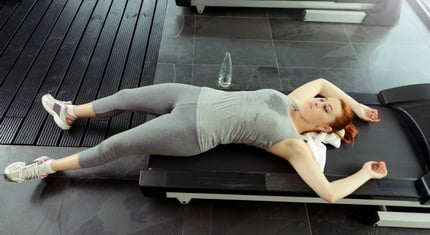
They’re meant to be inspiring, but if you took these statements literally you’d be forgiven for believing a workout doesn’t really count unless you’ve run your feet down to bloodied stumps, vomited up your breakfast, and collapsed in a heap.
Of course, exercise isn’t easy. It shouldn’t be — challenging yourself physically requires exertion, determination and yes, sweat. There’s often a level of discomfort involved, especially if you’re new to exercise, trying something new, or stepping up your regular workout.
What's a good workout with a bit of blood and vomit? Um... (via Pinterest)
However, there's an attitude that fitness results are synonymous with pain, suffering, and utter exhaustion— and that anything less than a 10 on the intensity scale is simply not worth the time. According to personal trainer Jonathan Angelilli, our culture's "obsession with aggression" has caused us to perceive exercise as a "war on the body", with soreness and exhaustion being the measure of victory.
RELATED: The 11 pieces of fitness advice you thought were true. They aren't.
"I call it the militarisation of fitness - all the boot camps, Marine-inspired workouts, ridiculously intense body building routines, and general glorification of pain. Even our recovery and regeneration techniques are prioritised by how painful they are," he writes.
Personal trainer and lifestyle coach Kirsty Welsh agrees this 'no pain no gain' ethos is symptomatic of a wider societal belief. "I think it's really ego-based, this notion that we always have to be competitive to get ahead... It can be a good thing, but if it's coming from a feeling of 'I'm not good enough as I am right now, I have to change something about myself' that's when it can be a bit destructive, perhaps," she says. (Post continues after gallery.)
If #fitspo posters were honest...
Lauren Hannaford, a personal trainer and former elite gymnast, believes it also stems from a patchy understanding of how exercise works.
"I think it's a lot of people who haven't been educated enough [about fitness] — they just listen to bits and pieces around and they've got that attitude, rather than listening to their body and working to what suits them."
This fetishisation of constantly 'going hard' is problematic for a few reasons. First of all, if you're continually working at a high intensity without proper rest in between, you could really hurt yourself — especially if you're not paying attention to your technique.
RELATED: Can exercise really help to cure a hangover?
"I don't think working out to complete exhaustion is the right attitude because you've got more chance of doing damage than of building muscle or improving fitness or whatever you're trying to achieve," Hannaford says.
"If you're so sore you can barely walk, and you then go and try and work out, you're just going against any muscle repair or rebuilding. You're going to do the opposite. Your body needs time to repair and rebuild."
Soreness does not equate to results.
Slogging it out can also detract from the more enjoyable, mood-lifting aspects of being active. Despite what those Pinterest memes might suggest, exercising isn't actually meant to be a painful, punishing ideal or a warzone — it should simply be a healthy, enjoyable and sustainable part of life.
"Exercise is so fun... We just have this collective belief that it's a painful experience. It's a matter of shifting that belief and relating it to the pleasure exercise brings to our lives and to our health and how that feels," Welsh says.
RELATED: "4 reasons why hiring a personal trainer is the best fitness decision I've ever made."
Measuring the success of a workout by how utterly wrecked your body feels afterwards can also distract you from the progress you've made — and ultimately deter you from sustaining that level of activity because the satisfaction of 'going hard' eventually wears off.
"People say, 'I smashed a session yesterday, I can barely walk today', but it's like, what did you achieve in your workout? They've forgotten about it... It's not about completely hammering yourself. You should be able to work out comfortably and listen to your body; if it doesn't feel like it's up to it, it's not ready," Hannaford explains. (Post continues after gallrey.)
How the rich and famous stay fit
Miranda Kerr.
Miranda Kerr weights for nobody. (Instagram)
Jessica Alba.
Reese Witherspoon.
Lena Dunham.
khloe kardas
Gigi Hadid.
Anna Kendrick.
Beyonce.
Julianne Hough.
Kahla Preston
Author
No Comments
Be the first to leave a comment