
Walkey Award winning journalist and Fairfax Media’s National Political Reporter, Latika Bourke shares her story about being adopted from India and growing up as an Australian kid.
She was adopted from India at the age of just eight months and grew up in Bathurst, New South Wales.
After hearing her name in the hit movie Slumdog Millionaire, Latika realised she knew nothing of her Indian roots and the world she was born into. Latika became more curious about her heritage and what it meant to be born in India and raised in Australia.
This led Latika on a deeply personal and sometimes confronting journey back to her birthplace to unravel the mysteries of her heritage.
Today, Latika has shared with Mamamia an extract from her new book From India with Love – a beautiful memoir of growing up, discovering your heritage and finding peace with who you are.
Latika Bourke’s book, From India With Love, is available from April 22nd 2015.
A Wanted Baby
My girlfriends would giggle whenever I showed up to school events with my mum, Penny. There we were, the darkest girl in the class with the whitest mother in the room. Of course everyone knew why. It was no secret and there was no malevolence behind the laughter. It was clear to anyone who met us as a family that I was adopted.
There were eight of us kids all up. Five were Mum and Dad’s biological children, and three of us were adopted—all three of us from India, and two of us from the same orphanage in north-eastern India, but we weren’t related. If we Bourkes stood out as a family I never thought it was because of our differing skin colours. No, rather it was the large number of us and the logistical effort involved in moving us anywhere as a group.
Related content: Mia chats with Walkey-Award winning journalist Latika Bourke.
In fact, my origins made so little difference to me that in my mind I always saw myself as white. If I look in the mirror I see, of course, dark brown eyes, black hair (that lightened as I grew older and not coincidentally after appointments at the hairdressers) and mocha- coloured skin (I once spent a whole day in the full sun with no sunscreen at a school swimming carnival to see if I’d burn like my friends, but only earned a flaky nose for my efforts). There were superficial differences, but I knew that inside I felt no different from anyone else.
So it was all the more galling when strangers said to me over the years, ‘Where are you from?’ Four words, with so many layers of meaning packed into them that left me mystified. Were they trying to say, You look different to the rest of us. You obviously aren’t one of us. Who were they to ask, at any rate?
I hated that question so much, and so did Mum. Loathed it. Despised it.
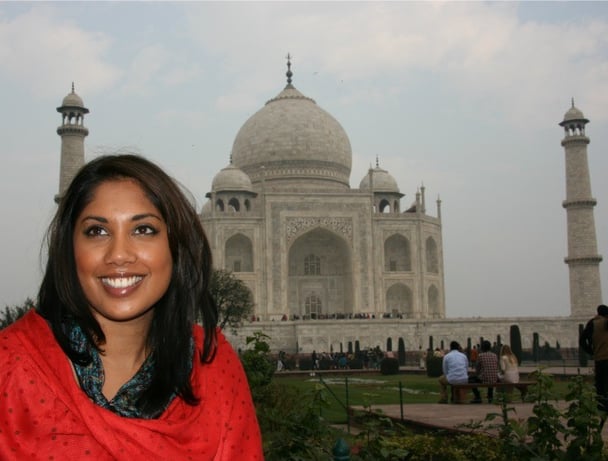
I deeply resented the presumptions that lay behind it. I detested the people asking it, whom I mentally labelled the Rude Inquisitors. Most of the time I knew they didn’t mean any harm. They were perfectly well-intentioned, they’d just never thought through what they were actually signalling about me by what they were asking. But even if they were benign, that didn’t make the fact that the colour of my skin was the initial and immediate prism through which they saw me any less infuriating. Sometimes I felt as though I could have been standing there wearing thongs, an Aussie flag–printed bikini, a blue cotton singlet and a trucker cap and still the first thing one of these people would say to me was ‘So, where are you from?’ And boy, were they persistent.
I’d usually start out with a curt ‘Bathurst’, hoping that might satisfy them. It rarely did. ‘No, I mean where are your parents from,’ they’d say. So I’d switch tactics. Force an exaggerated cheeriness I did not feel to send a warning that they had ventured beyond what was polite. ‘Oh,’ I’d say brightly, ‘well, my mum’s originally from England but she came here as a young girl, and Dad’s Aussie but his grandparents were Irish.’ I’d have a smile on my face but underneath I was boiling with anger as time and time again they totally failed to get the hint that I didn’t want to satisfy their ignorant curiosity. ‘No,’ they’d say, spelling it out, since I was obviously a bit simple, ‘what’s your heritage?’
Want more? Try: Racism in Australia. As experienced by Jamila Rizvi in a Sydney taxi.
At this point I’d usually give up, resigned to the fact that whomever I was talking to had the social sensitivity of a brick wall and the indefatigability of a pit bull. I knew what they were asking. Why are you brown?
‘I’m adopted from India,’ I would sigh, eyes rolling. Then, as though I felt compelled to provide a disclaimer to prove my Ocker-ness, I would hurriedly add, ‘But I was adopted when I was a baby, so I’m completely Australian.’
Nature or nurture? That wasn’t something I contemplated. I was a proud Aussie and I thought it showed in all that I was and everything I did. I didn’t need to question it, so why did they?
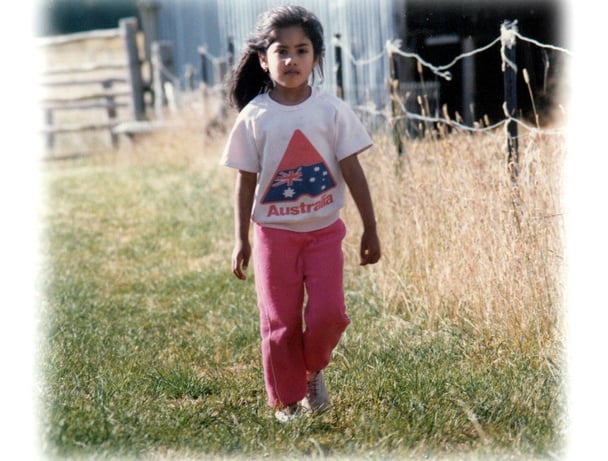
Latika Bourke as a child on holidays. Image via Facebook.
* * *
My soon-to-be-parents John and Penny were both teachers, but they didn’t meet in a classroom, they met through mutual friends on a blind date, and the rest, as they say, is history. They married and Melissa was soon on the way, followed by Catherine fifteen months later. And that was when they learned about a disease called cystic fibrosis.
CF, as it is commonly known, affects the exocrine system, which controls the respiratory and digestive systems, and among other things the disease brings a very high risk of lung failure. It’s cruel and relentless, requiring treatments, medications, and physiotherapy several times a day.
There is still no cure, and CF Australia describes it as ‘the most common, genetically acquired, life-shortening chronic illness affecting young Australians today’.
Read more: “My child has cystic fibrosis.” This is what their life is like.
Penny and John were told that their daughter was likely to live for less than twenty years. Catherine’s diagnosis was a huge shock. There was no one else in Penny and John’s extended families with the disease and they knew almost nothing about it. As they learned, it’s passed on from parents, most of whom have no idea they carry the CF genes. About one in twenty-five people carry the genes, and both parents have to be carriers in order for a child to get the disease. When two carriers have a child there is a kind of CF Russian roulette: one chance in four that the genes won’t be passed on at all and the child will be free of CF; two chances in four that the child will only get the gene from one parent, making them a carrier too; and one chance in four the child will have CF.
It was a devastating diagnosis, and also seemed to doom Penny’s long- held dream of having a big family. But if my parents have one standout trait it’s their tenacity. Penny began to explore other ways of having lots of children without the genetic risk of cystic fibrosis. She turned instead to the idea of adoption.
As Mum puts it, Catherine’s diagnosis was the catalyst but not the only reason for our adoptions. I suspect that even without CF she would have considered the possibility. On the sea voyage to Australia when she was a child, her family had stopped over in Mumbai (then known as Bombay), and the memories of the children, many of them beggars and deliberately disfigured and in so much need, had stayed with her ever since. Dad was less enthusiastic about adoption but was won over by Mum’s passion for the idea. So it became a question of how.
A friend of Penny’s knew of an Indian couple who were living in Australia but had managed to adopt from their home country. The friend suggested investigating the possibility of adopting an Indian child. Penny was initially sceptical, thinking that approval must have been contingent on the adoptive parents being Indian themselves. Still, it was worth looking into.
Want more? Try: India surrogacy case: Documents show New South Wales couple abandoned baby boy despite warnings.
The friend was right: Indian babies were being adopted out to Australians. However, as they started down this new road, my future parents learned that earlier enquiries about adopting from Vietnam and Bangladesh had made the Australian authorities suspicious of their motives. Were they ‘baby shopping’ (moving on from one country to the next because they were dissatisfied with the babies they were offered)? To anyone who knew Penny and John, this suggestion was beyond bizarre, but I guess I can see how it might have looked on paper. Of course, with a closer look at their situation, their sincerity and misfortune in trying to adopt to date were obvious. And so their first Indian adoption attempt got under way.
In 1980, and several long years after they had begun to look beyond Australia to expand their family, they held their new child for the very first time. (Back then all three of us were flown over, paid for of course by Mum and Dad but escorted by Indian guardians. Nowadays this would be unheard of!) She was eighteen months old and was called Pandeselvi. They renamed her but still opted for an Indian name, and one that was fairly popular: Rani, the Hindu word for queen. Penny was immediately captivated by the new baby. ‘I spent the first six months just looking at her,’ she told me.
The adoption experience had been so smooth that Penny was soon keen to repeat it. The nuns from the orphanage, too, were delighted by how well it was working out and were happy to put her in touch with the nuns at St Mary’s Orphanage in a village called Fakirana in the city of Bettiah in a north-eastern Indian state called Bihar.
The process began again. This time both the Australian and the Indian authorities understood about the couple’s CF risk and were satisfied about their motivation. Everything went to plan, and in August 1982 a baby arrived. It was the Bourkes’ first boy; Penny loved boys’ names beginning with D, and they renamed the baby Damian.
By late 1983, Penny was ready for another child. She wrote to the nuns at the Fakirana orphanage indicating that she would like to adopt another baby. After two successful and relatively easy adoptions, Penny thought she’d give the system one more try, although she was aware she was pushing her luck.
In theory, another adoption should have been simple. The family’s bona fides had been well and truly checked, and all had gone well with Rani’s and Damian’s adoption. But Penny suspected that a third child might be too much of an ask for a family that had already been blessed with two babies; confirming this suspicion, the nuns warned her in a letter about a new government policy to prohibit adoptions to families that already had three or more children. However, the nuns knew that Penny and John were loving parents, and they were keen to give them a third child if they could do so without breaking the rules. They wrote back in December, saying that while they had no suitable babies at the moment, age-wise, they would try when one came in.
Three months later, a candidate appeared. It was me.
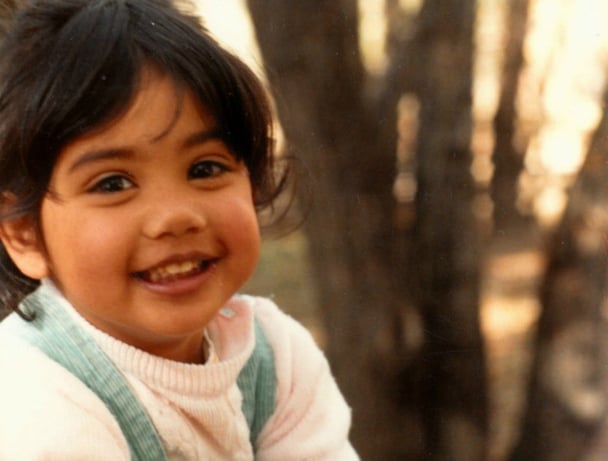
I had been delivered to the orphanage on 10 March 1984, the day after my birth. The nuns said that my grandmother and uncle had brought me in—they didn’t say if they were kin of my birth mother or father, though I guess it was more likely they were from my mother’s family. Scant information came with me, just that my mother was fourteen years old and my grandmother’s eyesight was so bad that her son had to act as her guide. The only other thing I know for sure is that I was incredibly lucky to be brought in so quickly after my birth.
Bihar remains one of India’s poorest states. At that point, nearly half its people lived below the country’s official povert
Author
No Comments
Be the first to leave a comment